My sister slapped my baby at Christmas dinner and told me I was overreacting, Like assaulting an infant was just festive fun. Everyone just sat there. But then My lawyer wife stood up and taught her a lesson She’ll never forget. She never came back.
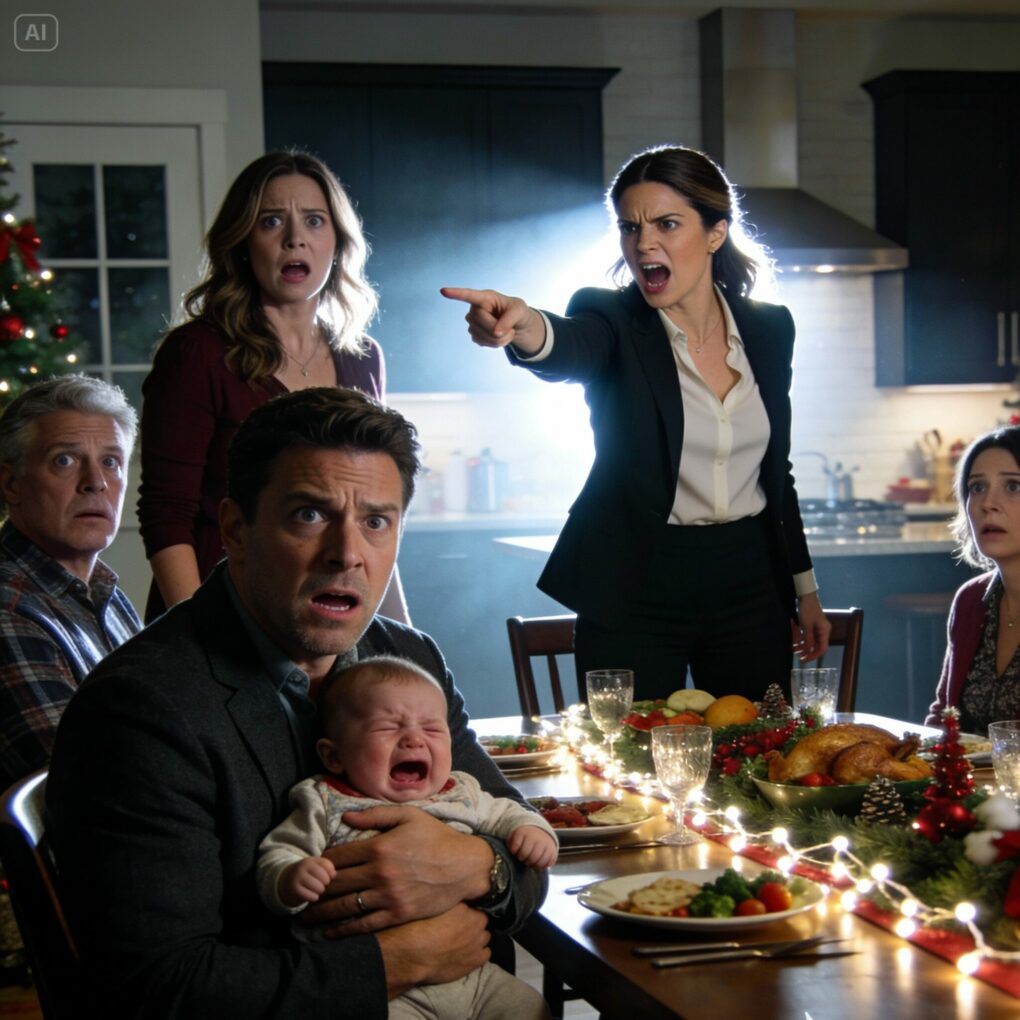
Christmas dinner at my parents’ house had always been chaotic, but that year it crossed a line no one expected. My sister, Olivia, had shown up with her usual storm-cloud energy, annoyed that traffic was bad, that the ham was too salty, that my nine-month-old son, Mason, was “too loud.” I kept brushing off her comments, trying to keep the evening from unraveling. My wife, Claire, watched everything quietly, the way she always did—measured, calm, already observing patterns the rest of us missed.
Mason was fussing because he was teething, and I bounced him gently on my lap to keep him comfortable. Without warning, Olivia walked up, muttered something about “spoiling him,” and then—like it was the most normal thing in the world—she slapped his tiny hand hard enough that Mason’s face crumpled before he let out a sharp cry.
For two seconds, the entire dining room froze. My mind couldn’t process what had just happened. Then the shock gave way to a cold rush of anger.
“What the hell is wrong with you?” I shouted, pulling Mason close.
“Oh, stop overreacting,” Olivia said, rolling her eyes. “Kids need discipline. You’re raising him soft.”
I waited for someone—anyone—to say something. But forks hovered, eyes dropped, and the silence stretched so loudly it felt like betrayal. I couldn’t believe it. My own family pretended nothing had happened.
But Claire stood up slowly, pushing her chair back with a quiet scrape that cut through the room. Her voice wasn’t loud when she spoke, but it carried more weight than my shouting ever could.
“Olivia,” she said, “what you just did wasn’t discipline. It was assault.”
The word hung in the air like a crack of thunder.
Everyone stared at Claire, suddenly fully awake. Olivia scoffed at her, but I could see something flicker—uncertainty, maybe even fear.
Claire didn’t sit back down. She walked to the center of the room, placed her hand on my shoulder, and said, still calm but unmistakably firm:
“And we’re going to talk about the consequences of that.”
That was the exact moment the night exploded.
Claire’s calmness was legendary in our family, but that night it had an edge—controlled, precise, the way she sounded in the courtroom. My sister had always underestimated her because Claire never raised her voice, never bragged about her job, and never engaged in family drama. But she wasn’t just a lawyer; she specialized in child welfare cases. She had seen more than enough to know when a line had been crossed.
Olivia folded her arms. “You’re being ridiculous. It was a tap.”
“No,” Claire said. “A tap is affection. A slap that leaves a red mark is battery. And legally? Against a baby? That’s child abuse.”
My father finally muttered, “Come on, let’s not escalate this,” but even he didn’t sound convinced.
Claire addressed him directly. “If a stranger did that to Mason in a supermarket, would you call it ‘nothing’? Or would you call security?”
My mother’s eyes filled with tears, and she whispered, “Olivia, why would you do that?”
Instead of apologizing, Olivia doubled down. “Kids cry all the time. He’ll survive. You all baby him too much. Someone had to toughen him up.”
Claire stepped closer, keeping her tone even. “You don’t get to ‘toughen up’ anyone’s child. Not legally. Not morally. And definitely not in this house.”
Olivia rolled her eyes again, but I saw her swallow. Claire continued:
“If you ever touch Mason again, we’ll file a report. I’ll personally make sure it’s documented with photos and statements. You won’t be able to explain it away as a ‘tap.’”
That sentence landed harder than anything else. Olivia glanced around for support, but the room was different now. People weren’t frozen—they were ashamed. Everyone had witnessed what she did, and Claire had forced them to acknowledge it.
My brother-in-law quietly took their coats from the hallway and whispered, “Liv… let’s just go.” But Olivia jerked her arm away and hissed, “I’m not going anywhere.”
Claire didn’t flinch. “You are. Right now. Because if you stay, the next conversation we have will involve the police.”
The room held its breath.
My sister stared at Claire, then looked at me—really looked. She shoved her chair back so hard it scraped the floor and stormed out the front door. Her husband trailed behind her without a word.
She didn’t return to the table. She didn’t apologize. And she never came back to another family holiday again.
Days passed before the full weight of the incident settled in. My parents called separately, each struggling with guilt for not stepping in sooner. My mother cried, telling me she replayed the moment over and over, wondering how she could’ve let it happen. My father admitted Claire was right—that if a stranger had slapped Mason, he would’ve reacted entirely differently. It hurt them, but they faced it.
Olivia, however, never reached out. Not a text, not a voicemail, nothing. Her husband apologized to us privately, saying he’d tried to talk to her but she refused to acknowledge any wrongdoing. “She says you all made her the villain,” he said quietly. “I’m sorry. I don’t know what else to do.”
Claire, meanwhile, held me while I grappled with conflicting emotions—anger, sadness, betrayal, even relief. She reminded me that protecting our child didn’t make us dramatic or sensitive; it made us responsible.
A week later, my parents invited us over for dinner—a quieter one this time. My mother had set the table carefully, and my father asked, almost timidly, if Claire would like to carve the roast. It was their way of saying they knew who had stepped up when they hadn’t.
Midway through the evening, my father cleared his throat. “We want you to know,” he said, “that we’re proud of how you and Claire handled everything. We should’ve spoken up sooner. We won’t stay silent again.”
It wasn’t perfect, but it mattered.
As for Olivia, she stayed away. Holidays came and went, and her absence became a strange sort of peace. No more drama. No more harsh comments. No more unpredictable outbursts. Eventually even my parents stopped expecting her to walk through the door.
Sometimes I wondered if she replayed that night the way we did. If she ever felt a flicker of regret. If she learned anything at all. But Claire told me something I try to remember:
“Your job isn’t to fix her. It’s to protect your son.”
And she was right.
That Christmas taught me more about family than any holiday before it—not the picture-perfect version, but the real kind, where love isn’t silent and boundaries aren’t optional.
If you’ve ever had a moment where someone crossed a line with your family and you had to stand up, I’d honestly love to hear how you handled it. Share your story—Americans especially, tell me: would you have stayed quiet, or would you have stood up too?







Leave a Reply