Dad Kicked Me Out at Christmas! Family Didn’t Know About My $68M Tech Company Until I Froze Them Out….
Dad Kicked Me Out at Christmas! Family Didn’t Know About My $68M Tech Company Until I Froze Them Out….
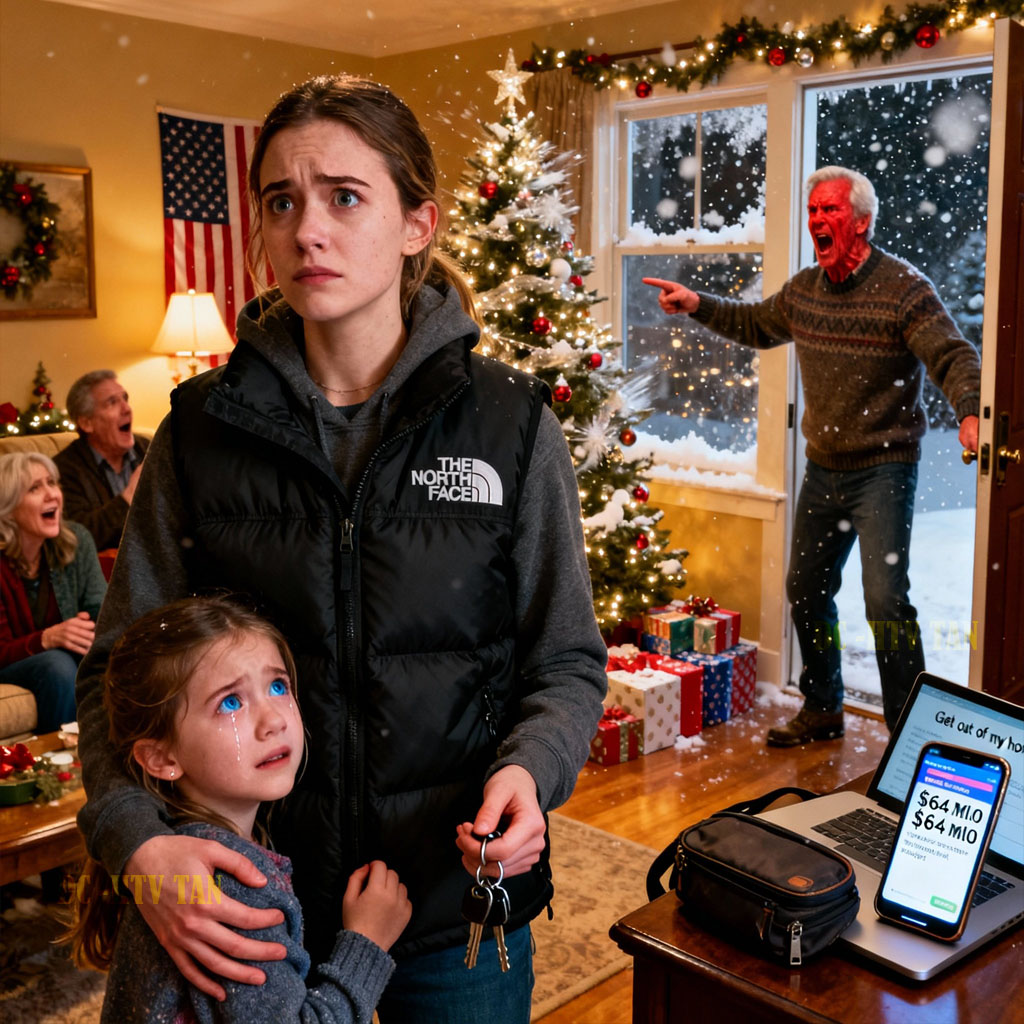
Snow was falling outside when my father’s voice cut through the laughter like a knife. Get out of my house. The crystal ornaments on the tree trembled as he shouted his face red with fury. My daughter clutched my arm, her small fingers tightening around my sleeve, her wide blue eyes glistening with confusion. I stood frozen, my mind struggling to process what had just happened.
Around the table, my brother smirked. My mother looked away, pretending to adjust the silver napkin rings. Somewhere between the roasted turkey and the glittering silverware, I realized this wasn’t a family dinner. It was an execution of my dignity.
What none of them knew was that everything in that house, the mortgage, the cars in the driveway, even the scholarship for my niece’s private school, had been quietly funded by the woman they were throwing out, me. So, I took a deep breath, held my daughter’s hand, and said only one word. All right. The silence that followed was deafening. The only sound came from the soft crackle of the fireplace, its light flickering across the polished marble floor.
“My father’s chest heaved as he glared at me, his hands clenched at his sides. “You’ve embarrassed this family enough,” he said, his voice trembling with rage. “Perading around here like some victim like you haven’t brought this on yourself. I didn’t respond. I didn’t trust myself to.
My heart was pounding so loudly I could barely hear anything else. Across the table, my brother Nathan leaned back in his chair, swirling his wine glass with a smug smile. Come on, Dad. He drawled. She’s used to people walking out on her. Remember Mark? The name hit like a slap. My ex-husband. My mistake. My daughter’s father.
My mother always, the diplomat, sideighed dramatically. Nathan, that’s enough, she said, though her tone lacked conviction. Then she turned to me, her expression heavy with false sympathy. Hannah, you should have known this would happen. Bringing your child here without calling first, expecting everyone to. What? Pretend everything’s fine.
I felt my daughter Emily shift against me, her voice trembling. Grandma, I wanted to see the tree. She looked toward the towering pine glittering in the corner, its branches heavy with gold ribbons and white lights. My mother’s face softened briefly before she caught my father’s glare and looked away. I bent down, brushing a tear from Emily’s cheek.
“It’s okay, sweetheart,” I whispered. “We’ve seen enough.” My father’s voice boomed again. “Don’t make this about you leaving Hannah. You made your choices dropping out of that marriage, quitting a stable job, chasing those ridiculous computer dreams. You made your bed. Now you lie in it. I straightened meeting his eyes. You’re right, I said quietly.
I did make my choices, then live with the consequences, he barked. The irony was suffocating. The mortgage payment on this very house, the two new cars outside the European vacations. Nathan bragged about all of it existed because of my ridiculous computer dreams. I could have said it then.
I could have told them that my tech company, Lunet Systems, had just signed a government contract worth over $30 million. That I was in fact the invisible hand that had been paying their bills and bailing them out of overdrafts for years. But looking at their faces at my father’s rigid pride, my brother’s arrogance, my mother’s fragile mask of superiority, I realized the truth would do nothing but deepen the divide. They weren’t ready to see me for who I was.
Come on, Emily, I said softly, taking her hand. Let’s go. Don’t turn this into another one of your pity plays, Nathan called after me. You’re not the victim here. You just can’t handle being ordinary. Ordinary? The word burned. I opened my mouth to respond, but then stopped. It wasn’t worth it. I’d spent too many years trying to prove my worth to people who’d already decided I had none.
As we crossed the living room, I caught a glimpse of my reflection in the massive goldframed mirror above the mantle. My face was calm, too calm. Behind me, the glow of the Christmas tree shimmerred like a memory I was already erasing. I had worn a simple emerald green sweater that evening, one Emily had chosen for me because she said it matched my eyes.
I looked modest, unassuming exactly how I wanted to appear. Let them think I was small. Let them underestimate me. At the front door, my mother’s voice trembled. “Hannah, wait,” she said, taking a hesitant step forward. “It’s Christmas. Don’t ruin it for your daughter.” I turned slowly. I’m not the one ruining anything, Mom.
She faltered, her gaze flicking to Emily. You know how your father gets. He didn’t mean it. The familiar script. The excuses. The decades of silence dressed up as peace. I had played this role too long. “Goodbye, Mom,” I said, opening the door. Cold air rushed in carrying the faint scent of pine and frost. Emily’s tiny hand tightened around mine.
Behind us, I could hear my father muttering something about respect and disgrace. The words no longer pierced the way they used to. As we stepped outside, snowflakes landed on Emily’s curls. She looked up at me, her breath visible in the winter air. “Did we do something wrong?” “Mommy,” I knelt to her level, brushing a strand of hair from her face. “No, sweetheart,” I said softly.
“Sometimes people forget what love really means.” She blinked, processing that, then nodded solemnly. “Will Santa still find us?” I smiled, despite the ache in my chest. “Santa always knows where to look.” We walked down the driveway, the crunch of snow beneath our boots echoing in the quiet night. The house behind us glowed warm and bright, a postcard of a perfect Christmas that had never truly existed.
I started the car, watching through the windshield as my family’s silhouettes moved behind the curtains, still together, still blind. Emily curled up in her seat, hugging her stuffed reindeer. “Where are we going?” she murmured sleepily. “Somewhere better,” I whispered. As we pulled away, I let the engines hum drown out the past.
Every turn of the wheels felt like peeling away another layer of guilt of old expectations of the need to belong to people who had never truly wanted me. For the first time that night, I allowed myself to exhale. Out of habit, I glanced at the dashboard where my phone screen lit up with a message from my assistant Zoe contract signed. Congratulations, Hannah.
Lunette just hit a $68 million valuation. I stared at the number, then back at the twinkling Christmas lights fading in the rear view mirror. 68 million, I murmured. Emily stirred half asleep. Is that a lot, Mommy? It’s enough, I said quietly. More than enough. We drove into the night, the snow falling thicker, now wrapping the world in silence.
Somewhere between the miles of frozen road and the beating of my heart, I made a promise to myself. No more hiding. No more begging for a seat at a table that was never meant for me. Next Christmas, we wouldn’t be guests in someone else’s house. We would build our own home, one filled with warmth, respect, and love that didn’t come with conditions.
For now, though, I let the snow guide us away from the chaos and toward the unknown. Emily’s breathing slowed steady and soft. I reached over, brushing her hair gently. “Merry Christmas, baby,” I whispered. “We’re finally free. The road stretched ahead like a ribbon of memory as snow dusted the windshield.
I drove in silence, the hum of the engine blending with my thoughts. The further we left that house behind, the clearer the past became, not as moments, but as echoes. I realized the voice that had ordered me out of the house was the same one that had haunted every stage of my life.
My father’s tone hadn’t changed in 30 years. He’d only grown louder because I’d finally stopped whispering. When I was little, our house in Michigan was the kind of place that looked perfect from the street. White shutters, trimmed hedges, and a front porch lined with potted plants. But inside, it felt like walking on thin ice. My father, Richard Harrison, was the kind of man who believed respect came through fear.
My mother, Evelyn, was the peacekeeper, always smoothing over his temper with a fragile smile. My brother Nathan could do no wrong. He was the golden boy with average grades but a strong throwing arm. My sister Lauren was the beauty adored for her charm and effortless laughter.
And then there was me, the quiet one, the afterthought, the child who filled the silence between their praise for each other. I learned early that in our family visibility came with conditions. My father’s attention was earned, not given. When he spoke, it wasn’t to ask what I thought. It was to tell me who I should be. Stand up straight. Smile more. Don’t question your elders.
He liked obedience, not individuality. My mother, who’d once dreamed of becoming a painter, traded her brushes for grocery lists and lesson plans. She’d pat my hand when he scolded me and whisper, “Just do what he says, dear. It’s easier that way.” And she was right. It was easier, but it was also emptier.
The first time I understood how deep the imbalance ran was at my piano recital when I was 10. I’d practiced for months memorizing every note, hoping my father would finally look at me the way he looked at Nathan when he hit a baseball or at Lauren when she twirled in her pageant gown. That night, I wore a pale blue dress my mother had ironed until it gleamed. The church hall was filled with parents holding camcorders and bouquets.
When my name was called, I took a deep breath and began to play. I didn’t miss a single key. When the final note faded, I turned toward the audience, searching for his face. His seat was empty. My mother clapped politely, but her eyes were somewhere else. I spotted him through the open doors outside on his cell phone, laughing loudly about Nathan’s game earlier that day.
He didn’t even look up when I walked past him, clutching the little certificate the teacher had given me. You were wonderful,” my mother said softly as we got in the car. “Your father just gets distracted sometimes. That was the night I learned applause meant nothing if the person you wanted it from wasn’t listening. By high school, I’d become an expert at disappearing.
While my siblings filled the house with noise and drama, I filled notebooks with equations and sketches of ideas I didn’t yet understand. I stopped expecting anyone to notice. I poured myself into academics because the numbers never argued, never compared, never asked me to be more like someone else.
When my report card came back with straight A’s, my father barely looked up from his newspaper. Grades don’t mean much in the real world, he said. Look at Nathan. He’s already making connections at the dealership. Lauren’s beauty pageant photos line the hallway. Nathan’s trophies filled the living room shelf. My achievements were kept in a drawer. When I was accepted into an advanced summer science program, my father sighed.
That’s good, but are there any boys in it? You’ll never get far in life if you scare them off with all that intellect. My mother laughed softly as if he’d said something endearing. I laughed, too, but inside I felt something closing, like a door being sealed. One night, I overheard my parents talking in the kitchen. My mother’s voice was low. Careful. She’s different, Richard.
Maybe we should encourage her, he snorted. Encourage her to what? Wastes time. She’s book smart, not people smart. You’ll see she’ll end up needing us one day. I crept back to my room and lay awake staring at the ceiling. Needing them was the last thing I wanted to do. By the time I was 17, I had learned that silence was the safest language. When you didn’t speak, they couldn’t twist your words.
When you didn’t ask for love, they couldn’t deny it. I moved through the house like a shadow, helping with chores, staying out of arguments existing between their expectations. My father had a way of making love sound like a loan. You owed him interest for every ounce of his approval. But not every adult I met believed I was invisible.
My physics teacher, Mrs. Green, noticed the way I stayed after class to fix the lab computers. One afternoon, she placed a hand on my shoulder and said, “You’ve got a mind built for creation, Hannah. Don’t waste it trying to please people who can’t see you.” Her words burned brighter than any praise I’d heard at home. For the first time, someone didn’t see me as lesser they saw potential.
The night I got my acceptance letter to Stanford, I ran down the stairs, heartpounding. “Dad, mom, it’s a full scholarship.” My mother looked surprised. My father frowned. That’s nice, he said. But college isn’t everything. Nathan’s already earning real money. Lauren glanced up from her phone. California isn’t that far. That’s the point, I said quietly.
My father shook his head. You’ll be back. The world’s not kind to girls who think they can do everything alone. On my 18th birthday, he handed me a suitcase instead of a gift. Don’t say we didn’t give you wings, he said. I smiled politely, though it felt like being pushed out of a nest midair. My mother hugged me at the bus station.
Call us when you settle in, she said, dabbing her eyes. And don’t argue with your father, he means well. I looked at her and almost said, “So did I.” But I just nodded. The bus pulled away and the town faded behind a blur of snow. For the first time, I didn’t feel small. I didn’t feel powerless.
I felt free and terrified. Freedom, I learned, doesn’t come with instructions. It comes with silence and possibility. I promised myself that one day I’d build a life where I didn’t have to ask anyone for permission to exist. The first few months at Stanford were overwhelming. The campus buzzed with confidence students who spoke like they’d been told their whole lives they could be anything. I didn’t know how to belong among them. My clothes were simple. my background ordinary.
I worked part-time at the campus library to afford books that my scholarship didn’t cover. But for the first time, my silence was a strength. I listened more than I spoke. I observed, learned, adapted. I joined a technology club because the idea of solving problems with logic fascinated me. That’s where I met Lena, the roommate, who became my first real friend.
She didn’t care about appearances or family backgrounds. When she heard me speak for the first time in a meeting, suggesting a way to make a code run more efficiently, she grinned. “Where have you been hiding?” she asked. I smiled, realizing that maybe I didn’t have to hide anymore. Every success I found on campus felt like rebellion against the house I came from.
Each A on a test, every project completed was proof that invisibility could be a weapon if you learned how to move through it unseen. My father’s voice still echoed in my mind. warnings, criticism, but it grew fainter with each step I took toward independence.
Sometimes during late night study sessions, I’d picture that blue dress from the piano recital, the empty chair, the quiet car ride home. But now the memory didn’t sting. It motivated me. That night had taught me something my family never meant to teach, that the absence of approval could be its own kind of freedom. Years later, standing outside my dorm after receiving my first internship offer, I called my mother.
Her voice was cautious. “Your father’s busy,” she said. “He heard you’re doing well.” I waited for the rest for pride for affection, but it didn’t come. Tell him I said thank you, I said, though I wasn’t sure for what. As I hung up, the campus bells chimed in the distance. For once, I didn’t need applause. I was learning to clap for myself.
The snow outside the bus window had turned into rain by the time the memory faded. Emily stirred in her seat, still half asleep, her small hand resting in mine. I looked at her and thought about the chain of silence that had traveled through generations. Fathers who shouted, mothers who soothed, daughters who shrank. I squeezed her hand gently and whispered, “It ends with us.
” The bus ride from Michigan to California took 3 days, but it felt like I’d been traveling my entire life just to get to that point. When the skyline of PaloAlto finally came into view, bright, sprawling alive, I pressed my forehead against the window and whispered, “This is it. I didn’t know anyone there. I didn’t know where I’d fit. But I knew one thing. I was never going back.
The air at Stanford was warm and full of possibility. Everything felt bigger, faster, louder. Students glided across the campus on bikes, coffee, in hand, wearing confidence like armor. I carried one suitcase, a scholarship acceptance packet, and a promise I’d made to myself I’d never let anyone make me feel small again. My dorm room smelled like new paint and freedom.
My roommate Lena arrived that same afternoon curly-haired, funny, and instantly friendly. “You’re the Michigan girl,” she said, smiling. “I heard you got the full ride.” “That’s insane,” I blushed, unaccustomed to being noticed for anything other than existing quietly. She pllopped onto her bed and announced, “We’re going to make this year unforgettable.
Classes were brutal, but I thrived in the structure. My professors pushed us to question everything, to break apart problems and rebuild them stronger. For the first time, my voice mattered. In group discussions, people listened when I spoke. The first time I saw my name on the top of the leaderboard in computer systems, I didn’t call home. I knew exactly what my father would say.
You’re wasting your time in a man’s field. So I kept the victory to myself, savoring it like a secret sunrise. Still loneliness crept in. Sometimes the cafeteria buzzed with laughter and social plans. But I usually ate alone earbuds encoding on my laptop between bites of salad.
I told myself solitude wasn’t sadness, it was strategy. Every hour I didn’t spend trying to fit in was an hour invested in building something of my own. By sophomore year, I joined a small tech innovation club. Most of the members were ambitious, idealistic dreamers who wanted to change the world. I wanted to protect it.
After one meeting about data leaks and privacy breaches, I found myself sketching diagrams in my notebook. What if I could design a system that identified network threats before they happened? I threw myself into research. Weeks blurred into months.
Lena would come back from parties and find me still typing at 2 in the morning, surrounded by coffee cups and empty ramen packets. You need sleep, genius, she’d tease. You’re going to fry your brain. But I couldn’t stop. For the first time, I felt the electricity of creation, the rush of solving something no one else could. By junior year, my prototype was working a lightweight cyber security algorithm that could predict and isolate hacking attempts in real time. I entered it in a student startup competition. The night before the presentation, I barely slept.
Lena stayed up with me, pacing the room, rehearsing my opening line. “Don’t underell yourself,” she said. “You built something incredible. Own it.” The auditorium buzzed with energy. Teams from across the state pitched ideas for apps and gadgets, all polished and loud. When my turn came, I walked to the stage with shaking hands and a heartbeat that roared in my ears.
I spoke clearly showed the demo answered every technical question with calm precision. There was polite applause when I finished. I didn’t win first place second, actually, but that was enough. Afterward, a man in a gray blazer approached me. You’ve got something impressive here, he said, handing me his card. We invest in early stage tech.
Call me if you’re serious about building this. The card? Said Brightstream Ventures. My hands trembled as I slipped it into my pocket. That night, I called home for the first time in months. My mother answered. Mom, I said, excitement bubbling. I got an investment offer. They want to help me build my program into a business.
She hesitated. Honey, that sounds risky. Are you sure it’s stable? It’s a real company, Mom. This could be something big. Well, she said with a sigh. You know, your father worries about you chasing things that don’t last. Maybe focus on finding a real job after graduation. When I hung up, the elation drained from me.
I stared at my reflection in the dark window and said quietly, “One day you’ll understand.” After graduation, my classmates celebrated job offers at Google and IBM. I packed my things into a borrowed car and drove to San Francisco with nothing but the second place check from the competition and the seed investment from Brightstream.
Luna Net Systems was born in a shared co-working space that smelled like burnt coffee and ambition. The first year was brutal. My office was a small corner desk wedged between two noisy startups that argued about branding slogans. I worked 18-hour days, lived off instant noodles, and coded until my wrists achd. When the system crashed, I rebuilt it.
When investors withdrew, I pitched to new ones. I learned to stretch every dollar until it screamed. At one point, my bank account dipped below $50. Swallowing my pride, I called my parents and asked for a small loan. My father answered, “What happened to all that independence you were so proud of, Dad. I just need some help this month?” I said quietly.
He sighed and I could hear him turning pages of his newspaper. I’ll send you a thousand, but you need to start living in the real world. He did, and I paid it back two months later with interest. Everything changed the following spring. A regional bank suffered a devastating cyber attack. Millions of customer accounts were compromised.
Panic swept the financial sector. I sent an email to their CIO offering a demo of Lunet’s realtime defense system. Two weeks later, they signed a contract. 6 months after that, Lunet had secured deals with three more institutions. The company grew faster than I could have imagined.
I hired a small team, brilliant engineers, mostly women, all eager to prove themselves in a maledominated field. We worked out of a renovated warehouse coding testing and celebrating every small victory. By the fourth year, Lunette was valued at $15 million. I didn’t tell my family. They still saw me as the unstable one, the dreamer who hadn’t settled down. I let them.
The less they knew, the safer my peace was. But even as success bloomed, part of me still longed for connection. Late one evening at a networking event for young entrepreneurs, I met a man named Daniel Cooper. He was charming, confident, and funny in a way that made you feel chosen when he looked at you.
We talked about work ambition and the absurdity of tech culture. For the first time in years, I felt seen not for what I built, but for who I was. Our first date was dinner at a small Italian restaurant near the pier. He asked about my family and I laughed. We’re complicated. He nodded as if he understood.
“Aren’t they all weeks turned into months?” He became a constant in my life, grounding me when I worked too much. “You’ve already proven yourself,” he’d say, taking my laptop away and pouring me wine. “You deserve to breathe.” When Luna reached its first million in profit, Daniel threw a small celebration. To Hannah, he toasted the most brilliant woman I know.
I smiled, but something about the phrasing stuck with me the way he said my woman in private, as if my success was his reflection. I brushed it off. Love, I told myself, meant compromise. I still remember calling home the week Daniel proposed. I’m engaged, I said, my voice trembling. That’s wonderful, my mother, replied relief, flooding her tone. Finally, something normal.
I didn’t bother correcting her. The wedding was small, elegant, surrounded by colleagues and friends, not family. My father claimed he was too busy. My mother said traveling made her nervous. I smiled through it all, telling myself I didn’t need their approval anymore.
Marriage, I believed, would fill the spaces they’d left hollow. For a while, it did. But cracks have a way of showing beneath the surface, no matter how carefully you paint over them. Looking back, I realized that success didn’t free me from my past. It only gave me new ways to hide it. At the time, though, I thought I’d finally made it. When I looked at Daniel across the dinner table, his smile confident, his hand resting on mine, I told myself I was done being invisible. I didn’t know yet that I was standing at the edge of another fall. The first time I met
Daniel, I thought he was different. It was at a networking event in downtown San Francisco, the kind I usually hated. Loud music, artificial smiles, people speaking in metrics and valuations instead of sentences. I was standing by the bar scanning my phone to look busy.
When he approached me with that disarming kind of confidence that made everyone else fade into the background. You look like someone who actually works for a living, he said his tone teasing but warm. I laughed surprised. And you look like someone who doesn’t, he smiled. Touche. Daniel Cooper. He extended a hand. Marketing executive at Whitmore Lane. I shook it. Hannah Harrison, founder of Lunet Systems.
His eyebrows rose. Ah, the woman who’s been making half of Silicon Valley nervous. That made me laugh again. And it wasn’t the polite kind. It was real, the kind I hadn’t heard from myself in years. Over the next few weeks, Daniel seemed to orbit my world effortlessly. Coffee meetings turned into dinners, dinners into long walks along the Embaradero.
He was attentive, funny, always asking questions about my company, my ideas, my plans. He listened like my thoughts mattered, like I wasn’t just another woman trying to survive in an industry that rarely made space for women at all. For the first time, I let my guard down. When he kissed me for the first time, I forgot about deadlines, investors, and code.
For the first time in years, I wasn’t building anything. I was just existing. We moved quickly. Within 6 months, he was spending most nights at my apartment cooking dinner, telling stories about clients and campaigns. He’d make pasta and pour wine, saying, “You need balance, Hannah. You work too hard.” Sometimes he’d glance at my laptop and frown. You don’t have to prove anything anymore.
You’ve already won. I wanted to believe him. A year later, he proposed at sunset on Baker Beach, down on one knee with the ocean crashing behind him. He said all the right words. How I made him believe in partnership. How we were better together. how he couldn’t imagine a future without me.
I said yes, not because I was swept away by the romance, but because I wanted to believe that love could finally be safe. We were married in an intimate ceremony at a vineyard in Napa Valley. It was elegant, understated, exactly how I liked it. My colleagues came. Lena gave a speech that made everyone laugh and Daniel’s family cried. My parents didn’t come.
My mother said travel was too complicated. My father didn’t bother with an excuse. I told everyone they were sick, but the truth sat heavy in my chest like a stone. During the dinner, I checked my phone more than once, hoping for a message that never came. After the wedding, Daniel and I moved into a loft downtown. It was airy and modern, full of glass and steel and light.
We shared everything. Bank accounts, dreams, late night takeout, exhaustion. For a while, it worked. He made me feel like I could exhale. But cracks appeared sooner than I wanted to admit. It started small. When I’d stay late at the office, he’d say, “You care more about your company than your marriage.
” When Luna landed a major defense contract, he joked, “Maybe I should quit my job and let you take care of me.” At parties when people asked about my work, he’d say things like, “She’s the real boss.” With a smile that didn’t quite reach his eyes. The first real argument happened when I came home from a late investor dinner.
He was sitting on the couch, drinking hand, eyes cold. Do you enjoy people thinking you’re the only successful one in this relationship? I stared at him, taken aback. Daniel, what are you talking about? You don’t even realize it, do you? Every conversation, every interview, it’s all about you. I’m just the husband who tags along.
I set my bag down slowly. I can’t apologize for having ambition. Ambition? He laughed bitterly. That’s what you call it. You’re obsessed. You don’t know when to stop. That night, he slept in the guest room. The next morning, he brought me coffee like nothing had happened. Over the next year, the distance between us grew disguised by routine.
We still went to dinners, took photos, smiled for the world. But I began to notice how he flinched whenever someone praised me. How his compliments turned into critiques. You’re intimidating when you talk about work. He said once, “You should try being more approachable.” I started shrinking again without realizing it, saying less in meetings, softening my tone. I told myself it was compromise. In truth, it was survival.
Then came the betrayal. It was a Thursday night in spring. I was at home reviewing a presentation when his phone buzzed on the counter. He was in the shower. The message flashed across the screen before it dimmed. Can’t wait to see you again. Last night was amazing. My stomach dropped. My fingers went cold. I didn’t want to believe it, but I already knew.
When I scrolled through the thread, the evidence was undeniable weeks of messages, photos, hotel receipts. The woman worked at his firm. When he came out, towel around his waist, I was still holding the phone. “Do you want to explain this?” I asked,” he froze. “You went through my phone. Don’t you dare twist this around.” My voice shook.
“How long has it been going on?” He hesitated just long enough to tell me the truth was worse than the lie. “It’s not what you think,” he said. Finally, we were just Don’t insult me. He sighed, running a hand through his hair. You’ve been so focused on work lately. I felt invisible. I made a mistake. Invisible. The words sliced through me like glass.
My entire life had been built on trying not to be invisible. And now it was being thrown at me like an accusation. I didn’t cry. I didn’t scream. I just said, “Get out.” He left that night, slamming the door so hard it rattled the frame. I stood there in the silence, surrounded by the life we’d built, the furniture, the photos, the memories, and felt nothing but exhaustion.
The divorce was quick, clean, clinical. My lawyer handled everything. Daniel tried to fight for part of the company at first, claiming he’d helped with marketing strategy. My legal team buried that argument within a week. When the papers were signed, he looked at me and said, “You’ll regret this.
No one wants to be alone forever.” “I already was,” I said. A month later, I discovered I was pregnant. For a while, I didn’t know what to feel fear, relief, anger. Maybe all of them. I went through the appointments alone, refusing to tell Daniel. The ultrasound technician smiled and said, “It’s a girl.
” I nodded, tears slipping down my face, though I couldn’t tell if they were from joy or grief. When Emily was born during a rainstorm, the world went still. The first time I held her, something inside me rewired. Her tiny fingers curled around mine. And for the first time, I understood what unconditional love was supposed to feel like. I whispered, “You’ll never have to earn my love. You already have it.
” The following years blurred together in a rhythm of exhaustion and determination. I raised Emily alone, running Lunette through sleepless nights and early mornings. When she took her first steps in my office, I thought, “This is what strength looks like.” Every laugh, every milestone, every bedtime story was proof that I didn’t need anyone else to make our life whole. My family called once briefly after hearing about the divorce.
My mother said, “Marriage takes work, Hannah. You can’t just give up when things get hard.” I said nothing and hung up. I learned long ago that silence was the only language they understood. By the time Emily turned four, Lunette had expanded internationally. We had offices in London, Toronto, and Tokyo.
The company valuation crossed $50 million, and the press called me a quiet powerhouse. I preferred the quiet part. I built a fortress of calm around us. School drop offs, bedtime routines, weekend beach trips. At night, when Emily slept, I’d sit by the window and look at the city lights. For years, I’d chased success as a way to prove my worth.
Now, I realized success wasn’t the victory. Peace was. One night, I caught my reflection in the glass and almost didn’t recognize the woman staring back, strong, steady, free. The same girl who once played piano for an empty seat had built an empire from silence. I whispered to myself, “We made it, baby. We made it.
” Emily stirred in her bed, murmuring something in her sleep. I smiled, turned off the light, and thought about how far we’d come. The girl who used to apologize for existing had built a life no one could take away. And though I didn’t know it yet, the same family who’d once looked down on me would soon discover they’d been living off the strength of the daughter they’d thrown away.
5 years passed before I realized I had become the woman I used to dream about being the one who didn’t flinch when the phone rang, who didn’t measure her worth by anyone’s approval. My mornings began before sunrise with the quiet hum of the ocean through my apartment window and the smell of coffee drifting through the air.
While Emily slept down the hall, I reviewed Lunette’s reports my laptop casting a soft glow across the kitchen counter. It wasn’t the noise of success that fueled me anymore. It was the calm that came with knowing I had built something no one could take away. Lunaet Systems had grown beyond anything I’d imagined. What started as a few lines of code in a dorm room had become a multinational cyber security company with offices across three continents.
Our systems protected banks, hospitals, government data, even small businesses that couldn’t afford to be vulnerable. I ran the company quietly preferring headlines about our technology instead of myself. It was strange after all those years of being invisible to finally choose anonymity. My office overlooked the San Francisco skyline, all glass and light.
Most mornings I worked in a simple white blouse barefoot sipping coffee while my assistant Zoey handled calls from London. “The board wants you in person for the quarterly review,” she said one morning, half apologetic. “They’re flying in next week. Make it Monday,” I said. eyes still on the spreadsheet and send an updated profit forecast. I want it ready before they ask. You’re terrifying, she laughed. That’s the goal, I replied. When I hung up, I walked into Emily’s room.
She was six now, all messy curls and sleepy smiles. She stirred as I tucked the blanket around her. “Mommy, do you have to work today?” she murmured. “I always work,” I whispered, kissing her forehead. “But not all day. Pancakes first.” Her eyes fluttered open and she grinned with chocolate chips always.
We cooked together her small hands clumsily stirring batter while I pretended not to notice the flower landing on the counter. Those mornings grounded me. The woman who’d once lived in survival mode now lived in a rhythm she’d created a rhythm of warmth, purpose, and control. Around that time, I learned my father had lost his job.
A mutual acquaintance mentioned it casually over coffee, saying the bank had downsized senior staff. I didn’t feel satisfaction, only a hollow ache. My mother hadn’t called me in years, but 2 days later, I received an email from her. It was short, polite, carefully worded. Your father and I have had a rough few months. We’ll manage, of course, but it’s been difficult adjusting. Hope you and Emily are well.
No apology, no acknowledgement, just a message sent into the void, expecting nothing and everything. I read it three times, then closed my laptop. That night, after putting Emily to bed, I sat on the balcony and watched the city lights shimmer against the fog. The instinct to help was immediate. It always was, but something inside me hesitated.
They had never helped me, not once, not even when I’d begged. But still, the part of me that refused to turn cruel couldn’t let them drown. The next morning, I called Zoe. I need to set up a new trust account, I said. Call it the Harrison Family Trust. Schedule monthly deposit 7,000 to my parents account. Make it anonymous. Zoe hesitated. Are you sure? Yes, I said simply.
No names, no signatures, no connection. By the end of the week, the transfers began. Months later, my mother called again. This time, her tone was brighter, lighter. “You wouldn’t believe how things turned around,” she said cheerfully. “Your father’s been consulting again. We even remodeled the kitchen.
” “That’s wonderful, Mom,” I said. “Though I already knew the truth. The consulting income was my money,” she continued oblivious. “And Nathan got promoted. Lauren’s been doing so well with her boutique. It’s been such a blessing having that family trust support everyone. We’re so lucky. I gripped the phone tighter, my pulse steady. Yes, I said softly. Lucky.
That night, I scrolled through their social media pages. New cars, a vacation in Italy, champagne toasts captioned, “Grateful for new beginnings.” They looked happy, maybe even proud. What struck me most wasn’t that they were spending my money. It was how easily they convinced themselves it wasn’t mine. For a long time, I didn’t tell anyone about the trust. Not even Lena. My silence wasn’t about humility.
It was about control. Let them believe they’d built their comfort on hard work and good fortune. Let them worship the illusion. Luna’s growth didn’t slow. Within 2 years, we hit 68 million in valuation. Investors wanted to buy us out, but I refused. “You built this empire alone,” Zoe reminded me one night as we reviewed acquisition proposals.
“You don’t owe anyone a single piece of it.” “I know,” I said, looking at the company logo on the glass door, Lunaet Systems Security without fear, but I owe the world better than what it gave me. I used the profits to expand programs for women in tech offering paid internships for single mothers and survivors of workplace discrimination.
When journalists asked me why I said because no one should have to choose between safety and success, they called me the quiet feminist, a nickname that stuck. I didn’t mind. Emily grew up alongside the company. On weekends, I’d take her to the park with a thermos of cocoa, and she’d run ahead shouting, “I’m faster than the wind.” She had no idea that every client contract, every press mention, every success had her name hidden in the margins, proof that she was my reason for everything.
But no matter how far I climbed, the past, found small ways to remind me it existed. One afternoon while signing partnership papers in my office, Zoe knocked. “You should see this,” she said, holding out her phone. “On the screen was a photo of my parents standing in front of a new SUV, smiling proudly.
” The caption read, “Blessed to be supported by the Harrison Family Trust, proof that good people always receive good fortune. I felt a strange mix of anger and amusement. They really think someone else is footing the bill, I murmured. Zoe frowned. You could tell them, you know. Make them see who you really are. I shook my head and give them power again. No, silence is stronger.
That night, after Emily fell asleep, I sat at the piano, a hobby I’d rediscovered recently, and let my fingers wander across the keys. The music filled the apartment soft and steady. I thought about my father’s words when I’d left home. You’ll be back. He’d been right in one sense. I had returned, but not the way he imagined.
I was the ghost in their prosperity. Invisible but omnipresent. Weeks turned into months. My parents bragged about the trust Nathan upgraded his house and Lauren posted photos from luxury spas. They never once wondered who was behind it. I told myself I didn’t care that helping them was about closure, not recognition.
But sometimes late at night, I’d catch myself whispering, “Do you see me now?” One spring afternoon, an old classmate stopped by my office. We hadn’t spoken since college. She’d seen an article in Forbes titled The Woman Protecting the Digital World: Hannah Harrison’s Quiet Revolution. She blinked at me across the desk. Hannah, this is you, Lunet Systems. I had no idea you were that Hannah. I laughed softly.
Still me, just older with better coffee. She grinned. Does your family know they must be so proud? I hesitated, then smiled faintly. No, and I think I prefer it that way. After she left, I stared out the window at the sun dipping below the skyline. The reflection in the glass showed a woman I barely recognized, composed, powerful, unafraid.
I realized then that my silence wasn’t hiding anymore. It was control. Later that evening, Emily climbed into my lap while I answered emails. Mommy, she said, tracing the bracelet on my wrist. Are grandma and grandpa nice? I paused. They love us in their own way, I said finally. But we love better. She nodded thoughtfully, satisfied with the answer. I closed my laptop and hugged her close.
Outside, the city lights flickered like a thousand unspoken promises. I didn’t need revenge or recognition. I had built my empire, quietly, fed their pride anonymously, and taught myself the one truth. My family never understood power, didn’t need to shout. It could whisper and still move mountains.
That night, before bed, I stood by the window and whispered a simple goodbye to the version of me who once needed to be seen. Silence had given me strength, and though my family didn’t know it yet, every comfort they enjoyed had my fingerprints on it. I smiled faintly. “Merry Christmas, Dad,” I whispered into the night. “Enjoy the lights while they last.” The call came on a gray December morning while I was reviewing quarterly reports in my home office.
The sky over San Francisco hung heavy with rain, the kind that made the city feel quieter than usual. My phone buzzed across the desk. And when I saw the name flashing on the screen, I froze. Mom. It had been over 2 years since her last message. A brief email thanking me for a birthday gift she never knew came from me.
For a few seconds, I just stared at the phone, wondering if I should answer. Then I did. Hannah, her voice sounded almost unfamiliar. Soft, warm, rehearsed. It’s been such a long time. How are you, sweetheart? I leaned back in my chair, eyes fixed on the drizzle outside. I’m fine, Mom. How are you? Oh, we’re we’re doing much better these days, she said quickly. Your father’s consulting again Nathan’s business is thriving.
And Lauren’s little shop is doing so well. The pride in her tone was brittle, as if she were reading from a script she didn’t believe. I’m glad to hear that, I said evenly. Well, she continued, that’s not why I called. We were wondering if you and Emily might want to come home for Christmas this year.
The whole family will be here. It’s been too long, Hannah. Everyone misses you. For a moment, I couldn’t answer. The words home for Christmas sank in like a stone dropped into still water. I don’t know, Mom. The last time we were all together didn’t exactly go well. That’s all in the past, she said quickly.
Your father would love to see you. He’s mellowed out since retiring. And Emily, she must be so big now. She should be around family. Family. The word carried more weight than she realized. I’ll think about it, I said finally. Please do, she urged. It’s Christmas, Hannah. Family should be together.
When I hung up, I stared at the raindrops running down the window, each one tracing the same path before vanishing. I’d built a world of peace, and with one phone call, she’d cracked it open. At lunch, I told Zoe about it. She raised an eyebrow as she sipped her coffee. “You’re actually considering it. I don’t know,” I admitted. “It’s been years. Maybe they’ve changed.
” Zoe gave me a look that only someone who’d seen the worst of my family stories could give. People like that don’t change, Hannah. They just learn new ways to pretend. Maybe, I said softly. But maybe I need to see it for myself. That night, after Emily fell asleep, I sat in the living room with a blanket around my shoulders, staring at the twinkling lights of our small Christmas tree. My reflection in the window looked calm, but my stomach churned.
I thought about all the times I’d imagined going back, not to make peace, but to show them who I’d become. I could almost see it, the shock on their faces, the pride they’d pretend to have. But the truth was, I didn’t want their pride. I just wanted to stop caring. The next day, my mother called again.
“So, have you decided?” Her tone was light, hopeful, with a hint of pressure woven through it. “Emily has school until the 23rd,” I said cautiously. “Perfect,” she said. “Christm Eve dinner is the big one this year. Your father insisted on it. Everyone will be there. Nathan, Lauren, their families. It’ll be just like old times. old times. The phrase made my throat tighten. Mom, I said slowly. I don’t want any drama.
If we come, I don’t want the conversation to be about my life or about Daniel or Oh, of course not, she interrupted. We’ve all grown up since then, Hannah. Your father even said he wants to start fresh. I almost laughed.
The same father who once told me I’d regret walking away from a cheating husband now wanted to start fresh. All right, I said finally. Emily and I will come. After I hung up, I felt both lighter and heavier. I booked the flights that night. In the days that followed, I tried to convince myself this trip would be different. I made lists, packed gifts, planned outfits. I told Emily stories about snow and Christmas carols about cousins she barely remembered. She was ecstatic.
“Will grandpa play in the snow with me?” she asked one morning, her eyes bright. “I’m sure he will,” I said, forcing a smile. “I spent hours choosing presents an antique watch for my father, a silk scarf for my mother, jewelry for Lauren, and a bottle of vintage whiskey for Nathan.
For their children, I picked thoughtful toys and books. It wasn’t about impressing them. It was about peace offerings wrapped in ribbon. One evening as I packed, Lena called. So, you’re really doing this, she said, disbelief, laced with concern. I guess I am, I said. Be careful, Han. Nostalgia can make us forget who people really are. I know, I said. But I also know I need to stop running from them.
I’m not the same girl they used to control. Promise me something, she said. If they try to make you feel small again, you walk out. No explanations. Just walk out. I promise. On the morning of the flight, I woke early to the sound of rain tapping against the glass. The air felt heavy expectant. As the driver loaded our suitcases into the car, Emily twirled in her new coat.
“Do you think grandma will like my dress?” she asked. “She’ll love it,” I said softly. During the flight, Emily watched cartoons while I stared out at the clouds, lost in thought. Somewhere beneath us stretched 2,000 mi of silence. The years I’d spent building a life without them. The years they’d spent pretending not to need me. I wondered what they’d say if they knew their house.
Their cars, even Nathan’s latest business venture, had all been funded by the daughter they’d dismissed. By the time we landed in Connecticut, the snow had started. The rental car hummed softly as I drove through streets that looked both familiar and strange. The town was prettier than I remembered. White rooftops, glowing windows, wreaths on every door. When I turned onto my parents’ street, I slowed.
Their house had changed. It was larger with a new wing, new paint, and two luxury cars in the driveway. For a moment, I just stared. Emily pressed her face to the window. Is this where you grew up, Mommy? Yes, I said, my voice barely above a whisper. But it didn’t look like this. As we got out, the front door opened. My mother stood there elegant in a cashmere sweater, her hair perfectly styled.
“Oh, Hannah,” she exclaimed, stepping forward. “And this must be Emily.” Her eyes swept over my daughter approvingly. “You’re even prettier than the pictures.” “Hi, Grandma,” Emily said shy. My mother smiled though she didn’t reach out for a hug. Come in. Come in. It’s freezing. Inside the house looked like a magazine spread marble countertops, chandeliers, a grand piano that had never existed before.
I ran my hand over the edge of the dining table. Imported wood. Expensive. The irony wasn’t lost on me. “Where’s dad?” I asked. “In the living room,” she said. “Watching the game, of course. He didn’t stand when we entered. just looked up briefly from his recliner. “So, you made it,” he said flatly. I smiled politely. “Hi, Dad.” Emily waved. “Hi, Grandpa.
” He gave her a short nod before turning back to the television. “You can put your things in your old room,” he said. The guest room’s full of gym equipment now. “My old room was unrecognizable, a storage space crowded with boxes.” Emily wrinkled her nose. “This is your room it used to be,” I said, forcing cheer. Let’s make it cozy.
As we unpacked, laughter drifted up from downstairs. Lauren’s voice, Nathan’s booming laugh. The whole family was already here. My stomach tightened. I took a deep breath and looked at Emily. Ready to meet everyone? She nodded, holding her stuffed bunny tight. When we stepped into the living room, all eyes turned toward us. Lauren was draped in designer clothes. Nathan in a tailored suit.
Well, look who it is, Nathan said with a smirk. The prodigal sister returns. Hello, Nathan, I said evenly. Lauren. Lauren air kissed my cheek. You look different. It’s been forever. My mother clasped her hands together. Dinner’s almost ready. Everyone, find your seats. As I followed them to the table, I glanced around the glittering room.
the chandeliers, the polished silverware, the laughter, it all shimmerred with the illusion of perfection. But beneath it, I could feel the same tension that had always lived here, humming like static under the surface. For a brief moment, I wondered if Zoe and Lena were right. Maybe people didn’t change.
Maybe they just learned new ways to disguise who they really were. Still, I smiled, took Emily’s hand, and sat down. I told myself that this time would be different. But somewhere deep down, a quiet voice whispered the truth. This house was still built on lies, and soon enough they’d all start showing their cracks. The dining room glowed with warm light from the chandelier, reflecting off crystal glasses and silver cutlery.
The table was set for 12, every seat assigned with elegant calligraphy place cards. My name Hannah sat at the far end next to a smaller card that read Emily. Across the long mahogany table, my parents, Nathan and Lauren, occupied the center like royalty presiding over a feast.
For a moment, I just stood there looking at them, wondering how I had ever believed this dinner would be peaceful. Come, sit, dear, my mother, said her voice, perfectly polite, but slightly clipped. We’ve been waiting. Emily’s hand was small in mine as we took our seats. She looked around the table, eyes wide, at the glowing candles and shiny silverware. It’s so pretty, she whispered. It is, I said softly, though. Something about the scene made my stomach tighten.
Nathan raised his glass. Well, look who finally came home. The runaway genius herself. I smiled thinly. Good to see you, too, Nathan. He grinned. Still doing that computer thing. Yes, I said. The computer thing is going well. Lauren laughed lightly, leaning forward. You must be exhausted, balancing work and motherhood all by yourself.
I honestly don’t know how you do it. Her tone was honeyed, but her eyes sparkled with something sharper. I took a sip of water instead of answering. My father cleared his throat. So, what exactly is it that you do again? Hannah, something with data, right? I run a cyber security firm, I said. keeping my tone calm. “We design systems to protect networks from cyber attacks,” he nodded as if only half listening.
“Must be hard managing all that and raising a child alone. It has its challenges,” I said evenly. Nathan chuckled. “You should have just married someone who could handle that for you. Not everyone’s cut out to be Superwoman.” Emily’s eyes darted between us, sensing the tension. I reached over and squeezed her hand. Superwoman’s overrated, I said lightly.
I prefer peace. My mother smiled as if trying to smooth over the air. We’re just glad you could join us for Christmas. It’s been too long. Lauren gestured toward the chandelier. Dad’s taste has improved, hasn’t it? Imported crystal. Cost a fortune. I glanced up at the chandelier. Its glittering crystals refracting the light into sharp angles.
It’s beautiful, I said softly. The dinner began with small talk that wasn’t small at all. Carefully crafted comments about promotions, travel, and investments. Lauren spoke about her boutique’s expansion, Nathan, about his dealership’s record quarter. My parents nodded approvingly, their pride palpable.
When the conversation turned to me, it wasn’t curiosity that filled the air. It was judgment disguised as interest. So my father said, carving the turkey with deliberate precision. Do you still live in that little apartment in San Francisco? It’s not so little, I said, smiling faintly. We’re comfortable. Well, as long as you can manage, he said. Stability is important.
Not everyone can rely on luck forever. I felt the words land heavy but familiar. My mother poured more wine, pretending not to notice. Emily tried to speak her small voice breaking the tension. I helped mommy decorate our tree. My mother smiled at her. That’s lovely, dear.
Did your mommy buy it or did you find one outside? Emily blinked, confused. We bought it at a shop. The conversation shifted again, but something in me began to tighten. A slow burning coil of anger mixed with disappointment. Dessert was served, and for a moment I let myself breathe. Emily giggled as she tasted the whipped cream on her pie.
Her laughter was pure, unguarded everything this house was not. Then it happened. She reached for her glass of water, and in one clumsy motion, it tipped. The clear liquid spilled across the lace tablecloth, spreading toward my father’s plate. The room went silent. “Oh no, I’m sorry, Emily,” gasped eyes. wide panic flooding her face. Before I could move, my father slammed his palm against the table.
The sound cracked through the silence like thunder. “For God’s sake, can’t you control your child, Dad?” I started, but he was already on his feet. “That tablecloth is from France,” he barked. “It cost over $1,000.” “You think everything can just be replaced.” Emily’s lower lip trembled, her eyes filling with tears. “Dad, stop!” I said sharply standing. She’s four. It was an accident.
Nathan smirked, swirling his wine. Guess the apple doesn’t fall far, huh? My mother’s voice came soft and strained. Richard, please not at dinner. He glared at her, then at me. This is exactly what happens when a child grows up without a father’s influence. No discipline, no respect. I felt the air leave my lungs.
That’s enough. Lauren let out a soft laugh as if to lighten the mood. Oh, don’t take it personally, Hannah. Dad just cares about manners. We all do. Emily whimpered, burying her face against my arm. I bent down and whispered, “It’s okay, sweetheart. You didn’t do anything wrong.” I straightened and met my father’s eyes. You will not talk to my daughter like that again.
The silence was deafening. My father’s jaw clenched. Don’t tell me how to run my house. Your house, I said quietly. Funny. I thought family came first, he scoffed. Family comes before ego. You’ve always put yourself above everyone else. Running off acting superior, pretending you’re better than the people who raised you. I never pretended anything. I said, my voice trembling with controlled anger.
I just stopped apologizing for who I am. Nathan leaned back in his chair. Wow. still dramatic as ever. My mother’s hands fluttered nervously. Everyone, please, it’s Christmas. My father’s voice rose again. You think you’re so accomplished, so independent, but look at you, single, alone, and struggling to prove something no one asked for.
For a moment, the years fell away. I was 16 again, standing in that kitchen, being told I’d never make it on my own. But this time, I wasn’t the same girl. I stood tall, my hand resting protectively on Emily’s shoulder. I’m not struggling, Dad. I’m standing exactly where I belong. He pointed toward the door, his face red with rage.
If you can’t respect this family, then you can leave. I didn’t move. You’ve been waiting years to say that, haven’t you? Nathan muttered. Maybe it’s for the best. Lauren reached for her glass, pretending not to look at me, but her smirk said everything. Emily tugged at my sleeve. “Mommy, can we go home now?” she whispered. I nodded slowly.
“Yes, baby, we can.” I turned to my father. “You know what, Dad? You’re right. I should go.” My mother’s eyes widened. “Hannah, wait.” But I was already gathering Emily’s coat. My movements calm, deliberate. “Thank you for dinner,” I said quietly. “I hope the tablecloth dries.” No one spoke as I helped Emily into her jacket.
The only sound was the faint clinking of cutlery as someone shifted uncomfortably. At the door, I turned back once. “Merry Christmas,” I said, my voice steady. “I hope this one’s everything you wanted.” Outside, the cold hit my face like a slap. Snowflakes drifted down in soft silence, coating the driveway in white. Emily clung to my hand, her small voice trembling. Did I make Grandpa mad? I knelt in front of her. No, sweetheart.
Grown-ups make themselves mad. You did nothing wrong. She nodded, tears freezing on her cheeks. I lifted her into my arms and walked toward the car. The house behind us glowed bright with golden light, the kind that looked warm from a distance, but burned when you got too close.
As I strapped Emily into her seat, I looked up one last time. Through the window, I could see them still sitting there. My family framed by chandeliers and shadows, pretending nothing had happened. I started the car. The engine hummed steady and strong. For the first time that night, I smiled. The snow fell harder as we pulled away the house, disappearing in the rear view mirror.
Inside that perfect home, they would keep eating, keep laughing, keep pretending. But outside, under the quiet sky, freedom tasted like winter air. And for the first time in my life, I didn’t feel invisible. I felt free. The hotel room was silent, except for the low hum of the heater and the faint sound of traffic outside.
Emily had cried herself to sleep, her little body curled tightly under the covers, clutching her stuffed bunny against her chest. I sat by the window, staring at the falling snow that blanketed the city in white. My reflection stared back at me from the glass, tired eyes, steady hands, and a calm I didn’t recognize.
For years, I’d feared moments like this. But now that it had happened, I didn’t feel broken. I felt done. My phone buzzed on the table beside me. It was my mother. I let it ring until it stopped. A minute later, a message appeared. He didn’t mean it. Just come back tomorrow. We can talk. I turned the screen face down and exhaled.
The room smelled faintly of coffee and cold air. I opened my laptop and logged into my banking portal. My fingers hesitated over the keyboard as I stared at the list of scheduled transfers, the monthly payments that had quietly kept my family’s world spinning for the last 5 years. My father’s consulting income, my siblings trust distributions, the lies I’d let them live inside.
For a moment, I thought about my mother’s voice on the phone, earlier, cheerful and oblivious. I thought about my father’s face, red with anger, shouting at a 4-year-old overspilled water. Then I clicked the first account. Cancel recurring transfer, I whispered. A box appeared on the screen. Are you sure you want to stop this payment? I pressed.
Yes. The soft chime that followed sounded like freedom. I repeated the process again and again, each confirmation a quiet victory. When I was finished, the screen read, “No active transfers.” For the first time in years, there were no strings tying me to that house. I closed the laptop and leaned back in the chair, breathing in the stillness. By the time dawn broke, I had already decided.
Emily and I weren’t staying in Connecticut. We weren’t going back to that house or pretending that blood meant belonging. We were flying home to California to the life I’d built on my own. Mommy Emily mumbled sleepily as the morning light filled the room. Are we going home now? I brushed a curl from her forehead and smiled. Yes, baby. We’re going home.
On the drive to the airport, the roads were quiet, lined with snow-covered trees that sparkled in the morning Sunday. Emily hummed softly in the back seat, unaware of the shift that had just taken place in our lives. When we boarded the plane, she pressed her nose to the window and whispered, “By Grandpa’s house.
” “By,” I echoed softly. Back in San Francisco, the air felt lighter, warmer. As we stepped out of the terminal, the Pacific wind brushed against my face, and I inhaled deeply as if I hadn’t breathed in weeks. I called my assistant Zoe before we even reached the car. Zoe, can you make sure the Malibu house is ready by tonight? You’re going there? She asked, surprised. That’s your quiet place.
Exactly, I said. I need quiet. She hesitated. Do you want me to reschedule the investor call tomorrow? Yes. Push it to next week. And Zoe, yes, boss. Cancel every automatic transfer from the trust accounts linked to my family. permanently. There was a short pause on the line, then a quiet exhale. Got it. I’ll take care of it.
When I hung up, I felt something I hadn’t felt in a long time control. By the time we arrived in Malibu, the sun was setting over the ocean, the horizon painted in shades of golden rose. The house stood quietly on the cliffs overlooking the waves below. I carried Emily inside, and she ran straight to the window, pressing her hands against the glass. It’s so big, she gasped.
Can we stay here forever? Yes, I said, kneeling beside her. For as long as we want. She turned to me with a sleepy smile. I love you, Mommy. I love you more. After putting her to bed, I poured myself a glass of wine and stepped out onto the balcony. The air smelled of salt and jasmine. Waves crashed softly below. For the first time, the silence didn’t feel heavy. It felt earned. My phone buzzed again.
This time I answered. Hannah, my mother’s voice came fast and breathless. Your father’s card was declined. He tried to get gas and they said the account was frozen. What happened? I stopped the transfers. I said simply. There was a stunned pause. You did what? I stopped paying for everything. Her voice wavered. You can’t just do that.
We have bills, your father’s medical insurance, the house, the cars, all luxuries you paid for with my money, I interrupted. Money I gave you when dad lost his job. Money you never asked where it came from because you didn’t want to know. Don’t talk to me like that, she snapped. We’re family. No, I said quietly. We’re people who share DNA. Family doesn’t let their granddaughter cry over spilled water and say nothing. Hannah, please.
Your father didn’t mean he meant every word I said. And so did you every time you stayed silent. Her voice dropped to a whisper. You can’t just cut us off. I can, I said. And I have. There was another pause. Then her tone hardened. You’ll regret this. You can’t erase family. I smiled faintly, though she couldn’t see it. I’m not erasing anything, Mom. I’m just finally starting fresh.
When I ended the call, I blocked her number. Then I blocked my father’s. The silence that followed felt like exhaling after years of holding my breath. The next morning, I called my lawyer, Marshall Blake. I just want to confirm, I said. Legally, I’m in the clear for cutting off those payments. Yes, he said his tone. Matter of fact, you had no written obligation. They were voluntary gifts. Then that’s all I needed to know. He paused.
“Are you all right? I’m better than all right,” I said. “I’m free.” That afternoon, I sat by the window watching Emily play in the sand below. She built small castles that crumbled when the tide came in, then started over without frustration. Each time, she smiled. Watching her, I realized she was teaching me something I should have learned long ago.
That sometimes rebuilding isn’t a loss, it’s a beginning. As the sun dipped low, painting the waves in gold, I opened my laptop again, not to check finances or read emails, but to plan something new. I’d spent years pouring money into people who only saw me as a resource. Maybe it was time to give differently.
The idea came to me slowly, like a wave rolling in an organization that helped women like me. Women who’d been underestimated, ignored, and silenced. I typed the name into a blank document. the Aurora Foundation. It meant dawn new beginnings. Later after dinner, Emily crawled into my lap, her small body warm against mine. “Are you sad about Grandpa?” she asked softly.
“No,” I said. “I’m sad it took me so long to see things clearly.” She tilted her head. “Are we going to see them again?” I hesitated. “Maybe someday,” I said. “If they learn how to be kind,” she thought for a moment, then nodded. Okay. Can we go to the beach tomorrow? I smiled. We can go everyday if you want.
When she fell asleep, I sat outside again, wrapped in a blanket, listening to the waves crash against the shore. The moon hung low over the water full and steady. I thought about the years I had spent trying to earn love that was never mine to earn. The years I’d confuse silence with peace. Now I finally understood that walking away wasn’t weakness. It was the purest form of strength. The wind carried the scent of salt and freedom.
Somewhere inside the house, Emily stirred and murmured in her sleep. I whispered to the night, “It’s over. The ocean didn’t answer, but I didn’t need it to. Its rhythm said everything. Tomorrow, my family would wake up to a new reality, one where their comfort depended on themselves. And I would wake up to mine, a life built on honesty, strength, and peace.
I finished my wine, closed my eyes, and let the sound of the waves drown out the ghosts of every voice that had ever told me I wasn’t enough. The tide washed in, the tide washed out. And for the first time, I didn’t look back. The first sign that my family had realized what I’d done came 3 days later on a Tuesday morning.
I was drinking coffee on the balcony in Malibu, watching the waves roll in when my phone began buzzing with message after message. I ignored it at first, thinking it was work, but then I saw the names lighting up the screen. Mom, Nathan, even Lauren. The subject lines were all the same, urgent. I didn’t open any of them.
Inside the house, sunlight poured through the floor to ceiling windows. Emily was sitting cross-legged on the living room rug, surrounded by seashells she’d collected the day before. “Look, Mommy,” she said, holding one up. “This one sounds like the ocean,” I smiled. That’s because it remembers where it came from. My phone buzzed again.
I set it face down on the counter. By noon, Zoe called. They’re blowing up the company line, she said. Your mom left a voicemail saying it’s a family emergency. Want me to block the numbers? Not yet, I said, sipping my coffee. Let them panic a little longer. Zoe laughed softly. You’re colder than I thought. I’m not cold, I said. I’m just done pretending their comfort is my responsibility.
That evening, as Emily and I ate dinner by the window, I checked my email. There were 17 unread messages from my mother alone. The most recent one simply said, “We need to talk, please.” I deleted it without reading the rest. The next morning, a new number called. I didn’t recognize it, but something told me to answer. Hannah, my mother’s voice was shaky small. It’s me.
Please don’t hang up. I’m listening. I said, “Your father’s furious,” she said quickly. “He went to the bank yesterday and they told him the family trust was empty. The distributions are gone. What happened?” I stopped them. “You can’t do that,” she said, her tone breaking. “That money supports all of us.
The mortgage, the car, your father’s pension isn’t enough. Then live within your means,” I said quietly. She went silent for a long time. When she finally spoke, her voice cracked. “You don’t understand. Your father’s pride. He can’t handle this. He’s humiliated. Please, Hannah. He didn’t mean what he said at dinner. He’s just old-fashioned.” “Old-fashioned,” I repeated.
He screamed at a 4-year-old over a glass of water. “That’s not old-fashioned, Mom. That’s cruelty.” He was upset. He’s always upset. I cut in. And you’ve always made excuses for him. I’m done living under that pattern. Her voice hardened. We’re your family. You can’t just abandon us. I didn’t abandon anyone, I said.
You all left me a long time ago. I just finally stopped paying the bill. When I ended the call, my hands were steady. There were no tears, no hesitation, just silence. Over the next week, I started hearing things, small whispers that reached me through mutual acquaintances, social media posts, and even business contacts. Nathan had been forced to sell one of his cars.
Lauren was closing her boutique temporarily for renovations. My parents were trying to refinance their mortgage. Zoe walked into my office one afternoon holding her tablet. “You’ll want to see this,” she said, showing me a local news article. Former bank manager Richard Harrison faces financial trouble after family trust suspended.
I scrolled through it briefly. There was no mention of me, of course, only vague references to unforeseen financial changes. The photo showed my parents standing in front of their house. My father looking stern, my mother looking away from the camera. Zoe studied my face. “You’re not going to say anything?” “No,” I said, closing the article.
I’m not giving them the attention they’re begging for. She nodded slowly. You really are free, aren’t you? That night after Emily went to bed, I poured a glass of wine and walked down to the beach. The tide was low, the air cool and clean. For years, I’d associated freedom with success, with the company, the money, the security. But standing there barefoot in the sand, I realized freedom wasn’t about what I had.
It was about what I no longer needed. A few days later, my phone rang again. This time, it wasn’t my mother. It was Nathan. Do you have any idea what you’ve done? He barked the second I answered. Hi, Nathan. Nice to hear your voice, too. Don’t play games with me, Hannah. You cut off the trust. My accounts are frozen.
I’ve got clients calling me about payments I can’t make. Maybe they’ll understand, I said calmly. After all, you’re so good at convincing people you’ve earned what you didn’t. Don’t you dare act righteous, he snapped. You think you’re better than us because you built a company because you got lucky. Luck had nothing to do with it, I said.
You all had my help for years. You just didn’t know it. He laughed bitterly. So, it was you. I knew it. Dad said some anonymous donor set up that trust, but I told him it had your fingerprints all over it. Well, I said he was right for once.
You enjoyed this, didn’t you? He said, “Letting us live off your money just so you could pull it away later and watch us fall.” “I didn’t enjoy any of it,” I said softly. “I did it because I wanted to believe we could still be a family. Turns out I was wrong. There was a long silence. Then his voice came back smaller. You’ve destroyed everything, Hannah.” “No,” I said, looking out at the ocean. “I just stopped fixing what was already broken.
” He hung up without another word. Later that week, Marshall called. Your family tried to contact our firm, he said. They’re asking if there’s a legal way to challenge the trust. I laughed quietly. There isn’t? No, there isn’t, he confirmed.
But if you want, I can send a formal notice to shut down any further inquiries. That won’t be necessary, I said. They’ll give up once they realize the money’s gone. He paused. How do you feel about all this? I looked around the room at the framed photos of Emily. The sunlight spilling across the floor, the piece that filled every corner of this life I’d built. “I feel like I can finally breathe,” I said.
The following morning, I woke before sunrise. Emily was still asleep, her hair fanned out across the pillow. I slipped out quietly and walked down to the shore. The waves were gentle, the horizon painted in soft pink light. I stood there, toes buried in cool sand, and whispered, “It’s over.” The wind carried the words away.
When I came back inside, I found a new email waiting for me. The subject line read, “You’ll regret this. It was from my father. I didn’t open it. I deleted it instantly. Then I blocked his address.” By afternoon, the calls had stopped. The messages slowed, then disappeared. The silence that followed wasn’t empty.
It was peaceful. In the days that followed, I spent hours just being present. I cooked with Emily, took her to the beach, laughed at her attempts to teach our dog to shake. I didn’t think about Lunette or my family or anything outside the sound of the waves. For once, my mind wasn’t calculating preparing defending. It was resting.
That evening, as the sky turned gold, Emily climbed into my lap with a handful of seashells. Mommy, she said, placing them in my hand. These are for you. Because you’re brave, I looked at her, my throat tightening. Why do you think I’m brave, sweetheart? Because you don’t let mean people make you sad, she said. You just walk away.
I hugged her close, my chest aching with love and relief. You’re right, I whispered. That’s the bravest thing anyone can do. Outside, the ocean kept moving endless and steady. Somewhere across the country, my family was probably unraveling, blaming each other, searching for someone to save them. But this time, it wouldn’t be me.
As the stars began to appear above the water, I thought about the life ahead, the foundation I wanted to build, the women I wanted to help, the peace I was determined to protect. The girl who had once begged to be seen was gone. The woman who took her place no longer needed an audience. And that night, as the tide crept closer to the shore, I whispered a quiet promise to myself.
Never again. The first cracks in their world appeared faster than I expected. By the second week of January, the messages from my mother had changed from pleading to panicked. “Your father’s credit card isn’t working.” One said, “Nathan can’t make payroll at the dealership. Lauren’s boutique is behind on rent. You need to call us right now. I read it once, then deleted it.
I wasn’t cruel. I was finished. Meanwhile, my mornings in Malibu began the same way. Sunrise spilling across the glass windows, the rhythmic crash of the ocean. Emily’s laughter echoing through the hallway as she chased the dog. I’d wake to the sound of her giggling, not the sharp tone of my father’s voice in my head.
Peace, I realized, wasn’t silence. It was the absence of fear. One afternoon, Zoe appeared on a video call, her hair tied up in a messy bun. Coffee in hand. You’re going to love this, she said, smirking. Guess who’s in the local news again? I raised an eyebrow. Let me guess my father. Blaming the economy. Close, she said, turning her camera to her laptop screen.
A headline blared across it. Former bank executive and family face financial turmoil after mysterious trust collapse. Below was a photo of my parents standing outside their house, expressions strained. My father’s face was red, my mother’s smile brittle. Small town scandals, Zoe said. They’ve been avoiding calls from reporters. I leaned back in my chair.
Karma moves quickly these days. They really have no idea it was you none. I said, “And if they did, they’d never admit it. That would mean acknowledging who they depended on.” Zoe tilted her head. So, what happens now? Nothing, I said. This isn’t about revenge anymore. It’s about peace. She nodded slowly. Still, there’s something satisfying about seeing people choke on their own arrogance. I smiled faintly.
Maybe, but I’d rather spend my time building something that matters. Later that week, I took Emily out for ice cream. The sky was a brilliant blue, the air warm enough that she could wear her pink sundress. She sat at the outdoor table, her feet swinging as she ate. “Mommy,” she said between bites.
“Can we stay here forever?” “Forever sounds perfect,” I said, brushing a strand of hair from her forehead. “When we got home, there was a thick envelope waiting in the mailbox, my mother’s handwriting. I hesitated before opening it. Inside was a letter written in a shaky hand, the words uneven. Hannah, your father is furious, but I am begging you.
Please restore the trust. You don’t understand what this has done to us. We’ve had to let the housekeeper go, and the car payments are overdue. Nathan’s business may fold. Lauren’s husband is threatening to leave. You’ve ruined us. You’re our daughter. Help us. There was no apology, no acknowledgement, just expectation. I folded the letter neatly and placed it in the fireplace.
The paper curled into ash within seconds. The next day, I received a call from Marshall, my lawyer. They’re trying to file a claim, he said, sounding amused. Apparently, your brother thinks he’s entitled to a share of your company since he was part of the family trust. I laughed out loud. You’re kidding.
I wish I were, he said. I’ve already drafted a response. There’s no legal standing. Do you want me to send it? Send it, I said. Then block their emails, you know. He added, most people would be furious right now. You sound calm. Because I am, I said simply. They can’t take what was never theirs.
That evening, I poured a glass of wine and sat on the balcony, watching the sun sink into the sea. The sky burned gold and orange, and for the first time, I felt the weight of my past slipping away completely. I wasn’t their scapegoat anymore or their invisible daughter. I was the woman who’d stopped the cycle.
But peace didn’t mean I’d lost empathy. The next morning, I called Marshall again. Set up a fund, I said. Not for them, for the kids, my nieces and nephews. They shouldn’t suffer for their parents’ choices. He paused. You want this to be anonymous, too? Yes. Monthly tuition assistance, nothing more.
Keep it clean and separate from me. Consider it done,” he said. After the call, I stood by the window and watched Emily chase the dog across the yard. Her laughter filled the house bright and unguarded. I thought about the generations of women before me, my mother, my grandmother, women who had learned to survive by shrinking themselves. I wouldn’t teach my daughter that.
I’d teach her to walk away before anyone made her smaller. Two weeks later, the gossip reached its peak. My mother’s church friends whispered about hard times for the Harrisons. My father stopped showing up to his golf club altogether. Nathan sold his second car. Lauren posted a vague quote online about being betrayed by those closest to you. The irony made me laugh.
Then one night, I received another call. The number was blocked. Against my better judgment, I answered. Are you happy now? My father’s voice snarled. You’ve embarrassed this family. You’ve destroyed us. I didn’t destroy anything, I said quietly. I just stopped funding the illusion. You think you’re better than us. No, I said.
I just learned to live without pretending. He was silent for a moment, breathing heavily. Then his tone shifted less anger, more exhaustion. You don’t understand what it’s like for a man to lose everything. I worked my whole life. You worked for yourself, I said, cutting him off. Not for us.
And when you couldn’t anymore, I stepped in. I gave you everything you needed, and you never even asked where it came from. You should have told us. And what would you have done? Dad praised me or demanded more. He didn’t answer. Enjoy the peace and quiet, I said softly. You earned it. Then I hung up.
Afterward, I sat on the edge of my bed for a long time, letting the sound of the ocean drift through the open window. I didn’t feel guilt or triumph, just stillness. By the end of the month, the headlines faded, and so did my family’s reach. Their calls stopped. Their emails went unanswered. The world kept moving. Lunet’s profits hit an all-time high, and the board voted to expand into new sectors.
I spent most of my days in Malibu writing the framework for what would become the Aurora Foundation, a mentorship program for single mothers in tech, named after the first light of dawn. When I wasn’t working, I was with Emily. We built sand castles, baked cookies, and painted seashells.
Some nights we watched movies until she fell asleep on my lap. Those were the nights I realized that peace wasn’t built on silence. It was built on love that asked for nothing in return. One evening while tucking her into bed, she asked mommy, “Are you happy now?” I smiled. “Happier than I’ve ever been.” She thought about it for a moment.
“Cuz you don’t talk to the mean people anymore?” I laughed softly. “Something like that.” When she drifted to sleep, I went outside and sat beneath the stars. The ocean whispered in the dark, patient and endless. My past, my pain, my family, they were all just echoes now fading into the sound of the tide.
Somewhere I knew they were still scrambling to rebuild, still pointing fingers, still trying to fill the hole left by my absence. But that wasn’t my problem anymore. I closed my eyes, breathing in the salt air. The woman I had become owed them nothing. Not her forgiveness, not her silence, not her time. They had lost the one thing they never valued me. And as the waves crashed against the shore below, I smiled and whispered.
This is what peace feels like. The ocean was calm that morning, the kind of stillness that felt earned. A year had passed since that Christmas night, and the sound of waves had replaced the shouting I used to hear in my dreams. Malibu had become more than a refuge it was home.
I woke up before dawn, poured coffee into a mug, and stepped onto the balcony as the first light painted the sky gold. The world was quiet except for the hum of the sea. For the first time in my life, quiet didn’t mean loneliness. It meant peace. Inside, Emily’s laughter floated down the hallway. She was seven, now taller, braver, always full of questions. She came running out in her pajamas, her curls bouncing.
Mommy, the sun’s awake, she said, pointing toward the horizon. It is I smiled, wrapping her in a hug. And so are we. She looked up at me with sleepy eyes. Can we go to the beach before school? 10 minutes, I said, but only if you brush your teeth first. Her laughter echoed through the house as she ran off.
I stood there watching the lights spill across the waves, thinking of how far we’d come. I used to believe freedom came from leaving. Now I knew it came from rebuilding. Later that morning, I drove down to the headquarters of the Aurora Foundation. The name was printed in silver letters on the building’s front window reflecting sunlight like a promise.
Inside, women filled the co-working space mothers with laptops open, children playing quietly in the daycare corner. Their laughter and determination created the kind of noise I loved. the sound of women who refuse to give up. Morning, Hannah Zoey greeted me from behind her desk, holding a stack of folders.
We’ve got our first wave of applicants for the grant program already, I asked, scanning the stack. That’s faster than I expected, she grinned. Word spreads fast when the help is real. I opened the top folder and read the first line of an application from a young single mother in Seattle. I just want to show my daughter that we can build something of our own. I smiled. She’s approved, I said.
Full grant, full mentorship. Zoe nodded. You always know because I’ve been her, I said quietly. By noon, the office buzzed with energy. I met with our board, discussed expansion plans, and finalized partnerships with a few major tech companies willing to sponsor training programs for women in STEM.
The kind of progress that used to feel impossible now moved easily naturally like a tide returning to shore. After the meeting, I found myself standing in front of the large mural we’d painted in the lobby. Dawn begins with one step. I touched the painted words and thought of the moment I’d taken mine walking out of my father’s house, holding Emily’s hand, choosing myself for the first time.
That evening, I attended a tech conference in Honolulu to speak about the Aurora Foundation. The crowd was larger than I expected, rows of women and men filling the auditorium. When it was my turn to take the stage, I didn’t use a script. I spoke from memory from experience. Success, I said, looking out at the audience, isn’t about wealth or power. It’s about freedom.
It’s the ability to choose peace over approval, truth over comfort. It’s about learning that family isn’t who demands from you, it’s who grows with you. When I stepped off the stage, people stood and applauded. But what stayed with me wasn’t the applause. It was the calm that followed. As I left the conference hall, a man caught up to me in the corridor.
Hannah Harrison, he said, extending a hand. I’m Christopher Bennett, CTO at Solaris Energy. I’ve been following your work with Lunette and the Aurora Foundation. Impressive. His smile was genuine, not the practiced kind I was used to from boardrooms. “Thank you,” I said. “It’s been a long road. Long roads usually lead to the right places,” he said with an easy confidence that made me pause.
“I’d love to discuss a collaboration Solaris could use your cyber security systems.” “Maybe over coffee tomorrow.” “Coffee sounds good,” I said, surprised by how natural it felt. The next day, we met at a quiet cafe overlooking the water. Conversation flowed effortlessly.
We talked about work, yes, but also about life, about the price of ambition, about the loneliness of success. He listened without trying to fix anything, and that more than anything disarmed me. When he told me he’d been raised by a single mother who built her own business, something in me softened. “She must have been strong,” I said. She still is, he replied with a grin. But she’d like you.
You remind me of her. I laughed, the sound surprising me. That’s a first. By the time we finished our coffee, the walls I’d built around my heart had shifted slightly. Not broken, but open enough to let in light. Weeks passed. Christopher became a regular presence in my life. He visited Malibu, often spending weekends with Emily and me.
They built sand castles, chased waves, and laughed until sunset. One evening, Emily whispered to me, “I like him, Mommy. He makes you smile different. He’s kind,” I said softly. “And that’s what matters. It wasn’t about replacing what I’d lost. It was about allowing something new to grow in its place.” A few months later, I received a letter forwarded to my office from my lawyer. It was from my father.
I almost didn’t open it, but curiosity won. Hannah, it began. I’ve spent the last year angry. Angry at you, angry at myself. After my heart attack 3 months ago, I realized that pride has cost me everything that matters. I’ve watched the news, seen what you’ve built. I was wrong about you. You didn’t destroy this family. You were the only one who kept it alive.
I don’t deserve forgiveness, but I’m asking for a chance to make amends. If not for me, for your mother. I read it twice, my hands trembling slightly. I didn’t cry. I didn’t feel rage or satisfaction. I just felt tired and strangely free. That night, I sat on the porch listening to the ocean.
I thought about the little girl I used to be, the one who played piano for an empty chair, hoping someone would clap. I thought about the woman I’d become clapping for herself. Then I wrote a short reply. I wish you peace, nothing more. I never expected to hear back, and I didn’t. But the act of writing it felt like releasing something heavy I’d been carrying too long. Spring came bringing warmth and light. Emily turned 8.
We celebrated with a small party on the beach balloons cupcakes laughter that carried over the sound of waves. Christopher was there standing beside me as Emily ran through the sand. “She’s incredible,” he said. “She saved me,” I said quietly. He looked at me for a long moment, the wind tugging at his hair. “Maybe she’s just showing you who you were all along.
” I smiled because maybe he was right. That night, after everyone left, I sat with Emily by the fire pit as stars shimmerred above us. She leaned her head against my shoulder. Mommy, she said softly. What’s your favorite thing in the world? I looked out at the sea at the reflection of the moon dancing on the water.
This I said right now. You, us, everything we built. She smiled sleepily. Then we should never let it go. I won’t, I promised. As she drifted off to sleep, I thought about the life ahead, the foundation, growing the company, thriving, the possibility of love that didn’t demand I shrink. I had rebuilt everything they tried to tear down, and I’d done it without hatred.
The wind carried the scent of salt and jasmine through the air. I closed my eyes and whispered, “Thank you, not to anyone in particular, but to the universe itself, for every ending that had led me here. For the first time in years, I didn’t feel the need to prove anything to anyone.
I had already won, not through revenge or recognition, but through peace, purpose, and love that finally felt real. The Christmas lights glowed softly along the deck, their reflection dancing on the windows as the waves whispered below. The air smelled of cinnamon pine and sea salt, a strange, perfect combination that felt like home. I stirred the pot of soup on the stove, humming quietly, while Emily arranged gingerbread cookies on a tray.
Mommy, can I make the stars all pink? She asked, her fingers already dusted with frosting. All pink, I teased, glancing over my shoulder. Are you starting a trend? She giggled. It’s Christmas at the beach. It’s supposed to be different. Then pink it is, I said, smiling. This was our first Christmas in Malibu. The first one that felt like ours.
No pretense, no shouting, no guilt, just peace, laughter, and warmth. Outside, the sun was beginning to set, washing the ocean in hues of coral and gold. Inside, the house buzzed with quiet joy. Zoe and Lena were setting the table, arguing over where to place the candles.
Christopher was stringing lights on the balcony with Rachel’s kids, who squealled each time one of the bulbs flickered to life. “Perfect timing,” Lena said, pulling off her apron as she peeked into the kitchen. “It smells incredible in here.” “Careful,” Zoe teased. She might put you on dish duty if you compliment her cooking too much. “Then I take it back,” Lena said quickly, and everyone laughed. Emily twirled in her pink dress, beaming. “Mommy said we could stay up late tonight.
” “Did she now?” Christopher asked, stepping inside with a playful grin. “Guess we’re all breaking rules this Christmas.” I smiled at him. “Only the right ones.” As the guests gathered around the table, I caught a glimpse of the ocean through the window. The same ocean I’d stared at a year ago, feeling lost.
Now it was simply beautiful. The table was simple but full of life mismatched plates, handpainted ornaments, candles flickering beside little bowls of fruit and bread. The laughter filled the air easily naturally, as if we’d all known each other forever. To new traditions, Zoe said, raising her glass. To love without conditions, Lena added.
To peace, I said softly, my eyes meeting Christophers across the table. And to pink stars, Emily shouted, raising her cookie like a toast. Everyone laughed and joined her. For a long while, there were no ghosts from the past, no shadows of what used to be, only warmth, only the kind of quiet that feels full instead of empty.
After dinner, when the dishes were cleared and the last slice of pie disappeared, Zoe came over holding a small envelope. This came earlier today, she said. It’s addressed to you. My name was written in my mother’s careful handwriting. I hesitated my pulse steady but slow. Christopher rested a reassuring hand on my shoulder. You don’t have to read it tonight, he said quietly.
I know, I said. But I think I want to. Inside was a simple Christmas card, the kind you’d find at any store. A snow-covered house, a glowing window. Inside, just a few lines. We saw your interview about the foundation. Your father and I are proud of you. Merry Christmas.
No excuses, no manipulation, just words that sounded like truth, or at least an attempt at it. I closed the card and placed it gently on the mantle beside the photo of Emily and me from our trip last summer. The ocean breeze rustled the curtains behind me. I didn’t cry. I didn’t feel anger. Just a quiet understanding that sometimes peace isn’t a reunion, it’s release. When I turned around, Christopher was watching me.
“You okay?” he asked. I nodded. For the first time, I think I really am. Later that night, after everyone had gone home, and Emily was fast asleep on the couch with frosting still on her fingers, I sat by the fire. The flames flickered low, casting golden light across the room.
Christopher joined me two mugs of hot cocoa in hand. “Your house feels alive,” he said softly. “It’s not the house,” I said. “It’s the people in it.” He smiled, brushing a stray curl from my face. “You built something beautiful, Hannah. We built it. I corrected him, glancing at Emily. All of us. We sat in comfortable silence for a while, watching the fire crackle. Then, as if sensing the moment, Emily stirred, opening her eyes halfway.
“Mommy,” she mumbled sleepily. “Are we going to have Christmas here every year?” “Every year!” I promised, tucking the blanket around her, and everyone will be better than the last. She sighed happily and drifted back to sleep. The next morning, I woke to the sound of the ocean. Dawn painted the horizon pink, the same shade as Emily’s frosting stars.
I stepped out onto the balcony, the air cool against my skin. The waves moved slowly, rhythmically, as if the world itself was breathing in peace. Emily ran down the steps a moment later, her laughter carrying on the wind. She ran straight into the sand, twirling, until she fell, giggling into the surf. “Come on, mommy!” She called out. Christopher joined me on the balcony coffee, steaming in his hand.
You know, he said a year ago you were terrified of falling apart. Now look at you. I smiled. Turns out falling apart is how you rebuild, right? We watched as Emily chased the tide. The morning sun kissed the waves and everything shimmerred with newness.
I thought of my father’s words, my mother’s letter, the years of silence and struggle, and how all of it had led me here. For the first time, I didn’t wish things had been different. The pain had carved space for peace to grow. Christopher slipped his arm around my shoulders. “Merry Christmas,” he said softly. “Merry peace,” I whispered back. “We stood there for a long while, watching the light stretch across the ocean.
“Maybe forgiveness wasn’t about forgetting. Maybe it was about refusing to let the past keep echoing louder than the present.” As the sun rose higher, I realized that what I’d built wasn’t just a company or a foundation or a house. It was a life, one that Emily would inherit, not through money, but through example that kindness doesn’t mean surrender and strength doesn’t have to roar.
The world outside glittered full of second chances. Before going inside, I glanced one last time at the endless water and whispered, “Thank you to no one in particular to time to loss to healing.” Because every ending that had once broken me had quietly been building this. And this was enough.







Leave a Reply