During babysitting our new baby, my 5-year-old daughter screamed, “Mom! Look at this!” I ran and couldn’t speak at the sight. My husband moved our daughter aside and called 911, hands trembling.
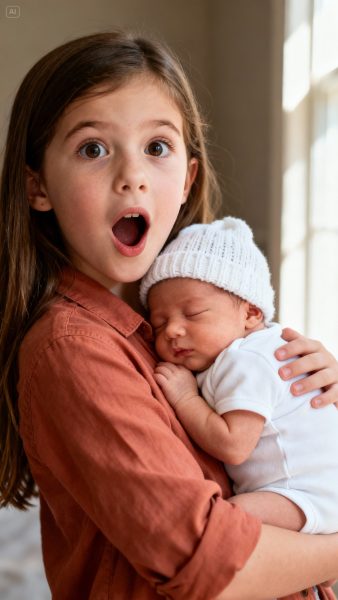
It was a quiet Saturday afternoon in our suburban home in Austin, Texas. My husband, Daniel, and I were babysitting our newborn niece, Lila, while my sister Jessica ran errands. My six-year-old daughter, Emma, had insisted on helping with the diaper change. I watched her excitedly toddle toward the nursery, little hands eager to “help mommy,” while Lila cooed softly in her bassinet.
A few minutes later, Emma’s voice rang out, high-pitched and panicked: “Mom! Look at this!”
I rushed into the nursery, heart hammering, expecting a small mess or spilled lotion. But the sight that met my eyes froze me completely. Lila’s diaper had… a strange, dark substance that wasn’t typical. It was sticky, shiny, and clearly harmful. I couldn’t comprehend it at first. My mind raced through possibilities—poison, chemical burns, something she had ingested?
Before I could react, Daniel stepped into the room, his face pale. Without saying a word, he gently guided Emma out of the nursery and into the living room, trying to shield her from the chaos. “Emma, sweetheart, go sit on the couch, okay? Everything’s going to be fine,” he said softly, his voice trembling.
I was frozen in place, staring at Lila, who was now fussing, clearly uncomfortable. My hands shook as I reached for my phone, but Daniel was already dialing 911, speaking quickly into the receiver. His usual calm composure was gone, replaced by a raw fear that mirrored my own.
“911, what’s your emergency?” The operator’s voice crackled through the line. Daniel’s words stumbled over one another as he explained the situation: newborn in distress, strange substance, unsure if it’s ingested, please send help immediately.
Meanwhile, I grabbed a towel and gently tried to clean Lila, but I could see the effect on her tiny body—she was lethargic, skin pale, eyes fluttering weakly. Panic surged through me. Every second felt like an eternity.
I glanced at Emma, sitting quietly on the couch, eyes wide with fear and confusion. “Mom, what’s happening?” she whispered. I swallowed hard, trying to calm my own panic so I could reassure her. “Sweetheart… we’re going to get help. You did the right thing telling me.”
The wailing of sirens in the distance marked the approaching paramedics. My mind raced with questions: how did this happen? Was it an accident or something more sinister? And, most importantly, would Lila be okay?
Every instinct screamed at me to hold her, to protect her, to find answers—yet all I could do was wait, trembling, as the professionals arrived to take over.
Paramedics arrived within minutes, their calm, efficient movements contrasting sharply with the chaos in our home. They quickly assessed Lila’s condition. Her small body was limp, and her breathing was shallow. One paramedic, Eric Sullivan, carefully lifted her onto a stretcher while another asked Daniel and me what had happened.
Daniel explained, voice still shaking: “We were babysitting my niece… my daughter found this… substance in her diaper. We don’t know what it is or how it got there. Please, hurry.”
The team moved swiftly. Lila was stabilized and transported to Dell Children’s Medical Center, with Daniel and me following behind in our car. Emma clung to my side, tears streaming down her face. “Is she going to be okay, Mom?” she asked, voice quivering. I held her tightly. “The doctors are very skilled. They’ll take care of her. We just have to stay strong.”
At the hospital, doctors ran a series of tests, checking for poisoning, infections, and other potential causes. Dr. Margaret Lin, the pediatrician on duty, examined Lila with meticulous attention. Her face was serious but composed. “We need to run blood tests immediately,” she said. “There may be toxins in her system. We’ll know more in a few hours.”
We waited, pacing the hospital corridors, consumed with fear. Every beep of the monitors, every rustle of nurses’ footsteps heightened the anxiety in the room. Daniel held my hand tightly. “I can’t believe this happened… I don’t understand how… who would do something like this?”
I swallowed hard, guilt gnawing at me for a brief moment—had I missed something? Could I have prevented this? But deep down, I knew Emma had done the right thing by alerting us. Without her vigilance, we might have been too late.
The blood test results confirmed the severity: Lila had ingested a toxic substance, consistent with household cleaning chemicals, but the exact source was unknown. Dr. Lin explained the next steps: IV fluids, monitoring for organ failure, and observation in the pediatric intensive care unit.
Hours stretched painfully. Emma sat quietly, holding a small stuffed bunny she had brought from home, repeating soft prayers and whispers of encouragement. Daniel and I alternated staying by Lila’s side, exhausted yet unwilling to leave her.
Finally, Dr. Lin returned with news that the immediate threat had been stabilized. “She’s responding well to treatment,” she said cautiously. “We’ll continue monitoring, but she’s going to survive.”
Relief flooded me, but it was tinged with lingering fear. Questions remained—how did Lila get exposed? Was it negligence, accident, or something deliberate? And could it happen again?
That night, we stayed at the hospital, Emma asleep in my lap, exhausted from worry, and Daniel beside me, both of us silently vowing to protect Lila from any future danger, no matter what.
The next day, detectives arrived to investigate. The police needed to determine whether the exposure to the toxic substance was accidental or intentional. I cooperated fully, recounting every detail of the babysitting arrangement, the cleaning supplies stored in the house, and who had access to the nursery.
It turned out that a small bottle of concentrated cleaning solution had been mistakenly left on a low shelf in the nursery closet by a visiting contractor who had been fixing a cabinet. Lila had been exposed during the diaper change when the bottle had spilled, contaminating a cloth used by Emma. The investigation concluded it was an accident, not a malicious act.
Relief was immense, though the shock lingered. Emma had unknowingly handled the contaminated cloth, yet she had alerted us immediately. Her quick thinking had likely saved Lila’s life. I hugged her tightly. “You were very brave, Emma. You helped save your cousin.” Tears streamed down her cheeks as she whispered, “I just wanted to help.”
Daniel and I reflected on the incident, realizing how fragile life can be, even in the comfort of our homes. Safety protocols, vigilance, and quick thinking had made all the difference. We reorganized cleaning supplies, established strict boundaries for dangerous materials, and rehearsed emergency procedures with both girls.
Lila spent a few more days under observation, but she gradually recovered. Her energy returned, her laughter came back, and she was finally discharged. Holding her tiny hand as we left the hospital, I felt an overwhelming gratitude for the second chance she had been given.
The experience changed our family dynamic. Daniel became more attentive, understanding the importance of listening to both children and taking potential dangers seriously. Emma gained confidence, realizing that her instincts and actions could make a real difference in critical situations. And I, while exhausted, knew that the responsibility of vigilance is one that can never be ignored.
In the weeks that followed, our home became safer, calmer, and more structured. We installed childproof locks, secured all chemicals, and made sure that no one else could inadvertently place the children at risk. Every small measure was a step toward ensuring this nightmare never repeated.
The memory of that moment—the call to 911, the trembling hands, the fear, and the relief—remains vivid. But it also stands as a testament to the courage and attentiveness of a six-year-old who acted quickly, and the collective resolve of a family to protect the ones they love most.
Through fear and uncertainty, we discovered resilience, responsibility, and the profound impact of vigilance and care in the lives of children.







Leave a Reply