They erased her from the family legacy — but at the class reunion, a military helicopter proved who she really was.
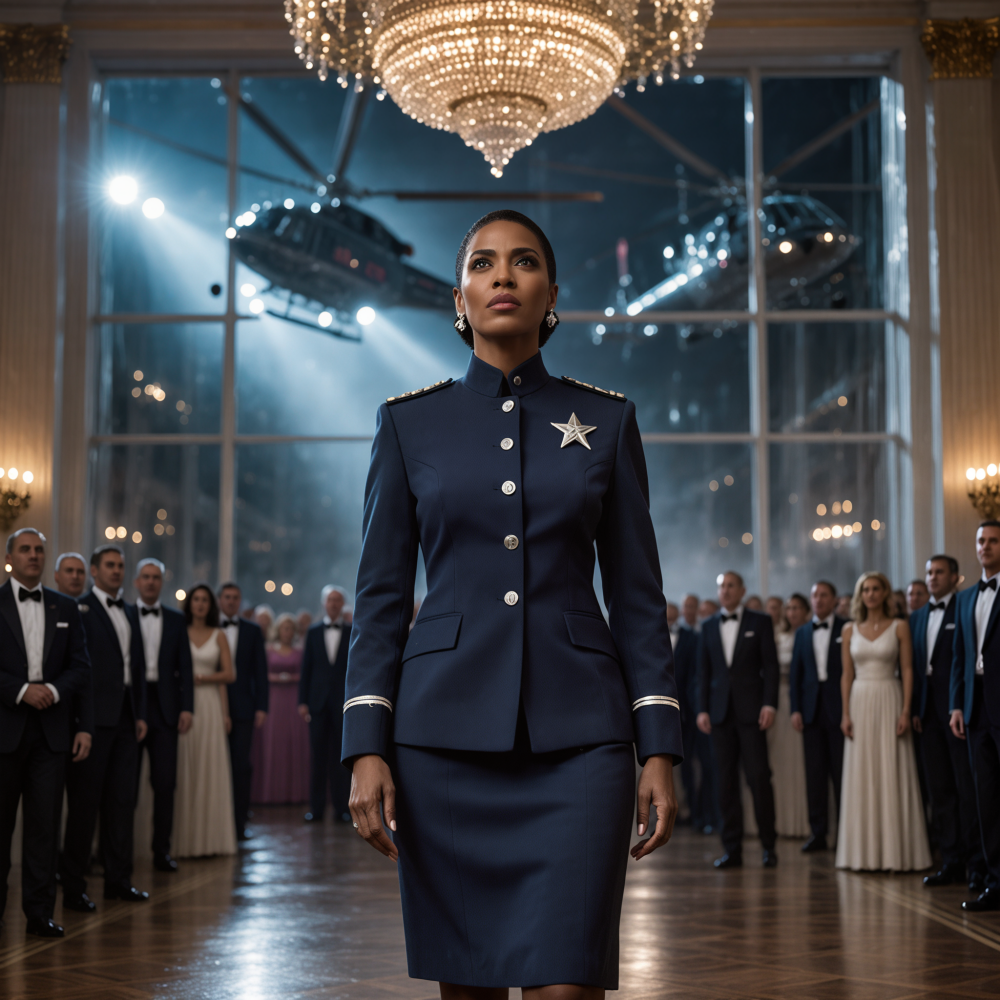
The chandelier light fractured across a thousand crystal edges, casting the ballroom into a golden storm of laughter and champagne. I stood at the entrance alone, my heels sinking into the polished marble, the hum of conversations rolling like thunder. They didn’t hug me. They didn’t even look at me. My mother’s eyes flickered for a second before dimming, as if I had just wandered in by mistake. My father’s gaze slid over me the way you skim over a misplaced coat on a rack. And just like that, I wasn’t their daughter—I was a ghost walking through a room that once held my name.
I had chosen the simplest dress I owned, a navy sheath worn once under a uniform no one here had ever seen. No jewels. No entourage. Just silence. Aspen Grove, Colorado, gleamed in its mountain luxury through the ballroom windows—snow peaks outside, chandeliers inside—but I might as well have been standing on another planet.
I scanned the photo wall by the champagne tower. Frame after frame told a story: prom night, homecoming, Harvard, golden accolades. My younger brother Bryce grinned from every angle, his achievements framed in captions of triumph. And me? Not a single picture. Not a single word. I’d been class president, orchestra chair, founder of the international relations club. But on these walls, I didn’t exist.
I stepped closer. My mother, pearls catching the light, gestured proudly toward Bryce’s photo. “Our Harvard man,” she declared to her circle, voice dripping with champagne warmth. When she noticed me, the smile faltered for half a breath. “Oh,” she said, as if I had interrupted a sacred rite. “You came.” My father didn’t add a word. Just that faint smirk of dismissal.
I moved toward my table—number 14, in the back near the exit. The cushion sagged, the centerpiece missing. Around me the names glittered: Dr. Patel, Senator Ames, CEO Lynn. Mine was plain: Anna Dorsey. No title. No recognition. Just letters printed without weight.
From across the room, I heard my mother’s voice rise above the music. “She was always the quiet one. No ambition for the spotlight.” Laughter rippled. Someone added, “Didn’t she do some military program for a summer?” My mother sipped her wine. “Something like that. We don’t really keep in touch.”
The sting wasn’t in the words but in the ease with which they were spoken. They hadn’t forgotten me—they had erased me. I sat perfectly still, the way I’d been trained: hands folded, face steady, silence as armor. But inside, a slow fire was spreading.
Melissa Yung slipped into the chair beside me. She held her phone with that uneasy look that said the truth was heavier than gossip. “I thought you should see this,” she whispered. The screen glowed with an email dated fifteen years back. Subject line: Re: Removal Request, Anna Dorsey. My father’s office address at the top.
My stomach turned as I read: Given Anna’s decision to discontinue her academic path and pursue non-traditional employment, we feel her inclusion in the alumni honor roll may cause confusion about our family’s values and narrative. Kindly remove her name from any future recognitions.
The words were precise. Polite. Brutal. My “non-traditional employment” had been four combat deployments and two commendations in intelligence. But here, in black and white, it was written as shame.
Melissa’s thumb swiped again. Another email. This one from my mother. Anna Dorsey has expressed her wish for privacy and anonymity. Please withdraw her nomination for the Medal of Honor.
My vision blurred, not with tears but with disbelief so sharp it cut. I had never asked for anonymity. I had never hidden. They hadn’t just ignored my service—they had stolen it.
I folded the napkin in my lap with military precision, each crease tighter than the last. Around me, the room buzzed with reunions, laughter, toasts. The DJ announced a slideshow. Baby photos, graduations, proms. Image after image lit up the screen. No trace of me.
When my name did flicker—once, in a group Model UN shot—the camera had blurred me into the back row. Someone behind me muttered, “Didn’t she drop out right after that?” The audience chuckled. On screen, the frame zoomed in on Bryce’s blazer, two sizes too big, his smile frozen like royalty.
That was the moment the truth hit harder than any battlefield. I hadn’t been misplaced. I had been rewritten. My parents had scrubbed my story so carefully, so consistently, it was as if I had never been born into their world at all.
And the worst part? It worked. No one in that room knew me anymore. And none of them cared to ask.
I lifted my glass of wine. It tasted of dust. I placed it down untouched. The ballroom roared with laughter, the chandeliers dripping light, Aspen Grove glowing outside. And I sat in the shadows, erased, a ghost in a room that carried my name only to deny it.
But ghosts don’t stay invisible forever.
…
The first toast rose before the salad plates even touched the tables. The MC—a theater kid turned real estate agent who never lost his love for the spotlight—clinked his glass with exaggerated flair. “Here’s to the brightest stars of 2003! Some went corporate, some went creative… and hey, did anyone here become a general?”
Laughter rolled across the ballroom like thunder in a canyon. Harmless, maybe. But then my father leaned back in his chair near the front, his voice cutting through the noise with surgical cruelty. “If my daughter’s a general, then I’m a ballerina.”
The crowd howled. Forks clattered against plates. Someone quipped, “Didn’t she do some military summer program? A semester, maybe?” My mother’s voice, cool and crystalline, carried above it all: “She’s always had a flare for dramatics. Probably still peeling potatoes on some base.”
The room exploded again. Even the DJ smirked, caught off guard by the meanness dressed as wit.
At Table 14 by the exit, I sat motionless. My napkin folded into sharp triangles on my lap. My wine untouched. My parents’ laughter wrapping the room like a chokehold. It wasn’t just mockery. It was erasure disguised as comedy.
Melissa caught my gaze from two tables away, her face tight with pity. But even she didn’t speak up. No one did. Not one voice reminded the room that I had led missions across continents, that my silence had saved lives they’d never know. They laughed because it was easy. They erased me because it was convenient.
The slideshow resumed, and the screen glowed with perfect lives. Wedding photos. Baby showers. Harvard dorm move-ins. My classmates gasped, clapped, whispered, “Oh my God, you look the same!” My face never appeared. When it did—once, in a Model UN photo—they had zoomed so far on Bryce’s too-big blazer that my blurred silhouette barely existed.
Someone behind me muttered, “Didn’t she drop out after that?” A ripple of chuckles followed.
I bit the inside of my cheek until I tasted iron. Betrayal doesn’t always come with knives. Sometimes it comes with PowerPoint slides.
I rose quietly. My chair barely scraped the marble. I slipped through the laughter and walked to the balcony.
The night air slapped me clean. Aspen Grove spread below, its ski-town lights scattered like jewels across the Colorado mountainside. The Rockies loomed, jagged and timeless, while inside the ballroom chandeliers dripped gold over people who believed I was disposable.
I gripped the railing, breathing until my pulse slowed. The wind smelled of pine and snow. And in that icy air, my mind flickered back—
West Point, seventeen years old, my boots blistering as we marched the long gray line. The stone walls, the cadence of voices shouting in unison. The first time I saluted a flag at sunrise, the ache in my arms from rifle drills, the weight of purpose settling on me like armor.
Deployment nights under foreign skies, sand grinding against my teeth, my hands steady on a map lit by red flashlight. The voices I’d ordered into danger, the ones I’d prayed would return. Silence on the radio that still haunted me.
And now, here—mocked by people who had never known discipline, never known risk. Who thought war was a metaphor for their careers.
Behind me, the ballroom cheered as Bryce’s name was called for another toast. Inside, I was a ghost. Outside, I was steel.
Then my phone buzzed.
Not a name. Not a text. A secure notification. The kind that carried the weight of worlds.
MERLIN: escalation confirmed. Threat Level Three. Requesting immediate eyes.
The ache in my chest hardened. I slipped back into the suite I’d rented upstairs, the laughter below muffled under thick carpet and oak doors.
From the closet, I pulled the black case I’d hidden beneath a hanging dress. Fingerprint. Retinal scan. Voice code. The lock hissed open.
Inside: my other life. The screen glowed with encrypted streams. NATO archive breach, multiple vectors, embedded signals. Not noise. Not simulation. War in code.
I laid the dress blues across the bed. The silver star caught the lamplight, gleaming sharp. For years, I’d worn silence like protection. But tonight, after watching them laugh and rewrite my story, silence felt like consent.
Another buzz. An encrypted voice message. Colonel Ellison, crisp and steady: “Ma’am, Merlin escalation confirmed. Extraction window required. Pentagon requests your presence by 0600.”
I closed the case. Straightened my back. And for the first time that night, I didn’t feel erased.
For the first time, I felt inevitable.
…
The ballroom was still glowing when the MC clutched the mic again. “And now,” he said with a flourish, “our final toast. Mr. and Mrs. Dorsey—proud parents of Bryce Dorsey, Harvard grad and rising star in venture capital!”
Applause shook the chandeliers. My mother lifted both arms like she was accepting an Academy Award. My father raised his glass as if he’d conquered a battlefield. Bryce basked in it, smile polished and practiced.
“And of course,” the MC added with a chuckle, “let’s not forget the Dorseys’ other child… wherever she ended up.”
The laughter was instant. A ripple, then a roar.
And then—another sound cut through.
At first a tremor, deep and low. Then louder. WUMP. WUMP. WUMP. The chandeliers rattled. The floor hummed. Wine glasses quivered. Napkins fluttered. The air shifted as if the night itself had split.
Phones shot into the air. Guests pressed against the windows, shrieking, laughing nervously, recording every second. Outside, a matte black helicopter descended onto the lawn, floodlights sweeping the ballroom like daylight breaking through storm clouds. Dresses whipped in the draft spilling through the open doors.
The grand entrance swung wide, and two figures strode in, uniforms razor-pressed, boots slamming marble in perfect unison. Conversations died mid-breath. Forks hovered over plates.
Colonel Ellison led the way. His eyes cut through the room, past senators and CEOs, past the golden tables, locking straight on me.
He didn’t pause. He didn’t flinch. He walked to Table 14, heels striking like a drumbeat, then stopped three feet away.
And saluted.
“Lieutenant General Dorsey, ma’am. Pentagon requires your immediate presence.”
The ballroom froze.
My mother’s smile cracked like porcelain under heat. My father’s glass slipped, spilling wine down his cuff. Bryce stared, lips parted, blinking as though buffering reality. The MC’s mic lowered in his hand, useless now.
Ellison’s voice rang, sharp as steel: “Merlin intel confirms active breach. Immediate extraction authorized.”
A gasp rippled through the guests. Someone whispered, too loud, “She’s a general? That’s their daughter?” Phones rose higher. A senator’s aide fumbled to start a livestream. The DJ’s music died mid-note.
I rose, napkin falling to the floor. My chair creaked in the silence.
I looked straight at my parents. My voice was calm, steady, lethal. “You didn’t just reject me. You tried to erase me.”
My mother opened her mouth. Nothing came out. My father tried to step forward, to reclaim control. “Anna, we—”
“No.” I cut him clean. “You don’t get to speak now.”
Ellison extended the red-sealed folder. Pentagon crest gleaming. “Chopper’s ready, ma’am.”
I took it. My hand didn’t shake.
And then I walked. Past the tables I was never meant to sit at. Past Bryce’s ruined smile. Past my parents’ silence. Through the storm of whispers, gasps, and cameras catching the one thing no one in that room had expected: the daughter they erased, standing taller than all of them.
The night air swallowed me whole. Rotor blades churned, whipping hair and gowns into chaos. Floodlights blazed. Reporters pressed against the velvet ropes, shouting questions drowned by the roar.
And for the first time in twenty years, I wasn’t invisible.
I was undeniable.
…
The South Lawn of Washington, D.C. shimmered under the September sun. Rows of cadets stood at rigid attention, brass polished, shoes gleaming. Senators filled the front row, flanked by journalists whose cameras clicked like rainfall. Somewhere behind the podium, I could hear the Marine Band rehearsing a march that had played for presidents and generals long before me.
And there I was—front and center, a silver star on each shoulder, the Pentagon’s crest heavy on the folder clutched in my hand.
The President adjusted the microphone. His voice carried across the crowd. “For acts of service beyond visibility. For protecting not only the mission, but the dignity of those who serve unseen. Today, the United States recognizes Lieutenant General Anna Dorsey with the Medal of Honor.”
Gasps, applause, the shuffle of cameras snapping closer. The ribbon slid over my neck, its weight less than I expected, but heavier than silence had ever been.
I didn’t smile. I didn’t cry. I stood straight, shoulders squared, because this moment wasn’t about recognition—it was about truth finally cutting through the noise.
In the third row, my mother sat with pearl earrings glinting in the light. Perfect posture. A face carved into porcelain calm. My father beside her, stiff as marble, eyes fixed forward, refusing to meet mine. They didn’t clap. They didn’t shed a tear. But Melissa—my old classmate—did. Colonel Ellison did. And a thousand cadets in dress uniforms raised their chins just a little higher.
Later that afternoon, I walked alone through the halls of Jefferson High. The building smelled of floor wax and echoes. At the far end, the newly restored Hall of Legacy gleamed with plaques mounted in bronze and marble. For years, my name had been missing. Today, it stood in place again:
Anna Dorsey — Led in Silence. Served Without Needing to Be Seen.
I traced the letters with one fingertip. No gold leaf. No ornate frame. Just truth etched in metal.
A cluster of cadets lingered nearby, whispering in awe. One of them, freckles dusted across her cheeks, finally stepped forward. Her voice trembled. “Ma’am… you’re the reason I enlisted.”
I nodded once, no more. “That’s enough,” I said quietly. Because it was.
Outside, reporters were still camped on the lawn. Hashtags were trending. The video of Colonel Ellison saluting me in that Aspen Grove ballroom had already crossed a million views. The world was catching up to who I’d always been.
But as I looked at my plaque, I realized something: I didn’t need my parents to understand. I didn’t need them to clap. The power they once had—the power to erase me—was gone.
That night, as the Capitol lights burned against the darkening sky, I stood taller not because I had been recognized, but because I had stopped asking for permission to exist.
If you’ve ever been erased by the people meant to love you, you’re not alone. Drop a 1 if you know the sting. Drop a 2 if you’ve carried the silence and turned it into strength.
Not for the algorithm. Not for attention.
Just so the rest of us know—we’re still here.
And we are undeniable.