While we were eating, my sister splashed an entire glass of wine on me and shouted, “You have until dawn to get out!” My parents cheered her decision. I merely smiled, dropped a key on the table, and replied, “Then your sixty seconds start now…”
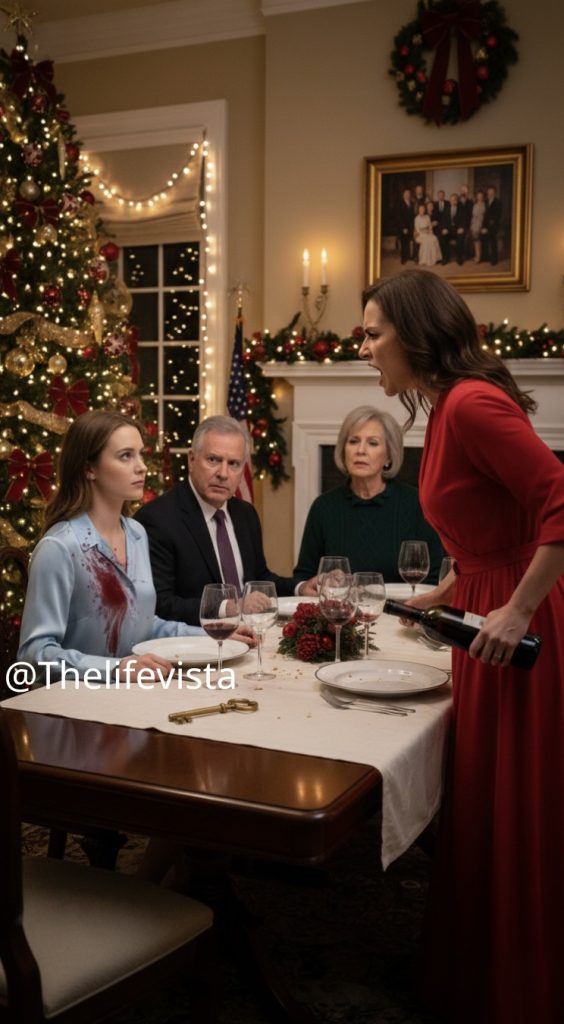
I felt the cold merlot dripping down my face as my sister Lauren towered over me, the empty wine bottle still in her hand.
“You have until sunrise to get out of my house,” she screamed, while our parents applauded from across the dining table.
Twenty years of being the family scapegoat culminated in this moment.
I calmly reached into my pocket, placed a brass key on the table, and spoke words that would change everything.
“Then you have sixty seconds to save your future.”
The stunned silence that followed my words lasted only a heartbeat before Lauren’s face twisted with rage. But before she could speak, I raised my hand, my voice steady despite the wine still trickling down my
I watched as confusion flickered across their faces. My mind drifted back to that gray March afternoon.
The funeral home had smelled of lilies and old wood polish. I’d been sitting alone in the back row while my family clustered together near the front, deliberately excluding me as always. Lauren had been holding court, dramatically dabbing at dry eyes while our parents comforted her.
Nobody comforted me.
Nobody ever did.
After the service, as everyone filed out for the reception, Eleanor’s lawyer, Mr. Harold Whitman, had approached me quietly. He was a distinguished man in his seventies, with silver hair and kind eyes behind wire-rimmed glasses.
“Miss Jenna, might I have a word with you privately?” he’d asked, glancing around to ensure we weren’t being watched.
We’d stepped into a small side room, and what he told me changed everything.
Grandmother Eleanor—who I’d thought barely tolerated me, like the rest of the family—had been watching all along. She’d seen how they treated me, documented every cruel birthday they’d forgotten, every holiday they’d ruined, every achievement they’d dismissed.
“Your grandmother was a very observant woman,” Mr. Whitman had said, pulling out a thick manila envelope. “She revised her will six months before her passing. You’ve been named executor of her entire estate.”
My hands had trembled as I took the envelope.
Three point two million dollars. Properties in Colorado and California. Investment portfolios. And most importantly, a specific clause that made my heart race:
Any family member who showed cruelty or hostility toward me would forfeit their inheritance entirely.
“And there’s one more thing,” Mr. Whitman had added, his expression growing serious. “Your grandmother insisted that you must document any hostile behavior for the clause to activate. She wanted to give them a chance to show their true colors, and she wanted you to have irrefutable proof.”
Back in the present, Lauren’s voice cut through my memories.
“What are you babbling about? You think some sob story about Grandma’s funeral is going to change anything?”
I smiled. Genuinely smiled—for the first time in years at a family dinner.
“I’m not looking for your sympathy, Lauren. I’m explaining why I’ve spent the last three months documenting every single cruel thing you’ve done to me.”
My mother, Patricia, shifted uncomfortably in her seat.
“Jenna, what is this nonsense? You’re embarrassing yourself.”
“Am I?”
I pulled out my phone, scrolling to the photos I’d taken of the will.
“Grandmother Eleanor left me in charge of her entire estate. All three point two million dollars of it.”
The color drained from their faces simultaneously. My father, Robert, half rose from his chair, his mouth opening and closing like a fish gasping for air.
“That’s impossible,” Lauren sputtered, wine bottle still clutched in her white-knuckled grip. “Grandma loved me best. She always said so.”
“She told you what you wanted to hear,” I replied calmly. “Just like she told you she loved that awful pottery you made in college. Remember how she displayed it prominently whenever you visited? She threw it in the garbage the minute you left. I know because I’m the one she called to come fish it out before your next visit.”
The truth hung heavy in the air.
All those years, I’d been Eleanor’s secret keeper, her quiet companion during the long afternoons when the rest of the family was “too busy” to visit. I’d been the one who took her to doctor’s appointments, who helped her sort through old photographs, who listened to her stories about growing up during the Depression.
“But here’s the truly interesting part,” I continued, standing up slowly, wine-soaked hair sticking to my neck. “The will has a very specific clause. Any family member who shows cruelty or hostility toward me forfeits their share entirely. And you, dear sister, just assaulted me with a wine bottle while our parents cheered you on.”
Lauren’s face cycled through emotions like a broken slot machine—disbelief, rage, fear, and back to rage again.
“You’re lying. You have to be lying.”
“Call Mr. Whitman yourself,” I said, pulling out his business card and sliding it across the table. “His office opens at eight tomorrow morning—though I should mention he’s already been thoroughly briefed on tonight’s events.”
My mother found her voice, shrill and accusatory.
“Jenna Marie, how dare you keep this from us? We’re your family.”
“Family?” I laughed, but there was no humor in it. “When have you ever treated me like family? When you forgot my sixteenth birthday because Lauren had a volleyball game. When you made me sleep in the garage during Christmas because Lauren’s college friends needed my room. When you told me I was probably adopted because I didn’t look enough like the rest of you.”
Each word landed like a physical blow, and I watched them flinch.
Good, I thought. It was about time they felt a fraction of the pain they’d inflicted on me for thirty-two years.
“I’m a financial adviser,” I continued, my professional composure taking over. “I understand money, investments, and—most importantly—I understand leverage. Grandmother Eleanor knew that too. She didn’t just leave me money. She left me the power to finally hold you accountable.”
Lauren slammed the wine bottle on the table, making the crystal glasses jump.
“This is insane. You can’t just waltz in here and claim you own everything.”
“I don’t claim it,” I said simply. “I have the legal documents to prove it. And thanks to your little performance tonight, complete with witnesses, you’ve just forfeited your share. That’s eight hundred thousand dollars you just poured over my head, Lauren.”
The number hung in the air like a guillotine blade. I saw the moment it truly hit her, watched her calculating mind try to process the magnitude of her mistake. Eight hundred thousand dollars—gone in a single moment of cruelty she’d thought would have no consequences.
My father finally spoke, his voice brittle.
“Jenna, surely we can discuss this reasonably.”
“Reasonably?” I touched my wine-soaked blouse. “Was this reasonable? Were twenty years of treatment that would make Cinderella’s stepfamily look kind reasonable?”
But I wasn’t done. Not even close. Because the wine dripping down my face was just the beginning of what I had endured. And the key I’d placed on the table was just the first of many surprises I had in store for them.
“You have sixty seconds,” I reminded them, glancing at my watch. “Fifty-five now. I suggest you start thinking very carefully about your next move.”
The dining room felt smaller suddenly, charged with an electric tension that made the air hard to breathe. Lauren’s hand shook as she reached for her phone, probably to call her boyfriend, her lawyer, or anyone who might tell her this was all some horrible nightmare.
But it wasn’t a nightmare.
It was justice—served at exactly the right temperature, with a side of consequences they’d never seen coming.
“And I’m just getting started,” I said.
“Forty seconds,” I announced, watching Lauren’s fingers fumble with her phone. Her perfectly manicured nails clicked against the screen as she tried to dial, but her hands were shaking too badly to manage it.
“What does this key even mean?” my mother demanded, staring at the brass key I’d placed on the table as if it might bite her.
I picked up a napkin, dabbing at the wine on my face with deliberate calm.
“That key? That’s the master key to this house. The house that, as of last month, belongs to me.”
The silence that followed was so complete I could hear the grandfather clock ticking in the hallway. Lauren’s phone slipped from her fingers, clattering onto the hardwood floor.
“What did you just say?” she whispered, her voice barely audible.
“You heard me correctly,” I said, pulling out a folder from my bag—the one I’d strategically placed by my chair before dinner. “This house, the one you’ve been lording over me from for the past five years, the one you inherited from Mom and Dad when they moved to Florida, the one you’ve been using as collateral for your lifestyle? It’s mine now.”
My father’s face turned an alarming shade of purple.
“That’s impossible. We gave Lauren this house free and clear.”
“You did,” I agreed, spreading the documents on the table, careful to avoid the wine puddles. “But what Lauren didn’t tell you is that she took out three mortgages on it. One in 2019 to fund her failed boutique. Another in 2021 for her cryptocurrency venture. And a third just last year for her essential oils pyramid scheme.”
Lauren lunged across the table, trying to grab the papers, but I pulled them back smoothly.
“Those were investments. Business opportunities,” she snapped.
“They were disasters,” I corrected. “And when you couldn’t make the payments, the bank started foreclosure proceedings. Funny how you managed to hide all those notices from Mom and Dad during their visits.”
My mother’s head swiveled between Lauren and me like she was watching a tennis match.
“Lauren, is this true?”
Lauren’s silence was answer enough.
“I found out about the foreclosure two months ago,” I continued, my voice steady and factual. “Did you know that foreclosure notices are public record? As a financial adviser, I make it my business to check these things. Imagine my surprise when I saw this address listed.”
I pulled out another document—the deed transfer paperwork.
“So I formed an LLC—Silver Lining Properties—and purchased the house from the bank. Cash offer. They were delighted to avoid the hassle of a full foreclosure auction.”
“You bought our house?” my father whispered.
“I bought Lauren’s house,” I corrected. “The one she destroyed with debt. The same house she just ordered me to leave by sunrise. Rather ironic, wouldn’t you say?”
Lauren found her voice again, shrill and desperate.
“This is illegal. You can’t just buy someone’s house out from under them.”
“Actually, I can. And I did. Everything was completely legal and above board. In fact, I’ve been more than generous. I’ve been letting you live here for the past month without paying rent while I documented your behavior. Every cruel word, every hostile action—all of it building my case for Grandmother Eleanor’s will provisions.”
I stood up, walking to the window that overlooked the backyard where we’d played as children. The swing set was still there, rusty now, a monument to a childhood where Lauren had always claimed the good swing and relegated me to the broken one.
“Do you want to know what really sealed my decision to buy this house?” I asked, not turning around. “It was Mrs. Patterson from next door. She told me about all the times she’s seen you throwing my belongings onto the lawn when I’ve tried to visit. About how you’ve been telling the neighbors I’m mentally unstable and dangerous.”
Mrs. Patterson was eighty-three years old, sharp as a tack, and had lived next door since before we were born. She’d been like a surrogate grandmother to me, sneaking me cookies when my family forgot to feed me dinner as punishment for some imagined slight.
“That old bat needs to mind her own business,” Lauren spat.
“That ‘old bat’ has been keeping detailed notes about everything she’s witnessed,” I replied. “She even has photos of you burning my college diploma in the backyard fire pit last Fourth of July. Remember that? You told everyone it was an accident, that you thought it was trash.”
I turned back to face them, taking in their stricken expressions.
“But here’s where it gets really interesting. When I bought this house, I had it thoroughly inspected. Would you like to know what they found?”
Lauren’s face had gone from red, to white, to an interesting shade of green.
“Apparently, you’ve been running an illegal Airbnb out of the basement apartment,” I continued. “The one that’s not zoned for rental, doesn’t have proper permits, and hasn’t been reporting income to the IRS. You’ve made nearly sixty thousand dollars in the last two years, all undeclared.”
“How do you know that?” Lauren’s voice was barely a whisper.
“Your guests left reviews, Lauren. Online reviews with dates and payment amounts. It wasn’t hard to piece together. I have spreadsheets if you’d like to see them.”
My mother stood up abruptly, her chair scraping against the floor.
“This is too much. Jenna, you’re being vindictive.”
“Vindictive?” I laughed—a short, sharp sound. “I’m being factual. Every single thing I’ve said can be verified with documentation. Unlike the lies you’ve all been spreading about me.”
I reached into my folder again, pulling out an eviction notice.
“As the legal owner of this property, I’m within my rights to ask you to leave. However, I’m not as cruel as you’ve been. I’m giving you thirty days’ notice, as required by law. More than generous considering you gave me until sunrise.”
“You can’t do this!” Lauren screamed, finally finding her fury again. “This is my home!”
“Was,” I corrected. “It was your home until you leveraged it into oblivion and lost it to the bank. I just happened to be the buyer. Think of it as keeping it in the family.”
My father stood up slowly, his legs unsteady.
“Jenna, we’re your parents. Doesn’t that mean anything to you?”
“It means everything to me,” I said quietly. “Which is why it’s hurt so much all these years. Do you remember when I graduated summa cum laude from college? You didn’t come because Lauren had a hair appointment she couldn’t reschedule. When I got promoted to senior financial adviser at twenty-eight—the youngest in the company’s history—you threw a party for Lauren’s engagement to that man who left her at the altar.”
The memories flooded back, each one a small wound that had never quite healed.
“Every achievement I’ve ever had has been overshadowed by Lauren’s failures, which you somehow always spun into being my fault. Well, now I’ve achieved something you can’t ignore or minimize.
“I own this house.”
“Twenty seconds,” I said, glancing at my watch again. “Though I suppose the countdown is rather moot now, isn’t it? You can’t exactly throw me out of my own house.”
Lauren made a strangled sound like a cat being stepped on. She looked around wildly as if searching for something to throw, but I’d been careful to stay out of reach of any potential projectiles.
“Here’s what’s going to happen,” I said, my voice taking on the professional tone I used with difficult clients. “You’re going to clean up this wine, sit back down, and we’re going to discuss this like adults. Because despite everything you’ve done to me, I’m still willing to be reasonable. But that window is closing fast.”
My mother sank back into her chair, looking older than her sixty-four years.
“I don’t understand how this happened,” she whispered. “How did we get here?”
“We got here,” I said slowly, “because for thirty-two years, you’ve treated me like I was worth less than the dirt under your shoes. We got here because you never once stopped to think that maybe—just maybe—I was keeping score.”
The grandfather clock in the hall chimed nine, its deep tones echoing through the house that was no longer Lauren’s sanctuary, but my statement of independence.
“Time’s up,” I announced. “So what’s it going to be? Are we going to handle this civilly, or do I need to call the sheriff’s department to enforce the eviction notice?”
Lauren’s face crumpled, and for the first time in my life, I saw real fear in her eyes. Not fear of me—but fear of consequences, that foreign concept that had finally caught up with her.
But if she thought the house was the biggest surprise of the evening, she was about to learn just how thorough I’d been in my preparations. Because the cameras I’d installed weren’t just for security.
They were for evidence.
And what they’d captured over the past month would change everything.
“I think,” I said, sitting back down at the table, “it’s time we talked about the surveillance system I had installed. You’d be amazed at what modern technology can capture. Shall we start with last Tuesday, when you went through my old room?”
The night was far from over, and I was just beginning to show them exactly what twenty years of careful planning looked like when executed by someone they’d dismissed as worthless.
Lauren’s hand shot out toward me, fingernails aimed at my face like claws. I stepped back smoothly, having anticipated this exact reaction.
“Don’t you dare touch her.”
The voice came from the kitchen doorway.
Marcus stepped into the dining room, his six-foot-two frame filling the archway. My boyfriend of three years looked calm, but I could see the tension in his shoulders. He’d been waiting in the kitchen, listening, ready to intervene if things got physical.
“Who the hell are you?” my father demanded, apparently finding his authoritative voice when confronted with a stranger.
“Marcus Chen,” he said simply, moving to stand beside me. “I’m the tech entrepreneur who helped Jenna install the comprehensive security system in this house. Every room, every angle—all completely legal since Jenna owns the property.”
I pulled out my tablet from my bag, swiping to the security app.
“Would you like to see last Tuesday, Lauren?” I asked. “When you used the spare key you didn’t know I knew about to enter my old bedroom?”
The screen flickered to life, showing crystal-clear footage of Lauren sneaking into the house at two in the afternoon. The timestamp was prominent in the corner as she made her way to my childhood bedroom—the one I’d stayed in during my brief visits over the years.
“That’s an invasion of privacy!” Lauren shrieked, but her protest died as we watched her on screen methodically going through my belongings.
The video showed her opening my jewelry box—the one Grandmother Eleanor had given me for my eighteenth birthday. Lauren’s fingers sorted through the contents, pocketing several pieces, including the pearl necklace Eleanor had worn on her wedding day.
“Those pearls,” my mother gasped. “Mother said she lost them years ago.”
“She didn’t lose them,” I said quietly. “She gave them to me the day before she died. Said she wanted someone who understood their value to have them, not someone who would just see dollar signs.”
We continued watching as video-Lauren moved to my closet, pulling out the designer dress I’d bought for my company’s annual gala. She held it up to herself, then deliberately took scissors from my desk and cut a long gash down the back.
“My God,” Marcus muttered. “I’ve seen the footage before, but it still shocks me.”
“That was a fifteen-hundred-dollar dress,” I said conversationally. “I had to attend the gala in a borrowed outfit because someone destroyed mine out of spite.”
But Lauren wasn’t done. In the video, she moved to my desk, where I’d left some work documents during my last visit. Her face lit up as she photographed them with her phone, page by page.
“Those were confidential client files,” I explained, “which you then tried to use to poach my clients—calling them and claiming I was about to be fired for misconduct. Fortunately, my clients trusted me enough to call me directly.”
My parents were staring at the screen in horror. This wasn’t the daughter they’d coddled and protected all these years. This was someone capable of calculated cruelty.
“There’s more,” Marcus said, switching to a different file. “This is from three weeks ago.”
The new footage showed my parents sitting in this very dining room with Lauren, their heads bent together conspiratorially.
“We need at least fifty thousand,” Lauren was saying in the recording. “If we can convince Jenna that Mom needs surgery, she’ll wire the money immediately. She’s always been soft about medical stuff.”
My mother’s voice came through the speakers, clear as day.
“Tell her I need a kidney transplant. That should get us a hundred thousand at least. We can say the insurance won’t cover it.”
“Brilliant,” my father agreed on the recording. “She won’t even question it. Too guilty about being a ‘bad daughter’ to verify anything.”
I paused the video, looking at my parents’ stricken faces.
“You were going to fake a kidney transplant to steal money from me.”
“It wasn’t stealing,” my mother protested weakly. “We were going to pay you back.”
“With what money?” I asked. “The inheritance you thought you were getting from Grandmother Eleanor? The same inheritance you just watched Lauren forfeit by assaulting me?”
Marcus pulled up another file.
“This one’s my personal favorite,” he said. “Last Sunday’s brunch with the neighbors.”
The video showed a backyard gathering, Lauren holding court with about fifteen neighbors. Her voice carried clearly across the recording.
“Poor Jenna’s really gone off the deep end,” Lauren was saying, shaking her head sadly. “We found her talking to herself in the garden at three a.m. last week. The doctors think it might be schizophrenia. We’re looking into having her committed for her own safety.”
Mrs. Patterson’s voice cut through.
“That’s funny, because I saw Jenna leaving for her business trip to New York that morning. Her Uber picked her up at 4:30 a.m. for a 6:00 flight.”
Lauren’s face in the video showed a flash of annoyance before smoothing back into fake concern.
“She must have snuck back. The delusions make her very cunning.”
“I have that entire business trip documented,” I said, pulling out receipts and photos—including the award I received for closing the biggest deal in company history. “Definitely sounds like something someone with schizophrenia would do.”
“This is entrapment!” Lauren shouted, spittle flying from her mouth.
“This is documentation,” Marcus corrected calmly. “Every single recording was made on property Jenna owns, in common areas where there’s no expectation of privacy. We consulted with three different attorneys to ensure everything was completely legal.”
I switched to another folder on the tablet.
“But let’s talk about what really matters. Your friends, Lauren—the ones you’ve been borrowing money from using my name.”
The screen filled with text messages—screenshots Lauren had sent to various people. In them, she claimed to be messaging on my behalf, “too embarrassed” to ask for money directly. The amounts ranged from five hundred to five thousand dollars, all with promises that “Jenna” would pay them back with interest.
“Sixty-seven thousand dollars,” I said. “That’s how much you’ve borrowed using my name and reputation from people who trusted me because of my professional standing. Do you know how many confused calls I’ve gotten from your friends, wondering when I’m going to pay them back for loans I never took?”
Before anyone could respond, the doorbell rang.
Marcus checked his phone and smiled.
“Perfect timing.”
He went to answer it, returning with a tall woman in a crisp navy suit. She carried a briefcase and had the no-nonsense bearing of someone who dealt with legal matters for a living.
“Good evening,” she said, surveying the wine-stained scene with professional interest. “I’m Catherine Brennan from Brennan and Associates. I’m here to serve papers.”
She opened her briefcase with practiced efficiency, pulling out multiple manila envelopes.
“Lauren Mitchell,” she said, placing an envelope in front of my sister. “You’re being served with lawsuits for defamation, fraud, identity theft, and destruction of property.”
Lauren’s mouth opened and closed soundlessly as Catherine moved on.
“Robert and Patricia Mitchell,” Catherine continued, placing envelopes in front of my parents. “You’re being served for conspiracy to commit fraud and defamation.”
“This is insane!” my father roared, pushing the envelope away. “We’re her parents!”
“Which makes your conspiracy to defraud her particularly egregious,” Catherine replied coolly. “The recordings Mr. Chen provided show clear intent to deceive and steal from Miss Mitchell through false medical claims.”
“Jenna, please,” my mother pleaded, tears finally starting to flow. “We’re family.”
“Family?” I repeated, the word bitter on my tongue. “Tell me—what kind of family plans to fake a terminal illness to steal money? What kind of family spreads rumors about mental illness to discredit someone? What kind of family celebrates when one member is literally drenched in wine and thrown out?”
The silence that followed was deafening.
Marcus pulled up one final video on the tablet.
“Jenna didn’t want to show you this one,” he said quietly, “but I think you need to see it.”
The screen showed a video clearly taken in my apartment. I was sitting alone on my couch, talking on the phone with my therapist, Dr. Rachel Martinez. The security camera in my living room had captured my side of the conversation.
“I just want them to love me,” my voice came through the speakers, thick with tears I rarely let anyone see. “After everything, I still just want my family to love me. Is that pathetic?”
My therapist’s voice was a muffled murmur through the phone, but my responses were clear.
“I know, I know they won’t change. But part of me keeps hoping that if I’m successful enough, kind enough, forgiving enough, they’ll finally see me as worthy of love.”
In the present, my mother made a choked sound. Lauren stared at the screen, something unreadable flickering across her face.
“No, I won’t back down from the plan,” video-me continued. “They need to face consequences. I just wish the consequences didn’t have to come from me. I wish they could have just chosen to be kind.”
Marcus turned off the video. The dining room was silent except for the grandfather clock’s relentless ticking.
“Every cruel word, every deliberate hurt, every planned deception,” I said quietly. “I have it all documented. Three months of evidence that shows exactly who you really are. Not the façade you present to the world— but the truth.”
Catherine cleared her throat.
“The lawsuits seek both compensatory and punitive damages. Based on the evidence provided, we’re confident in our case. However, Miss Mitchell has indicated she may be willing to discuss alternative resolutions depending on your response to what she has to share next.”
I stood up, walking to the window again. The moon was rising over the neighborhood I’d grown up in, casting silver light over familiar yards and houses. Somewhere in this tableau of suburban normalcy, my family had built a fortress of lies and cruelty with me as their designated target.
“Before we continue,” I said, still facing the window, “there’s something else you need to know. The surveillance system wasn’t just for gathering evidence of your cruelty. It also captured something much bigger. Something that explains why Grandmother Eleanor really left me in charge of her estate.”
I heard chairs scraping as they shifted uncomfortably.
“Good,” I thought. “It’s time they learned that their treatment of me has been a symptom of something much darker—something that would shake the very foundation of our family.”
“Lauren,” I said finally, turning to face my sister. “Would you like to tell them about your business ventures, or should I let the FBI agents do it when they arrive?”
The wine bottle slipped from Lauren’s nerveless fingers, shattering on the hardwood floor in a spray of green glass and leftover merlot. The sound seemed to echo in the silence, a crystal punctuation mark to the revelation that was about to destroy everything they thought they knew.
The shattered wine bottle lay between us like a crime scene, green glass catching the light from the chandelier. Lauren’s face had gone the color of old paper, her carefully applied makeup standing out in stark relief against her pallor.
“FBI?” my father whispered, the word barely making it past his lips.
“Did you really think I wouldn’t notice?” I asked Lauren directly. “When credit cards started appearing in my name? When business loans I never applied for began showing up on my credit report? When my professional reputation started taking hits for debts I didn’t owe?”
Marcus pulled up a new folder on his tablet, this one labeled with FBI case numbers.
“Six weeks ago, Jenna came to me in tears,” he said. “Her credit score had dropped three hundred points overnight. She was getting calls from collection agencies for debts totaling over four hundred thousand dollars.”
“That’s impossible,” Lauren said, but her voice shook like autumn leaves.
“Is it?” I pulled out a thick folder of bank statements, loan documents, and credit applications. “Green Energy Solutions, LLC—ring any bells, Lauren? The company you founded using my social security number, my financial history, my professional credentials.”
My parents looked between us, confusion evident on their faces. They’d been so deep in their own schemes, they hadn’t noticed their golden child’s biggest deception.
“Let me paint you a picture,” I said, spreading the documents across the table, careful to avoid the wine stains and broken glass.
“Eighteen months ago, Lauren discovered my social security number. Not hard, really, since Mom keeps all our important documents in that unlocked filing cabinet in the basement.”
I picked up the first document: a business registration form.
“She used my information to establish Green Energy Solutions, claiming to be developing revolutionary solar panel technology. The address listed? A P.O. box in Denver. The founder and CEO? Jenna Mitchell, according to all the paperwork. But with a twist,” Marcus added. “The contact email and phone number all routed back to Lauren. Brilliant, really—if it wasn’t so illegal.”
I held up the next set of papers.
“Then came the loans. First National Bank: seventy-five thousand. Colorado Credit Union: fifty thousand. Three online lenders: another hundred and fifty thousand total. All using my credit history, my salary verification from my actual job—my everything.”
“Lauren, tell me this isn’t true,” my mother whispered.
Lauren’s hands trembled as she reached for her water glass, knocking it over in the process. The water spread across the table, soaking into the legal documents. Somehow, that seemed fitting.
“But the loans were just the beginning,” I continued. “Then came the investors. Tell me, Lauren—how much did you raise from those retired teachers in Fort Collins? The ones who thought they were investing in the future of clean energy?”
“I was going to pay it all back,” Lauren burst out. “The business just needed more time to develop.”
“What business?” I laughed, but it was hollow. “The empty warehouse you rented for exactly one photo shoot? The ‘prototype’ you bought off Alibaba and spray-painted? The fake engineers you hired from Craigslist to attend one investor meeting?”
Marcus connected his tablet to the dining room TV, and suddenly the screen filled with surveillance footage from the warehouse.
“We hired a private investigator once Jenna discovered the fraud,” he explained. “This is what he found.”
The video showed the warehouse Lauren had rented, completely empty except for some cardboard boxes and that single spray-painted solar panel. The next clip showed her meeting with investors, confidently presenting falsified data and promising returns that would never come.
“Two point three million dollars,” I said quietly. “That’s how much you stole from innocent people using my name—retirees, teachers, small business owners who believed in sustainable energy and trusted the financial adviser whose credentials you forged.”
“Agent Diana Chen from the FBI’s white-collar crime division has been building this case for two months,” I continued, pulling out my phone to show them emails from the federal investigation. “She specializes in identity theft and investment fraud. Would you like to guess what the federal sentencing guidelines are for wire fraud exceeding two million dollars?”
My father’s face had progressed from purple to an alarming gray.
“Twenty years,” he whispered.
He would know. He’d worked in insurance long enough to understand federal crime.
“Twenty to thirty, actually,” I corrected, “depending on the judge’s mood and the number of victims. Currently, we’re at forty-three individual investors, not counting the banks.”
“But here’s where it gets really interesting,” Marcus said, pulling up another file. “Lauren didn’t work alone. She needed references, right? Professional people to vouch for the legitimacy of the business.”
The screen showed official reference letters, complete with letterheads and signatures. Two of them made my parents gasp.
“Recognize those signatures?” I asked. “Robert Mitchell, retired insurance executive, vouching for his daughter Jenna’s business acumen. Patricia Mitchell, former school administrator, confirming she’d personally seen the ‘revolutionary technology’ in action.”
“We didn’t know,” my mother protested. “Lauren said it was just to help with initial paperwork.”
“Really?”
I pulled out copies of checks.
“Then why did you each receive five thousand dollars from Green Energy Solutions—‘consulting fees,’ according to these records?”
The truth hung in the air like smoke from a fire that had been burning for months. My parents had been willing accomplices—either through greed or willful blindness.
“The FBI has been monitoring all of this,” I continued. “Every transaction, every forged document, every investor who lost their retirement savings. They’ve built what Agent Chen calls an airtight case.”
“You set me up,” Lauren accused, finding her voice again. “You knew, and you let me do it.”
“I found out six weeks ago,” I said firmly. “And my first call was to the authorities—not to warn you. Because unlike you, I actually care about those forty-three people who trusted my name and reputation. Do you know what it’s like to get a call from an eighty-year-old woman who invested her husband’s life insurance payout because she believed in you?”
I pulled out a photo from my folder, sliding it across the wet table. It showed an elderly woman standing in front of a foreclosure sign.
“That’s Mrs. Eleanor Hoffman. No relation to our grandmother—just an unfortunate coincidence with the name. She invested fifty thousand dollars in Green Energy Solutions. It was everything she had left after her husband died. She lost her house last month.”
Lauren wouldn’t look at the photo. My parents stared at it in horror.
“I’ve been paying her rent in a senior living facility,” I said quietly. “Anonymously—because she’s too proud to accept charity. But she shouldn’t have to accept charity. She should have her fifty thousand dollars back.”
“I don’t have it,” Lauren whispered. “It’s gone.”
“Spent on what?” I asked, though I already knew. “Your Tesla. The vacation to Cabo. The designer clothes and bags. The Botox and fillers. How much of Mrs. Hoffman’s life savings is currently in your face, Lauren?”
Marcus looked at his phone.
“That’s our cue.”
The doorbell rang again. This time I knew exactly who it would be.
Catherine moved to answer it, returning with two people in dark suits, their FBI badges visible on their belts.
Agent Diana Chen was a compact woman with sharp eyes and an air of absolute professionalism. Her partner, Agent Williams, was tall and imposing—the kind of man you didn’t want to see at your door.
“Lauren Mitchell,” Agent Chen said. “I’m Agent Chen with the FBI. We have a warrant for your arrest on charges of wire fraud, identity theft, and operating a fraudulent investment scheme.”
Lauren stood up so fast her chair toppled over.
“No, wait—I can explain!”
“You’ll have plenty of opportunity to explain,” Agent Williams said, moving behind her with handcuffs. “You have the right to remain silent. Anything you say can and will be used against you in a court of law…”
As they read Lauren her rights, I watched my parents. They seemed to have aged a decade in the last hour, their carefully constructed world crumbling around them.
But we weren’t done yet.
There was still one more revelation to come—one that would explain everything about why they’d always treated me differently.
“Robert and Patricia Mitchell,” Agent Chen said after Lauren was cuffed. “We also have some questions for you regarding your involvement in this scheme. You’re not under arrest at this time, but I strongly suggest you contact attorneys.”
“Jenna!” Lauren pleaded as the agents prepared to lead her out. “Please—you have to help me. I’m your sister.”
“My sister,” I repeated softly. “The same sister who’s been telling everyone I’m mentally unstable. Who destroyed my belongings out of spite. Who committed federal crimes using my identity. That sister?”
Despite everything, I felt a pain watching her in handcuffs. I wasn’t heartless.
“Lauren, I’ve already contacted a defense attorney for you,” I said. “Bradley Morrison. One of the best in Denver. He’ll meet you at the federal building. I’ve paid his retainer.”
Confusion flickered across her face.
“Why?”
“Because unlike you, I don’t abandon family,” I said simply. “Even family that spent decades trying to destroy me. But his help comes with conditions. You’ll make full restitution to every investor. You’ll cooperate completely with the investigation. And you’ll finally tell the truth about why you’ve hated me all these years.”
Lauren’s face went even paler, if that was possible. She knew exactly what truth I meant.
“Take her,” I told the agents. “But please let her know that despite everything, I want her to get help. Real help. This isn’t just about punishment.”
As they led Lauren out, I heard her break down—great, heaving sobs that echoed through the house. For the first time in twenty years, they sounded genuine.
Agent Chen turned back to me.
“Miss Mitchell, thank you for your cooperation in this investigation. Your documentation has been invaluable. We’ll be in touch about your testimony.”
“Of course,” I replied. “Those investors deserve justice. And despite what she’s done to me, I hope Lauren gets the help she needs along with her punishment.”
After the agents left, the house felt different. Emptier—but also cleaner, somehow. As if a poison had been drained from its walls.
My parents sat in their chairs like broken dolls, staring at the space where their favorite daughter had been. The grandfather clock chimed ten, reminding us that this nightmare of a dinner had only been going on for two hours. It felt like a lifetime.
“There’s more,” I said quietly. “Something that might help you understand why all of this happened. Why you’ve treated me differently all my life. Why Lauren’s hatred ran so deep.”
My mother’s head snapped up.
“What are you talking about?”
I pulled out the final folder, the one I’d been dreading and anticipating in equal measure.
“It’s time we talked about Uncle Thomas,” I said. “And about what really happened thirty-three years ago.”
The silence that followed was different from before. This wasn’t shock, or anger, or fear. This was the silence of a secret that had been buried so deep they’d almost forgotten it was there.
My mother’s face went through a transformation I’d never seen before. It started with confusion, shifted to recognition, and settled into a mask of pure terror. Her hand reached for my father’s, but he pulled away, his eyes fixed on me with an intensity that could have burned holes through steel.
“How do you know about Thomas?” my mother whispered, her voice barely audible over the grandfather clock’s ticking.
I pulled out a manila envelope, my hands steady despite the earthquake of emotions inside me.
“Uncle Thomas died thirteen months ago,” I said. “Did you know that?”
Of course they didn’t. They’d cut him out of their lives so completely that no one even thought to notify them.
“Good riddance,” my father spat, but his voice shook.
“Is that what you really think?” I asked, pulling out the first document. “Because Uncle Thomas never forgot about his family. Especially not about his daughter.”
The words landed like a bomb in the already devastated dining room.
My mother made a sound somewhere between a gasp and a sob, covering her mouth with both hands.
“Don’t,” she pleaded. “Jenna, please don’t.”
“Don’t what?” I asked. “Don’t talk about the man whose DNA runs through my veins? Don’t mention that Robert Mitchell isn’t my biological father? Don’t bring up the secret that’s poisoned this family for thirty-two years?”
I spread the documents on the table—DNA test results, Uncle Thomas’s death certificate, and a letter in his handwriting that I’d read so many times I could recite it from memory.
“He knew,” I continued. “Uncle Thomas knew about me from the beginning. You told him, didn’t you, Mom?”
My mother’s tears were flowing freely now, but I felt no sympathy. She’d had thirty-two years to tell me the truth. Thirty-two years to protect me from the fallout of her choices.
“It was a mistake,” she whispered. “One night. Robert and I were having problems and Thomas was there and… and…”
“And nine months later, I was born,” I finished. “The living reminder of your betrayal. The child who looked just a little too much like Uncle Thomas and not enough like Robert.”
My father stood up abruptly, his chair scraping against the floor.
“I raised you. Fed you. Kept a roof over your head. That should have been enough.”
“Should it?” I pulled out photos from my childhood, laying them out like evidence. “Look at these, Robert. Really look at them. Every family photo—I’m pushed to the edge or cut out entirely. Every birthday party—I’m in the background while Lauren takes center stage. Every Christmas morning—the difference in presents was so obvious even the camera couldn’t hide it.”
Marcus moved closer to me, his presence a steady comfort. He’d been the first person I’d told after discovering the truth—holding me while I sobbed for the childhood that finally made sense.
“Uncle Thomas tried to be part of my life,” I continued. “He sent birthday cards that you returned. Christmas gifts that you donated. Letters you burned. I know because he kept copies of everything, hoping someday he could share them with me.”
I pulled out a thick bundle of letters, all addressed to me, all marked “Return to Sender” in my mother’s handwriting.
“Thirty-two years of letters,” I said, running my finger along the stack. “He wrote to me every birthday, every Christmas, every milestone he imagined I might be reaching—first day of school, high school graduation, college acceptance. He celebrated every moment of my life from afar because you wouldn’t let him near me.”
“We did what we thought was best,” my mother protested weakly.
“Best for who?” I demanded. “For me—the child who grew up thinking she was fundamentally unlovable? For Lauren, who learned that cruelty would always be rewarded? For yourselves, living a lie that twisted you into people capable of planning fake illnesses to steal from your own daughter?”
I pulled out the most important document, the one that had started this entire chain of events—Uncle Thomas’s will.
“He left me one point five million dollars,” I said. “And a letter explaining everything. His lawyer tracked me down through public records. That’s how I learned the truth about my paternity.”
“One point five million,” my father repeated, his voice hollow.
“Money he earned through honest work,” I said. “He was a pediatric surgeon. Spent his life saving children because he couldn’t be there for his own. The irony isn’t lost on me.”
I picked up Uncle Thomas’s letter, the one I’d memorized but still needed to see.
“Would you like me to read what he wrote?” I asked. “Or should I skip to the part where he talks about Lauren?”
My mother’s head snapped up.
“What about Lauren?”
“Oh, you didn’t know?” I pulled out another document. “Lauren’s known since she was eighteen. You told her, Mom, during one of your wine-fueled crying sessions. She’s been using it as blackmail ever since.”
The pieces were falling into place like dominoes. Each revelation triggering the next.
Marcus pulled up bank records on his tablet, showing regular transfers from my mother’s personal account to Lauren’s.
“Five hundred here, a thousand there,” I noted. “All to keep Lauren quiet about the family shame. That’s why she’s always been so confident in her cruelty toward me. She knew she had the ultimate leverage.”
“I didn’t mean to tell her,” my mother sobbed. “It just slipped out.”
“And she’s held it over your head for fourteen years,” I said. “Demanding money, favoritism, constant validation. Building her confidence on the foundation of my degradation. Every time you chose her over me, it was because she threatened to expose the truth.”
I pulled out more photos, these from Uncle Thomas’s collection—pictures taken from afar at my school events, my graduation, moments he’d hired private investigators to capture because he couldn’t be there himself.
“He watched me grow up from a distance,” I said. “Celebrated my successes alone. Do you know he framed my college graduation photo in his office? Told his colleagues I was his niece who lived far away. He was so proud when I became a financial adviser. Said I inherited his head for numbers.”
“How did you get all this?” my mother asked.
“His lawyer, Mr. Richardson,” I explained. “Uncle Thomas made sure everything would come to me if something happened to him. Thirty-two years of documentation—letters, photos, explanations. He wanted me to know I was loved, even if he couldn’t show it in person.”
Marcus pulled up another file.
“There’s something else,” he said. “Jenna didn’t want to share this part, but I think you need to see it.”
The screen showed a video clearly taken in a hospital room. Uncle Thomas was propped up in bed, thin and pale, but with eyes that looked exactly like mine. His voice was weak but clear.
“My dear Jenna,” he said to the camera. “If you’re watching this, then Richardson found you—and you know the truth. I want you to know that not a day passed when I didn’t think of you, love you, wish I could be your father in more than just biology.”
My mother made a broken sound, turning away from the screen.
“I know Patricia and Robert did what they thought was best,” Uncle Thomas continued. “I don’t blame them for protecting their marriage. But I need you to know that you were never a mistake to me. You were the daughter I always dreamed of—even if I could only love you from
He paused, coughing weakly, before continuing.
“I’ve left you everything I have. But more importantly, I’ve left you the truth. You deserve to know where you came from—to understand that the way they treated you was never about you. It was about their inability to see past their own pain to the incredible person you are.”
The video ended with him holding up one of my professional headshots, tears in his eyes.
“I love you, Jenna. Your real father loves you. Be free.”
The dining room was silent except for my mother’s quiet sobs and the eternal ticking of the grandfather clock.
“He died alone,” I said quietly. “The nurse said he was holding my photo when he passed. Thirty-two years of loving a daughter he could never claim. And he died with my picture in his hands.”
“I didn’t know,” my father said. And for the first time all evening, he sounded broken. “I didn’t know he’d been watching her, caring about her.”
“Would it have mattered?” I asked. “Or would you have just built higher walls to keep him out?”
“Jenna,” my mother reached for me, but I stepped back.
“No,” I said firmly. “You don’t get to reach for me now. Not after thirty-two years of choosing your comfort over my well-being. Not after letting Lauren weaponize this secret against me. Not after planning to fake a kidney transplant to steal from me.”
I gathered up the documents, carefully organizing them back into their folders.
“Uncle Thomas’s money is already in a trust,” I said. “I’m using it to expand the foundation I’m starting—helping other family scapegoats find their freedom. His legacy will be healing the damage that secrets like yours cause.”
“What happens now?” my father asked, looking every one of his seventy years.
“Now?” I glanced at my watch.
“Now you face the consequences of your choices. Lauren’s facing twenty to thirty years for fraud. You’re both facing charges for conspiracy. Your reputations in this community are about to be destroyed. And all because you couldn’t find it in your hearts to love a child who desperately needed it.”
The doorbell rang one more time.
Catherine went to answer it, returning with an elderly man in an expensive suit, carrying a leather briefcase.
“Good evening,” he said. “I’m Harrison Richardson, Thomas Mitchell’s attorney. I understand it’s time for the final phase of his instructions.”
He pulled out a sealed envelope, handing it to my parents.
“Thomas asked me to deliver this personally once Jenna learned the truth,” he said. “He said you’d know what to do with it.”
My mother opened it with shaking hands, pulling out a single sheet of paper. As she read, her face crumbled completely.
“What is it?” my father demanded, snatching the paper. I watched his face change as he read, knowing what the letter contained. Uncle Thomas had shown me a copy in his video messages.
“He forgave us,” my father whispered. “After everything… he forgave us.”
“Of course he did,” I said. “Because unlike you, Uncle Thomas understood that forgiveness isn’t about the people who hurt you. It’s about freeing yourself from the poison of carrying hatred. He forgave you for his own peace, not yours.”
I moved toward the door, Marcus and Catherine flanking me.
“But forgiveness doesn’t mean freedom from consequences. And it doesn’t mean reconciliation. Uncle Thomas forgave you from afar, just like he loved me from afar. Some distances are necessary for survival.”
“Jenna, wait,” my mother called out. “What can we do? How can we fix this?”
I turned back, looking at the two people who had raised me but never truly parented me.
“You start by facing the truth,” I said. “All of it. The FBI charges. The lawsuits. The community judgment. You own what you’ve done—without excuses or justifications. You get therapy—real therapy—to understand why you were capable of treating a child the way you treated me.”
“And then?” my father asked.
“And then you live with it,” I said simply. “The way I’ve lived with your rejection all these years. The way Uncle Thomas lived with loving a daughter he couldn’t claim. Sometimes the consequences of our choices follow us forever. It’s what we do with those consequences that defines who we become.”
I walked back to the table one last time, picking up the brass key I’d placed there at the beginning of this nightmare evening.
“This house has thirty days of memories for me,” I said. “Thirty days of documenting cruelty, gathering evidence, preparing for tonight. After you move out, I’m going to transform it completely. Make it somewhere healing can happen instead of hurt.”
“You’re really going to make us leave?” my mother asked.
“I’m really going to hold you accountable,” I corrected. “For the first time in your lives, you’re going to face actual consequences for your actions. Consider it a gift. Most people never get the chance to truly see themselves and change.”
As we reached the door, I turned back one final time. They looked smaller somehow, diminished by the weight of their exposed secrets and impending consequences.
“Uncle Thomas wrote something else in his letter,” I said. “He said, ‘The opposite of love isn’t hate. It’s indifference.’ For thirty-two years, you made me believe I was hated. Tonight, I learned it was worse. I was simply inconvenient—a living reminder of a mistake you couldn’t erase.”
I took a deep breath, feeling lighter with each word.
“But I’m not a mistake. I’m a successful woman who built herself from nothing. I’m someone who chooses kindness, even when surrounded by cruelty. I’m Uncle Thomas’s daughter—and I’m finally proud of that.”
The last thing I saw before leaving was my father holding Uncle Thomas’s forgiveness letter, tears streaming down his face as he finally understood the magnitude of what they’d all lost to their secrets and lies.
Standing in the doorway of my childhood home, I watched my parents crumble under the weight of thirty-two years of deception.
But I wasn’t done.
The evidence I’d gathered painted a picture far darker than even tonight’s revelations had shown.
“Before I leave,” I said, turning back to face them, “there’s one more matter we need to discuss. Your taxes.”
My father’s tear-stained face went rigid.
“What about our taxes?”
I smiled, but it held no warmth.
“Did you really think I wouldn’t look into everything once I became executor of Grandmother Eleanor’s estate? Her accountant had some very interesting questions about discrepancies going back fifteen years.”
Marcus pulled up another set of files on his tablet, connecting it once more to the dining room TV. Spreadsheets filled the screen, row after row of numbers highlighted in damning red.
“Let’s start with 2010,” I began, walking back into the room. “The year you claimed massive losses from a home-based business that never existed. Sixty thousand dollars in deductions for a consulting firm that had no clients, no income, and no actual operations.”
“That was legitimate,” my father protested, but his voice cracked.
“Was it?” I pulled out IRS forms, laying them on the table. “Because I have here your signature on documents claiming business meetings in Hawaii, Switzerland, and Japan. Funny how those align exactly with your vacation photos from those same years.”
My mother sank deeper into her chair.
“Robert handled all of that.”
“With your signature on joint returns,” I pointed out. “Making you equally liable for fraud.”
“But it gets better. From 2015 through 2020, you claimed rental losses on the Florida condo—the same condo you’ve been living in full-time since moving there.”
The evidence kept mounting. Charitable deductions for donations never made. Medical expenses that were actually cosmetic procedures. Lauren’s college tuition claimed as business training expenses. Year after year of systematic fraud that would make even seasoned criminals impressed.
“Four hundred thirty-seven thousand dollars,” I announced. “That’s the total amount you’ve stolen from taxpayers over fifteen years. Not including interest and penalties, of course.”
“You’re going to turn us in to the IRS?” my mother whispered.
“I could,” I said, placing a thumb drive on the table. “Everything’s right here—documented, organized, and ready for submission. The statute of limitations for tax fraud is six years, but willful fraud? That has no limits. You could be looking at massive fines and serious prison time.”
Catherine stepped forward.
“Based on my experience with federal tax cases,” she said, “you’re looking at a minimum of five years each—possibly more, given the systematic nature and extended time frame of the fraud.”
“But I’m not without mercy,” I continued. “Unlike you, I don’t take pleasure in destroying family members. So I’m offering you a choice.”
They looked at me with desperate hope, the same look I’d had so many times as a child, hoping for scraps of affection.
“Option one,” I said, holding up a finger. “I turn over all evidence to the IRS, FBI, and state authorities. You face the full weight of criminal prosecution—prison time, financial ruin, and public humiliation that will follow you for the rest of your lives.”
“What’s option two?” my father asked quickly.
I pulled out a stack of legal documents Catherine had prepared.
“Complete confession and restitution,” I said. “You sign over all claims to Grandmother Eleanor’s estate, acknowledging that your treatment of me violated the conditions of her will. You provide written statements admitting to every single act of fraud, cruelty, and conspiracy we’ve discussed tonight.”
“That’s still ruining us,” my mother protested.
“No,” I corrected. “That’s accountability. But there’s more. You’ll each enter intensive therapy—with practitioners I choose. Minimum twice a week for the first year. You’ll participate in family counseling sessions when your individual therapists determine you’re ready. Real work—not just going through the motions,” Marcus added.
“You’ll also make public statements to everyone you’ve lied to about me,” I said. “Every neighbor, friend, and family member who’s heard your poison over the years gets to hear the truth.”
“I can’t,” my mother sobbed. “The shame. The shame—”
I laughed incredulously.
“You’re worried about shame now? Where was that concern when you were telling people I was schizophrenic? When you were planning fake medical emergencies? When you were raising Lauren to see cruelty as currency?”
I pulled out my phone, showing them a contact.
“Dr. Sarah Martinez is one of the best family trauma therapists in the country. She’s agreed to take you both on—despite her usual waiting list—because she’s fascinated by the dynamics at play here.”
“What about Lauren?” my father asked.
“Lauren’s facing federal charges that I can’t make disappear,” I said. “But the lawyer I’ve hired for her is excellent. If she cooperates fully, makes complete restitution, and agrees to intensive therapy, she might get five to seven years instead of twenty to thirty. Time to really think about who she’s become—and who she wants to be.”
“And if we refuse your deal?” my mother asked.
I shrugged.
“Then you’ve learned nothing from tonight. I expose everything, let the legal system handle it, and walk away knowing I tried to offer you redemption.”
“This is blackmail,” my father said, but there was no force behind it.
“This is consequence,” Catherine corrected. “Your daughter is offering you a path to rehabilitation instead of pure punishment. I’d strongly advise you to consider it.”
The grandfather clock chimed eleven, its deep tones seeming to count down their time to decide. I watched them wrestle with their pride, their fear, their desperate need to avoid consequences warring with the reality that they were trapped.
“There’s one more thing,” I said, pulling out a final document. “Part of your therapy will include making amends to everyone you’ve hurt. Not just me—but every investor Lauren defrauded using your references. Every friend you’ve lied to. Every family member you’ve manipulated.”
“How long do we have to decide?” my mother asked.
I looked at my watch—the same one Grandmother Eleanor had given me for my college graduation, the one my parents hadn’t attended.
“You told me I had until sunrise to leave your house,” I said. “I’m giving you the same. When the sun comes up, the offer expires and I proceed with option one.”
“That’s only seven hours,” my father whispered.
“Seven more hours than you gave me,” I pointed out. “Seven hours to decide if you want to finally become people worthy of forgiveness—or if you want to continue down the path that led you here.”
Just then, movement outside caught my eye. Mrs. Patterson from next door was standing in her garden, pretending to check her roses by porch light. She’d been watching the FBI arrival, the comings and goings—probably putting together pieces of a puzzle she’d been observing for years.
“I should mention,” I added, “that Mrs. Patterson has agreed to testify in any legal proceedings. She’s documented quite a bit herself over the years. Elderly people make excellent witnesses. Juries love them.”
The hope drained from their faces again as they realized how thoroughly they were trapped. Every avenue of escape had been cut off by their own actions, documented and verified by multiple sources.
“You planned all of this,” my father said, a note of unwilling admiration creeping into his voice. “Every single detail.”
“I learned from the best,” I replied. “Years of watching you all scheme and manipulate taught me the importance of thorough preparation. The difference is, I use those skills to seek justice—not to destroy innocence.”
My phone buzzed with a text from Marcus’s tablet. He showed me the screen—the security system had captured everything tonight in high definition from multiple angles, every confession, every revelation, every moment of truth.
“Tonight’s footage will be kept secure,” I assured them. “If you complete the therapy, make the amends, and show genuine change, it never sees the light of day. But if you revert to old patterns—if you try to spin this story to make yourselves victims—everyone will see exactly who you really are.”
“You’re not the little girl we could push around anymore,” my mother said quietly.
“No,” I agreed. “I’m the woman you created through your neglect. Strong because I had to be. Strategic because I learned to be. Compassionate because I chose to be—despite having every reason to become as cruel as you.”
Marcus stepped forward, placing a hand on my shoulder.
“We should go,” he said. “They need time to discuss their decision.”
I nodded, gathering my things one final time.
But before leaving, I had one last truth to share.
“You know what the saddest part is?” I asked, looking at my parents with genuine pity. “If you had just loved me—even a little—none of this would have happened. Grandmother Eleanor would have split her estate equally. Lauren wouldn’t have become a criminal trying to maintain her false superiority. You wouldn’t have descended into fraud and cruelty to manage your guilt.”
I picked up a family photo from the mantle—one where I’d been obviously edited out, my shoulder still visible at the edge where someone had done a poor job cropping me away.
“All I ever wanted was to belong,” I said. “To be part of this family. To have parents who were proud of me and a sister who saw me as an ally instead of competition.”
“Jenna…” my mother started.
“But you chose this instead,” I continued, setting the photo down. “Every cruel word, every forgotten birthday, every moment you made me feel worthless led directly to tonight. You created your own destroyer through your inability to see a child’s heart past your adult grievances.”
I walked to the door one final time, pausing at the threshold.
“Seven hours to decide,” I said. “Option one: complete destruction. Option two: the hard work of redemption. Choose wisely. It’s the last choice regarding me you’ll ever get to make.”
As we stepped onto the porch, Mrs. Patterson called out from her garden.
“Jenna, dear, are you all right?”
I smiled at her, genuine warmth filling my chest.
“I’m better than all right, Mrs. Patterson,” I said. “For the first time in my life, I’m free.”
She nodded knowingly.
“Good for you, sweetheart. It’s about time someone held them accountable.”
As we walked to Marcus’s car, I felt the weight of thirty-two years lifting from my shoulders. Behind me, my childhood home stood illuminated in the darkness, and inside, two people faced the hardest decision of their lives: continue living in destructive delusion, or finally face the truth of who they’d become.
The thumb drive with the tax fraud evidence sat on their dining room table like a ticking time bomb. The legal documents offering redemption lay beside it. Two paths diverged in their wine-stained dining room, and they had until sunrise to choose which one to take.
“Do you think they’ll take the deal?” Marcus asked as we drove away.
“I honestly don’t know,” I admitted, watching the house disappear in the rearview mirror. “But for the first time in my life, it doesn’t matter what they choose. I’ve done what I needed to do. The rest is up to them.”
The night air was cool and clean, carrying the scent of Mrs. Patterson’s roses and the promise of new beginnings. Somewhere in federal holding, Lauren was meeting with the lawyer I’d hired. Somewhere in my parents’ dining room, two people were discovering that the foundations of their carefully constructed lives were nothing but sand. And somewhere in my chest, where a hurt child had lived for thirty-two years, a grown woman was finally learning what it felt like to stand up straight, speak her truth, and demand nothing less than justice—served with a side of mercy they’d never shown her.
Seven hours until sunrise.
Seven hours for them to decide if they wanted to finally become the parents I’d deserved all along—or remain the strangers they’d always chosen to be.
Six months later, I stood in the transformed dining room where my life had changed forever. The wine-stained hardwood had been replaced with warm bamboo flooring. The crystal chandelier that had witnessed so much pain now cast gentle light over a space designed for healing.
Through the windows, I could see the garden where Mrs. Patterson and I had planted a memorial rose bush for Uncle Thomas.
“The last family just moved in yesterday,” Marcus said, wrapping his arms around me from behind. “Single mom with two kids. Escaped from a situation not unlike yours—but with physical violence added to the emotional abuse.”
I leaned back against him, surveying what this house had become.
The “Jenna Mitchell House for Family Scapegoat Survivors” now provided transitional housing for up to three families at a time, offering not just shelter but therapy, legal aid, and job training.
“Any word from the federal correctional facility?” I asked.
“Lauren’s thriving in the rehabilitation program,” Marcus replied, pulling up the latest report on his phone. “Her therapist says she’s making real progress understanding how her entitlement led to her crimes. Model prisoner, apparently—helps other inmates with their appeals.”
It was hard to reconcile this description with the sister who had drenched me in wine, but people could change when faced with no other option. Lauren’s sentence had been reduced to seven years with good behavior, thanks to her complete cooperation and the restitution plan we’d worked out.
“She’s paid back forty percent of what she stole,” I noted, checking my own files. “The art authentication business she’s running from prison is actually legitimate—and profitable. Who knew she had real skills when she couldn’t rely on fraud?”
My phone buzzed with a text.
“They’re here.”
I smoothed down my dress—similar style to the one Lauren had destroyed, but in a deeper blue. This wasn’t about revenge anymore.
It was about closure—and possibility.
The doorbell rang, and Mrs. Patterson answered it. She’d become our unofficial house grandmother, offering cookies and wisdom to families who’d never known unconditional kindness from an elder.
My parents entered hesitantly, looking like strangers in the home where they’d once held court. Six months of intensive therapy had changed them. My father’s arrogance had been replaced by something approaching humility. My mother no longer wore her victim mask, but faced the world with clear, accountable eyes.
“Jenna,” my mother said softly. “Thank you for agreeing to see us.”
Dr. Martinez followed them in, her presence a professional buffer for this first family meeting. We’d had individual sessions—processing trauma and establishing boundaries—but this was our first attempt at interaction as a family unit.
“Let’s sit in the living room,” I suggested, leading them to a space that had once showcased their achievements while erasing mine. Now it held photos of the families we’d helped—success stories of survival and transformation.
“I wanted to show you something,” my father said, pulling out a worn envelope. Inside were photographs I’d never seen—baby pictures of me, candid moments from my childhood, report cards and awards they’d saved despite their cruelty.
“We found these in the attic,” he explained. “Hidden in a box labeled ‘Christmas decorations.’ I think… I think part of us always knew we were wrong. We kept these because, deep down, we were proud of you. We just couldn’t let ourselves feel it.”
“Dr. Martinez has helped us understand the generational trauma,” my mother added. “My father was Uncle Thomas’s favorite—the golden child who could do no wrong. When I betrayed Robert with Thomas, I was really trying to hurt my father through his favorite son. You paid the price for psychological patterns set before you were born.”
“That explains things,” I said carefully. “It doesn’t excuse them.”
“No,” my father agreed quickly. “Nothing excuses what we did. We’re not here to ask for forgiveness. Dr. Martinez says that’s not ours to request. We’re here to show you who we’re trying to become.”
They pulled out a folder thick with documents.
“We’ve made full restitution to the IRS,” my mother said. “Sold the Florida condo. Liquidated our retirement accounts. Every penny of fraudulent refunds has been repaid—with interest.”
“We’ve also met with every person we lied to about you,” my father added. “Forty-three separate conversations, admitting that we were the problem, not you. Mrs. Chen from the country club actually cried. Said she’d always suspected, but was too polite to intervene.”
I felt Marcus’s hand on my shoulder, grounding me. This was what accountability looked like—not grand gestures, but systematic correction of every small cruelty.
“Lauren writes to us,” my mother offered. “She’s taking college courses. Plans to get a real business degree. She wants to make things right with you but says she understands if you’re not ready.”
“I’m not,” I said simply. “Maybe someday. But not yet.”
Dr. Martinez leaned forward.
“Jenna, would you like to share what you’ve prepared?”
I pulled out my own folder, containing the hardest letter I’d ever written.
“I’ve decided to forgive you,” I began, watching their faces shift with surprise and hope. “But forgiveness doesn’t mean forgetting. It doesn’t mean we’ll have a traditional parent-child relationship. It means I’m choosing to release the poison of hatred so it doesn’t contaminate my future.”
“We understand,” my father said quietly.
“I’ve set up education funds for the grandchildren of Lauren’s victims,” I continued. “Seventeen kids will have college paid for because their grandparents’ retirement savings were stolen. It’s funded partly by the estate, partly by the auction of everything in this house that held painful memories.”
“The dining room table brought in twelve thousand,” Marcus added with dark humor. “Apparently wine stains add character to antiques.”
“We want to contribute,” my mother said quickly. “We’ve both taken second jobs. Everything beyond basic expenses goes to restitution.”
I studied them—these strangers who’d raised me. They looked older, worn down by consequences, but also clearer somehow. The toxic fog of denial had lifted, leaving behind two people forced to see themselves clearly for the first time.
“There’s a position open here,” I said slowly. “Maintenance and garden work. Nothing glamorous, but honest labor. Mrs. Patterson needs help managing the property.”
They exchanged glances.
“You’d trust us here?” my father asked.
“I’d trust Mrs. Patterson to supervise you,” I corrected. “Consider it part of your amends. Every family who stays here has been betrayed by people who should have protected them. Seeing you work honestly to maintain their sanctuary might help them believe people can change.”
“We’ll do it,” my father said immediately.
The meeting continued for another hour, establishing boundaries and expectations. They would work at the house but live elsewhere. They would continue therapy indefinitely. They would respect my need for distance while remaining available if I ever wanted more contact.
As they prepared to leave, my mother turned back.
“The sunrise,” she said suddenly.
“What?” I asked, confused.
“The morning after that dinner,” she said. “We watched the sunrise while making our decision. It was the first honest conversation we’d had in thirty years. We chose redemption as the sun came up. It felt… symbolic.”
I thought about that night—how I’d given them the same deadline they’d given me. The sun rising on consequences and choices, illuminating truths that darkness had hidden for too long.
After they left, I stood in the garden with Marcus, looking at Uncle Thomas’s memorial rose bush. It had bloomed beautifully, pink petals catching the afternoon light.
“Do you think he’d be proud?” I asked.
“I think he’d be amazed,” Marcus replied. “You took unspeakable pain and transformed it into healing for others. You forced accountability while leaving room for redemption. You became everything they tried to prevent you from being.”
That evening, we held our weekly dinner for the families staying in the house. Three mothers, seven children, and various volunteers gathered around a new table in the dining room where my life had shattered and reformed. The children laughed over spaghetti while their mothers shared resources and encouragement.
“Miss Jenna?” asked Katie—a seven-year-old whose mother had escaped a narcissistic family system. “Why do you help people like us?”
I knelt beside her chair, thinking about how to explain generational trauma and healing to a child who’d already seen too much.
“Because someone should have helped me when I was your age,” I said finally. “And now I can make sure other kids don’t have to wait as long as I did to find safety.”
She nodded solemnly, then brightened.
“Mrs. Patterson says you’re getting married. Can I be a flower girl?”
Marcus laughed.
“She’s got you there. We do need flower girls for next month.”
The wedding would be small—just chosen family and the survivors we’d helped. Lauren had sent a letter saying she understood why she couldn’t attend, but wished us well. She was cross-stitching a wedding sampler in her prison art class, apparently. Strange to imagine those hands that once held a wine bottle in violence now creating something beautiful.
As the evening wound down and families retreated to their apartments, I found myself back in the spot where I’d stood that night—wine dripping down my face, key in my hand. The person I’d been then felt like a ghost, someone who’d needed to die so who I was now could be born.
“Any regrets?” Marcus asked, finding me there.
I thought about it seriously.
“No,” I said. “Every cruel moment led to this. Every betrayal taught me what real loyalty looks like. Every lie showed me the value of truth. I wouldn’t change anything—because it all led to helping these families find what I searched for so desperately.”
Mrs. Patterson appeared with her usual perfect timing, carrying a plate of cookies.
“For the children’s lunchboxes tomorrow,” she said, then paused. “You know, dear, I always wondered when you’d finally fight back. Took longer than I expected—but my goodness, when you did, it was spectacular.”
“You knew what was happening all along,” I said. It wasn’t a question.
“Hard to miss when a child sits in your garden crying every holiday,” she replied. “But you had to find your own strength. Outside intervention would have just made them circle the wagons. You needed to build your case—and strike when they least expected it.”
She was right, of course. The timing had been everything—Grandmother Eleanor’s death, Uncle Thomas’s revelation, Lauren’s escalating crimes, my parents’ tax fraud—all converging into one moment of perfect clarity where justice became not just possible, but inevitable.
Later that night, as I lay beside Marcus in our apartment across town, I thought about transformation. Lauren in prison, learning honesty through forced constraint. My parents doing manual labor, understanding that worth isn’t inherited but earned. Me building sanctuary from the rubble of childhood pain.
My phone lit up with a notification. Another family had applied for housing. Another story of scapegoating and survival. Tomorrow I’d review their case—offer hope where there had been none.
But tonight, I simply existed in the peace I’d fought so hard to achieve. No wine bottles thrown in anger. No keys dropped in defiance. Just the quiet breathing of the man I loved, and the knowledge that I’d transformed my deepest wound into my greatest purpose.
The sunrise would come again tomorrow, as it had every day since that fateful dinner. But now it illuminated not just consequences and hard choices, but possibility. The possibility that broken families could heal. That cruel people could choose kindness. That a girl once drenched in wine could rise up and create sanctuary for others drowning in their families’ dysfunction.
Uncle Thomas had been right in his final message.
Be free.
Freedom wasn’t just escape from cruelty, but the choice to transform pain into purpose. And in that transformation, I’d found something my family had never been able to give me:
Unconditional love—for the person I’d chosen to become.
The Jenna Mitchell House for Family Scapegoat Survivors would help twenty-three families in its first year. Each one would arrive broken and leave stronger. Each would teach me something new about resilience. And each would prove that sometimes the best revenge isn’t destruction, but creation—building something beautiful where ugliness once reigned.
As sleep finally took me, I whispered a thank you to the universe that had led me through fire to forge this new life. Tomorrow would bring new challenges, new families to help, new ways to heal. But tonight, I was simply grateful for the journey that had brought me home to myself.
The wine had washed away more than just my naïveté that night. It had christened me into a new existence—one where I was no longer defined by others’ cruelty, but by my own capacity to transform pain into purpose. And that transformation would ripple outward, touching lives I’d never meet, healing wounds I’d never see.
All because, one night, I decided that “enough” was finally, truly, completely enough.
To those of you listening who recognize yourself in my story—who’ve been the family scapegoat, the unwanted child, the bearer of others’ projections and pain—I want you to know your story doesn’t end with their cruelty. It begins when you decide to write your own ending. And sometimes, just sometimes, that ending is more beautiful than any beginning they stole from you could have been.
So I ask you: What wine has been poured over your head? What keys do you need to drop on the table? What boundaries must you set to transform from victim to victor?
Until next time, remember: you are not what they said you were. You are what you choose to become.
Choose wisely.
Choose bravely.
Choose yourself.







Leave a Reply