My daughter stood in the middle of her wedding reception in the fancy venue in the U.S. that I paid for, grabbed the mic, and joked about me “starting over” in my career at this age, making 200 guests laugh—until the groom’s boss heard my name, asked for the microphone, and said one sentence that silenced the whole room and made my daughter burst into tears.
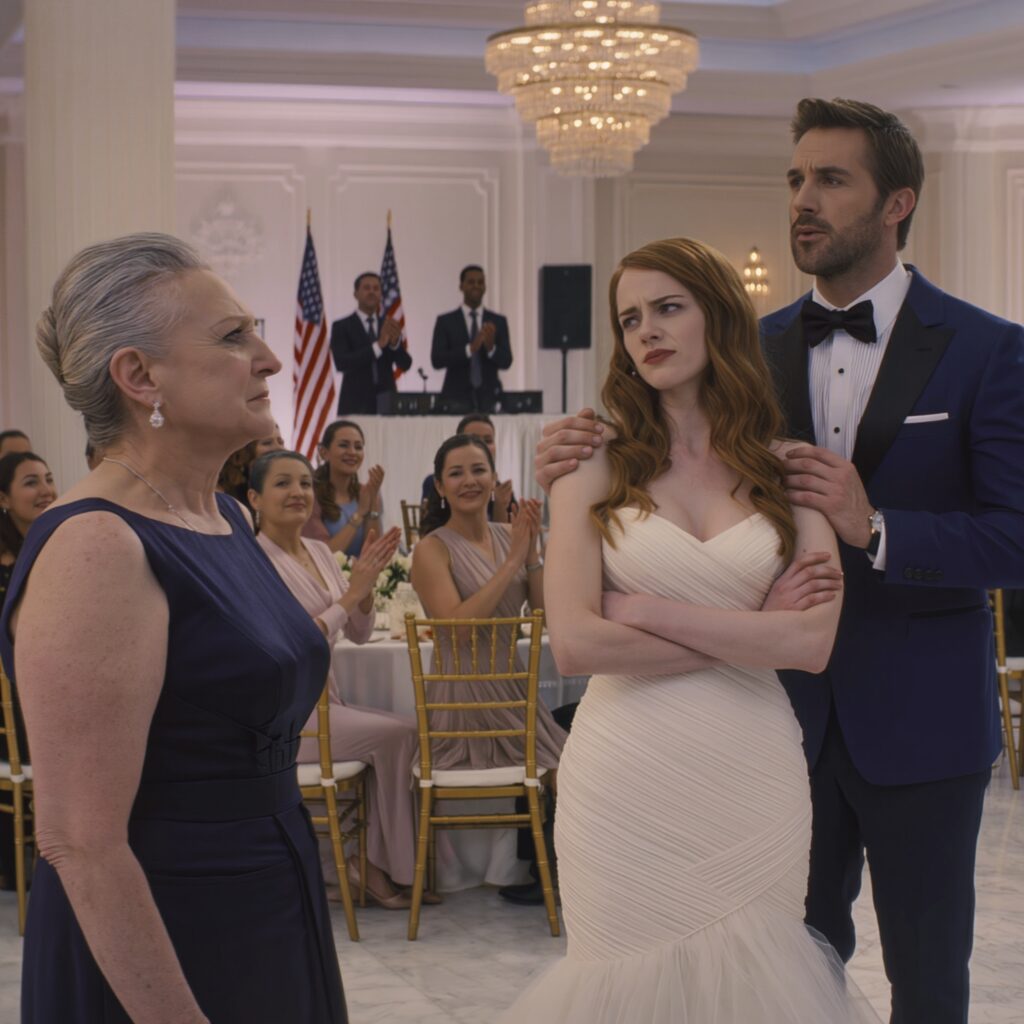
You know that moment when your own daughter stands up at her wedding reception and decides to roast you in front of two hundred guests?
Well, that happened to me.
But what happened next? Let’s just say the room went from roaring with laughter at my expense to complete, echoing silence in about thirty seconds.
Picture this: a beautiful East Coast wedding venue with crystal chandeliers throwing soft gold light across white tablecloths, a live band playing jazzy covers in the corner, candles flickering in tall glass cylinders. Everyone dressed to the nines. The kind of place where the staff glide instead of walk and the napkins feel more expensive than half the clothes in my closet.
My daughter Rachel looked absolutely stunning in her white gown – lace bodice, fitted waist, soft tulle skirt that made her look like she was floating every time she moved. Her hair was pinned up with tiny pearls. When she walked down the aisle earlier, my heart had nearly burst with pride. Whatever else had gone wrong between us over the years, I loved that girl with everything I had.
I watched her now as she stood up, bridal glow and all, grabbing the microphone for what I thought would be a sweet thank-you speech. I was already bracing myself to cry again. I imagined something like, “Thank you, Mom, for everything you’ve done for me,” and maybe a mention of the dress fitting or late-night talks when she was a teenager.
Instead, she smiled at the crowd, glanced right at me, and said,
“I want to talk about my mom for a minute. She’s going through what I guess you’d call a late life crisis.”
The room chuckled. A few people actually clapped.
“At sixty,” she continued, “she decided she wants to build an empire.”
She actually lifted her hands and did the finger quotes around “build an empire.” The laughter got louder. Someone near the bar snorted. I felt my face burn.
“We keep telling her she should act her age, but she won’t listen,” Rachel added, cheerful and breezy, like she was talking about a quirky neighbor and not the woman who’d raised her.
I sat there, my lips pulled into a smile that hurt, my fingers wrapped so tightly around my champagne flute I thought the glass might crack. On the outside, I was the picture of a supportive mother enjoying the joke. On the inside, I was shrinking, dying inch by inch while two hundred people laughed at my so-called midlife crisis.
But here’s what none of them knew – including my own daughter.
While they were all mocking the crazy old lady trying to “play entrepreneur,” the most powerful person in that room was sitting quietly at table six, in a navy-blue dress from an outlet mall and a pair of low heels I’d had for years.
Because what happened next… that involved Rachel’s new husband’s boss standing up, nearly choking on his champagne while staring at me in shock and saying five words that changed everything.
But to understand how my daughter’s wedding reception turned into the most satisfying moment of vindication in my entire life, I need to take you back two years. Back to when this whole “late life crisis” supposedly started.
Before we continue, please leave a comment telling us where you’re watching from and subscribe to the Never Too Old channel. We’re building a community of incredible people who know our best chapters can happen at any age.
Now, back to the story.
Two years earlier, I was Diana Thompson. Sixty years old. Recently divorced. And honestly, feeling pretty lost.
For thirty years, I’d worked as an office manager at a mid-size logistics company. I was the one who knew where every file was, who really did what, which vendor always missed deadlines, and which department would implode if you moved one person. I was the quiet engine that kept the whole thing running.
Then corporate “restructuring” happened.
Which, if you’ve ever worked in an office, you know is usually code for: “Let’s replace the older, higher-paid employees with younger, cheaper ones and act like it’s about innovation.”
They called me into a glass-walled conference room on a Tuesday. The HR rep had a folder. The new VP, who looked barely old enough to rent a car without a surcharge, kept using the words “strategic realignment.” I walked out that day with a severance package, a branded mug, and a pit in my stomach.
For the first time in decades, I was truly on my own.
Rachel was thirty-two and living with her fiancé, Jake, in a trendy neighborhood full of coffee shops with minimalist logos and overpriced avocado toast. My ex-husband, Mark, had remarried a yoga instructor fifteen years younger than him—because apparently that’s what some men do during their actual midlife crisis. Meanwhile, I was sitting alone in a small one-bedroom apartment with beige carpets, wondering what on earth I was supposed to do with the rest of my life.
There’s a special kind of silence that comes when your kids are grown, your marriage is over, and your job is gone. Your phone doesn’t ring as much. The days start to blur. You find yourself standing at the kitchen counter at two in the afternoon, holding a mug of coffee you don’t remember making, thinking, Is this it? Is this all I get?
But here’s the thing about being sixty and suddenly unemployed: you have two choices.
You can decide your best years are behind you. You can shrink your life down to the size of your fear, fill your days with television reruns and “age appropriate” hobbies, and wait for time to pass.
Or you can look at those same decades and realize every one of them gave you something. Skills. Instincts. Experience. A spine.
I chose option two.
The idea came slowly. At first, it was just a vague thought while I was reorganizing my own kitchen cabinets for the third time in a week. I knew how to run an office better than half the executives I’d worked for. I knew where time and money got wasted. I knew how to put out fires before anyone else smelled smoke. I’d been the one quietly training bright young managers for years.
So why couldn’t I do that… for myself?
I started small. I took a free online course about small business operations, mostly to reassure myself that I still remembered how to learn. I ordered a used laptop from a refurbished site and set it up at my tiny dining table. I made a list of every skill I had that someone might pay for: process mapping, hiring systems, vendor management, workflow optimization. It didn’t sound glamorous. But it was real.
I registered a business name: DT Enterprises. Clean. Professional. Not too flashy. It kept my full name off the paperwork, which felt safe somehow. I built a basic website using a drag-and-drop builder, squinting at templates and teaching myself what a “CTA button” was supposed to be.
My first client was a family-owned printing company, recommended by a friend of a friend. Their office was chaos—stacks of paper everywhere, orders written on sticky notes. The owner, a man in his fifties named Carlos, shook my hand and said, “We’re drowning. If you can help, I’ll pay you whatever you ask.”
Within a month, I’d streamlined their workflow, set up a basic project-tracking system, and renegotiated three of their vendor contracts. They saved money. Deadlines stopped slipping. The phone stopped ringing every five minutes with crises. On my last day of that first contract, Carlos hugged me and said, “You saved my business.”
He sent me a glowing testimonial. Then he sent two more clients my way.
My calendar started filling up: a dental clinic on the verge of burning out its staff, a regional HVAC company that had grown too fast and was now choking on its own paperwork, a small tech firm in need of operational structure. My hourly rate slowly crept up. My inbox turned into something that looked suspiciously like demand.
Then something unexpected happened.
One of my tech clients mentioned they were struggling with investors. They needed capital but didn’t want to give up control to a giant corporation that would strip the company for parts. I’d read enough business news to know this was a common story.
The thought that had been lurking in the back of my mind finally stepped into the light.
What if I didn’t just help companies run better? What if I acquired them?
It sounded insane at first. I was a sixty-year-old divorced woman in a small apartment with an old Honda and a modest savings account. People like me did not walk into acquisition meetings.
Except… why not?
I started learning everything I could about private equity, strategic acquisitions, and deal structures. I stayed up late at night reading case studies and SEC filings. I took notes like I was back in school. The more I learned, the more I realized something that made my pulse race: this world was full of people who knew how to talk about business. I was one of the rare people who had actually made things work from the inside.
One deal led to another. I partnered with a quiet, conservative investor who cared more about fundamentals than flash. We structured our offers carefully. We prioritized companies with strong products and terrible operations. That was my playground.
Eighteen months later, I had acquired six companies. Six. Including a major tech firm that Jake had once mentioned admiring over Thanksgiving dinner.
I was, by every definition, successful. Quietly, strategically, almost invisibly successful.
I deliberately kept my lifestyle modest. I stayed in my small but comfortable apartment. I drove the same Honda. I didn’t post anything flashy on social media. I didn’t buy designer bags or start taking pictures on yachts. My money went into the companies, the people, and a future I was building one decision at a time.
And yet, somehow, my own family still saw me as a bored older woman “playing entrepreneur.”
Rachel would roll her eyes whenever I mentioned a new contract or client.
“Mom, you’re sixty, not twenty-three,” she’d sigh over brunch. “Maybe it’s time to act your age. You don’t have to keep proving yourself, you know.”
Jake loved to mansplain basic business concepts to me like he’d invented the stock market.
“In this economy,” he’d say, leaning back in his chair, “it’s really hard to make it with a small business. Have you considered finding a normal job instead of this entrepreneur phase?”
My sister, Linda, would chime in at family dinners.
“Diana, be realistic. You missed your chance. Just find something stable. Maybe part-time at a doctor’s office or the school district. Something with benefits.”
Even my friends–the ones who meant well, who’d known me since Rachel was in diapers–had a way of making their “support” feel like a pat on the head.
“It’s cute that you’re trying,” they’d say, laughs soft and sympathetic. “But realistically, how much can you really accomplish starting over at your age?”
Meanwhile, my clients were thriving. Revenues were climbing. I’d sat in boardrooms across from attorneys, accountants, and middle-aged executives who’d stopped underestimating me about ten minutes into any serious conversation.
Rachel, however, had made up her mind: Mom was having a phase.
Her wedding planning only made it worse.
She booked a gorgeous venue with floor-to-ceiling windows and a garden straight out of a magazine. She picked out a photographer with a six-month waitlist and a florist whose arrangements looked like artwork. We had countless calls about seating charts and napkin colors and whether the bridesmaids’ dresses should be blush or champagne.
Money came up more than once.
“Mom, I know things have been tight since the divorce,” she said one night over FaceTime, not knowing I’d just wired mid-six figures into a new investment. “So if it’s too much to help with the rehearsal dinner, I understand.”
“I’ll manage,” I told her. “Don’t worry about it.”
She didn’t ask where the money came from. She assumed it was the divorce settlement. I let her.
The worst conversation came about a month before the wedding.
We were sitting in her living room surrounded by vendor contracts and swatches.
“Oh, one more thing,” Rachel said, almost as an afterthought. “Jake’s boss, Mr. Anderson, will be there. And a bunch of people from his tech company. They’re serious business people, Mom, so… could you please not go on about your little projects?”
She said “little projects” the way some people say “stray cats.”
I stared at her. “My little projects?”
“You know what I mean,” she said quickly. “Your consulting thing. I mean, it’s fine, but please don’t tell them you’re building an empire or something.”
I laughed, but there was no humor in it. “Have I ever said that to you?”
She shrugged. “You’re always talking about clients and deals and strategies like you’re some CEO. It’s just… I don’t want you to feel judged if they don’t get it. So maybe just say you’re between jobs, okay? It’ll be easier.”
I looked at my daughter, this woman I’d raised, who I’d taught to stand up for herself and never shrink for anyone, and realized she had no idea who I had become.
But I loved her. I wanted her wedding to be perfect. So I swallowed my pride and nodded.
“Fine,” I said. “I’ll keep it simple.”
“Thank you,” she said, already moving on to talk about table runners. “And Mom? Just blend in, okay? Don’t stress. This is going to be the best day of my life.”
The morning of the wedding dawned bright and clear. I woke up early in my little apartment, made coffee, and sat at the tiny kitchen table with my mug between my hands. My dress hung on the closet door: navy blue, simple, elegant, chosen for one reason only—I did not want anyone to look at me instead of my daughter.
I thought about all the versions of myself I’d been: the young wife, the exhausted working mom, the woman who’d stayed late at the office while dinner got cold at home, the discarded employee in that glass conference room. And now, this woman, sixty-two and quietly, almost secretly successful.
I did my makeup carefully, smoothing concealer under my eyes, patting powder into the lines at the corners, adding just enough lipstick to feel put together. In the mirror, I saw an older woman with tired eyes and a stubborn set to her mouth.
“You did not come this far,” I told my reflection softly, “to be erased at your own daughter’s wedding.”
But I still intended to keep my promise and stay quiet.
The ceremony was beautiful. Rachel walked down the aisle on her father’s arm, veil floating behind her. People dabbed their eyes. Jake looked at her like she’d hung the moon. When the officiant pronounced them husband and wife, the room burst into applause. I clapped until my hands stung.
During the cocktail hour, I did exactly what Rachel had asked. I mingled quietly with my side of the family, complimented outfits, admired the centerpieces. When I was introduced to Jake’s colleagues, I smiled politely and said, “Oh, I’m just helping out with some business consulting here and there,” and then redirected the conversation back to them.
Meanwhile, I could hear bits of their conversations—market shares, mergers, tech trends. It was my world, and I could have stepped into any one of those discussions and contributed something useful. But I stayed silent, nodding along like some harmless extra in the background of their story.
Then came dinner.
The salads were cleared. Glasses refilled. The band transitioned into that soft background music that tells you speeches are coming.
Rachel’s maid of honor, Amy, stood up first. She was tall, blonde, wearing a fitted rose-colored dress and a smile that said she knew she owned the room.
She started out sweet, talking about their college days, late-night study sessions, the way Rachel had cried happy tears when Jake proposed. People laughed at the right moments, sighed at others. It was going well.
Then she glanced over at me and her tone shifted.
“Now,” she said, her grin widening, “I have to talk about the bride’s family. Especially Rachel’s mom, who’s been quite the character lately.”
The room chuckled. My stomach dropped.
“Diana’s going through what I guess you’d call a late life crisis,” Amy continued. Laughter rippled deeper. “At sixty, she decided she wants to build an empire.”
There it was again—those finger quotes. “Build an empire.”
“We keep telling her she should act her age, but she won’t listen,” Amy added. “She’s trying to compete with people half her age in business.”
More laughter. Heads turned toward me with amused smiles, some genuinely entertained, some awkward and unsure how much they were allowed to laugh.
“But hey,” Amy finished, “at least she’s keeping busy instead of just gardening like normal moms her age, right?”
This time, the laughter was full-bodied. The whole room was in on it now. Two hundred people enjoying a neat little joke about the delusional old woman with the ridiculous dreams.
I pressed my fingertips into my napkin, willing myself not to cry. My cheeks were hot. My heart pounded so hard I could feel it in my throat.
“We love our delusional mom anyway,” Amy said, and took a dramatic bow.
Applause. Clinking glasses. A few people looked at me sympathetically. Others looked away, embarrassed on my behalf. Rachel… Rachel was laughing.
She wasn’t squirming or trying to stop Amy. She wasn’t shaking her head in protest. She was laughing like this was all harmless fun.
When Amy sat down, Rachel got to her feet and took the microphone. I told myself, Here it is. She’ll fix it. She’ll balance it out. She’ll say something kind.
“Thanks for that, Amy,” Rachel said, still grinning. “Yes, my mom has definitely been on an adventure lately.”
The crowd chuckled, already primed.
“She keeps insisting she’s building a business empire,” Rachel went on, emphasizing the words like they were a punchline. “But we’re just trying to get her to accept that some dreams have expiration dates. When you’re over sixty, maybe it’s time to be realistic about what you can actually accomplish.”
The laughter this time was loud and long. Jake’s colleagues were practically wiping tears from their eyes. Mr. Anderson, his boss, sat with an amused smile, shaking his head like he was watching a sitcom. Even the servers looked like they were trying not to laugh as they cleared plates.
I wanted to run. To disappear. To be anywhere but there.
“But we support Mom’s hobby anyway,” Rachel continued cheerfully. “Even if it means listening to her talk about client meetings and business strategies like she’s some kind of CEO.”
Something inside me snapped—not into anger exactly, but into a painful, crystalline clarity. It was like suddenly seeing the shape of a door you hadn’t realized you’d been locked behind.
This wasn’t just a lack of support. This was contempt wearing a pretty dress and holding a microphone.
Rachel finished her speech to thunderous applause. People clinked their glasses. The band started playing again. And I sat there, a frozen statue in a navy dress, realizing my own daughter would rather humiliate me than try to understand me.
I decided that as soon as the cake was cut, I’d slip out. I’d fake a headache if I had to. I wasn’t going to make a scene on her wedding day, but I also wasn’t going to sit there being the punchline any longer than necessary.
I thought the worst was over.
I was wrong.
As people got up to mingle between courses, the comments started.
“Good for you for trying something new at your age,” one of Jake’s aunts said, touching my shoulder. Her tone was that same tone people use on toddlers who manage to stay upright on a tricycle for the first time.
“It’s never too late to chase dreams, even small ones,” another guest added with a soft, condescending smile. “My neighbor started selling jewelry at sixty. She made almost three hundred dollars last year.”
I smiled weakly and took a sip of water so I wouldn’t say what I was thinking.
Jake’s colleagues were worse.
When someone introduced me as “the bride’s entrepreneurial mother,” they’d nod politely and immediately pivot back to talking about their projects, their teams, their bosses.
“That’s wonderful,” one of them said. “My mother-in-law started making crafts on Etsy. It keeps her busy.”
As if I were some lonely woman hot-gluing plastic gems to picture frames just to fill the hours.
Then Jake pulled me aside near the bar.
“Diana, thanks for being such a good sport about the speeches,” he said, looking genuinely pleased with himself. “I know Rachel was just having fun, but I didn’t want you to feel bad about your consulting thing.”
“My consulting thing?” I repeated, trying to keep my voice even.
“Yeah,” he said, glancing around like we were sharing some private joke. “I mean, it’s great that you’re staying active and trying new things, but I hope you’re not putting too much pressure on yourself to make it into something big. At your age, it’s really more about staying engaged than actually building a career, right?”
I stared at him. This man. This man my daughter had chosen. He honestly thought he was being kind.
“Jake,” I said carefully, “what exactly do you think I do?”
He shrugged.
“Some kind of small business consulting. Rachel mentioned you help local shops with their paperwork or something, which is nice. Every little bit helps when you’re starting over later in life.”
Local shops. Paperwork. Starting over.
I nodded once, because I knew if I tried to speak again, my voice would shake. I excused myself to the restroom.
I locked myself in a stall, sat down, and pressed the heels of my hands into my eyelids until I saw white bursts of light. I refused to cry. I refused to ruin my makeup. I refused to let the narrative of the night be “Rachel’s hysterical mom had a meltdown at the wedding.”
They thought I was pathetic. They thought I was delusional. They thought my success was a fantasy I’d invented so I wouldn’t feel like a failure.
They had no idea that in the past eighteen months, I’d acquired six companies, including one major tech firm that half this room probably name-dropped in meetings.
When I’d pulled myself together, I stepped back into the hallway outside the ballroom, only to hear Rachel’s voice drifting from the bar area. I froze.
“Poor Mom,” she was saying to one of her bridesmaids. “She’s been so lost since the divorce. This whole business thing is just her way of feeling important again. We don’t have the heart to tell her it’s never going to be anything real.”
My hand tightened around my clutch.
“That’s so sad,” the friend replied. “But at least she’s keeping busy instead of becoming one of those depressing empty nest moms who calls their kids every day.”
“Exactly,” Rachel said. “And honestly, I’d rather have her playing entrepreneur than dating again. Can you imagine?”
They both laughed.
That was the moment something inside me didn’t just crack—it reset.
This wasn’t just underestimation. This wasn’t just generational misunderstanding. My own daughter genuinely believed I was a sad, fragile woman grasping for relevance, and she was more concerned about being embarrassed by me than about who I actually was.
I walked back into the reception, found my seat, and smiled through the rest of dinner like a woman wearing full plate armor under a navy dress.
I was planning to quietly slip out after the cake, take off my heels in the parking lot, and drive home in the dark, letting the radio fill the silence.
But the universe, as it turns out, had other plans.
During the after-dinner mingling, as people milled around the dance floor and the band slid into a Motown set, a man approached me.
“Mrs. Thompson,” he said politely.
I turned. He was in his early fifties, tall, with graying hair and the kind of posture that came from years of boardroom chairs and long flights. His suit was nice—but not “trying too hard” nice.
“I don’t think we’ve been properly introduced,” he said, holding out his hand. “I’m Robert Anderson, Jake’s supervisor at Sterling Tech.”
Sterling Tech.
My heart skipped. Sterling Technologies was one of the companies I’d acquired three months earlier.
“It’s Miss Thompson, actually,” I said, shaking his hand. “And yes, I know who you are.”
He smiled.
“Jake mentioned you’re in business consulting. That’s wonderful. What kind of work do you do?”
I looked at him and, for a second, considered giving my usual vague answer.
But I was tired. Tired of shrinking. Tired of pretending to be less than I was to make other people comfortable.
“Well, Mr. Anderson,” I said, “I work in acquisitions and operational consulting. I help companies optimize their efficiency and growth potential.”
He nodded. “That sounds fascinating. Mostly with small local businesses, I imagine?”
“Actually,” I said, “I focus on mid-size companies in the tech sector. Firms that are ready to scale but need strategic guidance and capital investment.”
His eyebrows rose slightly. That got his attention.
“Really? That’s quite specialized. How long have you been in that field?”
“About two years seriously,” I replied, “though I’ve been building toward it for a long time.”
“Impressive,” he said. He meant it, but I could still see the assumption in his eyes—he thought I was talking about boutique deals, maybe some investors’ group, nothing too large. “Have you worked with any companies I might know?”
I paused. This was the crossroads.
I could protect my anonymity and leave the wedding as the joke of the night. Or I could tell the truth and let the chips fall where they may.
“Actually, yes,” I said. “I recently completed an acquisition of Sterling Technologies.”
The polite smile froze on his face. It was almost funny watching the expression die in slow motion.
“Sterling Technologies,” he repeated.
“Yes,” I said calmly. “The acquisition closed about three months ago.”
He stared at me, really stared, and I could see his brain grabbing at facts, headlines, internal memos.
“Wait a minute,” he said slowly. “Sterling Technologies was acquired by DT Enterprises.”
He lowered his voice. “You’re not saying you’re D. Thompson.”
“Yes,” I said. “I am.”
The color drained from his face.
“You’re the D. Thompson,” he said, his voice barely above a whisper. “The D. Thompson who acquired Sterling.”
“That would be me,” I said.
He almost dropped his champagne glass. He set it down on a nearby table like it suddenly weighed fifty pounds.
“Oh my God,” he said. “Oh my… I had no idea. I mean, when Jake said his mother-in-law was in consulting, I never imagined…”
He ran a hand through his hair, completely rattled.
“Miss Thompson, I am so sorry,” he said. “If I had known—”
“It’s fine, Mr. Anderson,” I said. “I deliberately keep a low profile.”
But he was shaking his head. “No, it’s not fine. Not after… this evening. The way people have been talking to you, treating you like—”
He glanced around the room where, not long ago, people had been making jokes about my “little business” and my “midlife crisis.”
“This is mortifying,” he muttered.
“Mr. Anderson,” I said quietly. “Please don’t worry about it. I chose not to correct anyone.”
“But you shouldn’t have had to,” he said. “Do you realize that half the people in this room work for companies in your portfolio? The way they’ve been talking about your little consulting business when you literally own…”
He trailed off, shaking his head in disbelief.
I followed his gaze around the room and realized he was right. The Hendersons at table four worked for Quantum Solutions—acquired in January. The Patels by the dance floor? DataFlow Systems—my March acquisition. A couple near the bar? They were from a smaller firm we’d just brought under the DT umbrella.
They’d all been treating me like I was a sweet, misguided woman playing dress-up with spreadsheets.
“Mr. Anderson,” I said. “Really. This is my daughter’s wedding day. I have no intention of making a scene.”
He looked genuinely torn.
“Ma’am,” he said, “with all due respect, what’s happening here isn’t just impolite. It’s wrong. These people don’t just owe you basic respect as a person. Many of them literally owe their paychecks to decisions you’ve made.”
I felt a strange mix of vindication and sadness. It was like having someone finally hold up a mirror that reflected the truth and the damage at the same time.
“What’s really disturbing,” Anderson went on, “is that your daughter’s speech mocked you for having unrealistic business ambitions, but you haven’t been unrealistic at all. You’ve been extraordinarily successful. She just doesn’t know it.”
By now, Jake had noticed us. He started making his way over, his expression curious.
“Everything okay here?” he asked, forcing a light laugh. “You two seem to be having quite an intense conversation.”
Anderson looked at me. I nodded. I was done hiding.
“Jake,” Anderson said carefully, “I was just learning more about your mother-in-law’s consulting business.”
“Oh, that,” Jake said, chuckling. “Yeah, Diana’s been trying her hand at the business world. It’s actually pretty cute how seriously she takes it.”
The look on Anderson’s face was almost comical—like he’d just watched someone insult the head of state without realizing who they were talking to.
“Cute,” Anderson repeated flatly.
“Well, you know how it is when people start over later in life,” Jake said. “You have to encourage them even if their goals are a bit optimistic. But we support Diana’s little venture, don’t we, Mom?”
He patted my shoulder.
If looks could vaporize someone, Anderson’s gaze would’ve done it.
“Jake,” Anderson said slowly. “I don’t think you understand who you’re talking about.”
Jake frowned. “What do you mean?”
Anderson looked at me one last time. I gave him another small nod.
“Your mother-in-law isn’t playing at business, Jake,” he said. “She is business. Diana Thompson is D. Thompson of DT Enterprises. She owns Sterling Technologies. She owns the company we work for.”
Jake’s face went completely blank. His mouth opened, closed, opened again.
“What?” he croaked. “That’s… that’s impossible. She drives an old Honda. She lives in a small apartment.”
“She deliberately maintains a modest lifestyle,” Anderson said. “A lot of serious investors do that. It keeps them focused on business rather than lifestyle inflation.”
Around us, people were starting to notice. Heads turned. Conversations stuttered and stopped. I could feel the energy in the room shift, like the air pressure had changed.
“You know what?” Anderson said suddenly, his voice tightening with something like righteous anger. “I think people should know this.”
Before I could stop him, he was striding toward the DJ, gesturing for the microphone.
“Mr. Anderson—” I started, but it was too late.
“Excuse me, everyone,” he said into the microphone, his voice booming through the speakers. “I’m sorry to interrupt the festivities, but I need to share something remarkable that I just discovered.”
The band cut off mid-song. The chatter died instantly. Two hundred faces turned toward him.
Rachel, standing near the head table with her bridesmaids, frowned in confusion. Jake froze at my side.
“I just had the most enlightening conversation with the mother of the bride,” Anderson continued. “And I need to apologize—to all of you, and especially to Miss Diana Thompson—for a serious misunderstanding.”
You could have bottled the tension in that room.
Rachel’s head whipped around toward me. People started glancing between us, sensing something big.
“You see,” Anderson said, “we’ve all been treating Miss Thompson as if she were some kind of amateur dabbling in business as a hobby. We’ve been patronizing her, dismissing her accomplishments, and frankly, we’ve been incredibly rude.”
The silence was absolute. I could practically hear hearts beating.
“What we didn’t realize,” his voice grew stronger, “is that Diana Thompson is actually D. Thompson, the founder and CEO of DT Enterprises. She is one of the most successful entrepreneurs in our industry.”
There was a collective gasp. Someone actually dropped a fork. I heard Rachel make a choking sound.
“In the past eighteen months alone,” Anderson went on, “Ms. Thompson has acquired six major companies, including Sterling Technologies, where I serve as chief operating officer. She’s built a fifty-million-dollar business portfolio while many of us—myself included—have been treating her like she was playing dress-up.”
The silence that followed was so deep it almost rang in my ears.
Then chaos.
“What?” Rachel shrieked.
Voices rose everywhere. People turned to stare at me like I’d just materialized out of thin air. The Hendersons, who had spent half the night making gentle jokes about my “little business,” were whispering frantically. The Patels looked like they’d seen a ghost. Jake stood next to me with his mouth hanging open like a stunned fish.
“Furthermore,” Anderson said, clearly unable to stop now, “I should point out that roughly half the people in this room work for companies that Miss Thompson now owns. So when we’ve been making jokes about her unrealistic business dreams, we have, in effect, been mocking our own boss.”
That did it.
I watched executives and employees mentally rewind every conversation they’d had with me that evening. The man who’d compared me to his crafting aunt turned a shade of gray I’d previously only seen in hospital waiting rooms.
Rachel stared at me, eyes wide, face pale beneath her makeup. Shock. Horror. Something else I couldn’t quite name.
“Mom,” she said, her voice trembling. “Is this true?”
Before I could speak, Anderson held out the microphone to me.
“I think Miss Thompson should be the one to answer that,” he said.
Two hundred people waited.
I stood up slowly. My knees were shaking, but my spine felt like steel.
I took the microphone.
“Well,” I said, my voice coming out softer than I intended but steady. “Yes. It’s true. I am D. Thompson of DT Enterprises.”
The room erupted again. Gasps, whispers, the scrape of chairs as people leaned forward.
I held up my hand.
“I know this comes as a surprise to many of you,” I said. “Especially my family. I’ve deliberately kept a low profile because I prefer to let my work speak for itself. I don’t love publicity, and I certainly didn’t plan to announce anything tonight.”
I looked directly at Rachel. Her eyes were shining, but not with joy.
“Honey,” I said gently, “I didn’t tell you because you specifically asked me not to talk about my business tonight. You were embarrassed by what you thought was my little consulting hobby. So I respected your wishes and stayed quiet.”
“But, Mom,” she said, her voice small, “you said you were doing small business consulting.”
“I never said small business consulting,” I replied. “I said business consulting. You assumed it was small because…”
I took a breath.
“…because you thought I was too old and too inexperienced to accomplish anything significant.”
You could feel people flinch on her behalf.
“When you gave your speech earlier,” I continued, “about my late life crisis and how I should act my age, you were talking about a business that employs over four hundred people across six companies.”
I didn’t say it angrily. Just factually.
“When you said I was being unrealistic about what I could accomplish, you were referring to accomplishments that have already happened.”
I turned my gaze to Jake.
“And when you told me it was cute that I was trying my hand at business, and that at my age it was about staying engaged rather than building a career… you were talking to the woman who now signs off on decisions that affect your job security.”
Jake swallowed hard.
“Diana, I—I had no idea,” he stammered. “I’m so sorry. I feel like such an idiot.”
“Jake,” I said, “you assumed that a woman my age couldn’t possibly know more about business than you. That’s worth thinking about, don’t you think?”
There was a ripple through the crowd. Some people looked down at their plates.
But the person I kept coming back to was Rachel.
She looked utterly shattered. Not proud. Not excited. Just mortified that she had been so wrong, so loudly.
“Mom,” she whispered, barely audible through the mic. “Why didn’t you tell me?”
“Because every time I tried to,” I said quietly, “you rolled your eyes. You changed the subject. You told me I was having a midlife crisis. You said some dreams have expiration dates. You asked me not to embarrass you in front of your fiancé’s colleagues.”
I gestured around the room. “Many of whom, it turns out, now work for me.”
A few people winced. I could see shoulders tightening, jaws clenching.
Anderson stepped back up beside me.
“If I may add something,” he said, taking the mic for a moment. “Miss Thompson has been incredibly gracious tonight. A lesser person might have walked out after the first speech. Instead, she endured public mockery rather than upstage her daughter’s wedding with news of her business success. That shows remarkable character and love.”
Amy, the maid of honor, looked like she wanted the floor to open up and swallow her whole.
“So,” I said, taking the mic again, “I hope you’ll all forgive the dramatic reveal. This is not how I planned to spend the evening. But sometimes the truth has a way of coming out, whether we schedule it or not.”
I forced a small smile.
“And now, if it’s all right with everyone, I’d like us to get back to celebrating this beautiful couple and their future together.”
I handed the microphone back. My hands were shaking so badly I had to clench them around my clutch as I sat.
The noise level in the room slowly crept back up, but the tone had completely changed. Heads bowed toward me in respect. People who’d avoided eye contact earlier were now practically lining up.
“Ms. Thompson,” said the man who’d compared me to his crafting aunt. “I owe you a huge apology. I honestly had no idea. If I’d known—”
“It’s all right,” I said. “Really. I chose not to correct anyone.”
But it wasn’t all right. Not yet.
As the night went on, people approached me not with platitudes but with business cards. Questions about strategy. Respect in their voices instead of pity. Mr. Anderson hovered nearby like a protective guard dog, directing some of his more important executives my way.
Rachel stayed across the room for a long time, watching me with red-rimmed eyes.
Eventually, when the band had switched to slower songs and some of the older guests had started drifting out, she came over. Her dress swished softly against the floor. Her mascara had smudged a little at the corners.
“Mom,” she said, voice barely above the music. “I don’t know what to say. I feel… I feel horrible.”
I looked at her carefully. “Rachel,” I said, “it’s your wedding day. I don’t want this to be what you remember.”
“But I was so awful to you,” she said, tears spilling over. “The speech… the jokes… all of it. And you just sat there and took it because you didn’t want to ruin my day. What kind of daughter does that make me?”
I swallowed. There were a hundred ways I could’ve answered that.
“What kind of daughter?” I repeated softly. “The kind who was more afraid of being embarrassed by her mother than interested in who her mother actually is.”
She flinched.
“You stood up in front of two hundred people and mocked me for refusing to act my age,” I said, my voice calm but firm. “You told them some dreams have expiration dates. That wasn’t just a misunderstanding. That was cruel.”
Tears slid down her cheeks. “I know,” she whispered. “I know. And I am so, so sorry.”
“I believe you’re sorry,” I said. “But we have a lot to work through before things can go back to normal.”
The next morning, they left for their honeymoon. I stood on the curb outside their hotel, hugged my daughter goodbye, and watched the car pull away. I felt strangely light and heavy at the same time.
Because whatever else happened, one thing was now true: I was done letting people—family or not—tell me what I was too old to do.
Six months after the wedding, everything had shifted.
Jake started calling me “Miss Thompson” half-jokingly at family dinners, then dropped the joke and simply called me “Diana” with a new sort of respect. He asked my opinion on business decisions, listened when I answered, and stopped explaining basic concepts to me like I’d never seen a spreadsheet before.
Turned out, he was a lot more humble when he realized his boss’s boss’s boss was also his mother-in-law.
My sister Linda retired her lectures about “realistic expectations” and started bragging to her friends about her “brilliant entrepreneur sister.” She sent me articles about successful women over fifty and added little notes like, “This reminded me of you.” Amazing how fast people change their tune when success becomes undeniable and public.
Rachel and I… that was harder.
She came back from her honeymoon assuming the dust would have settled. It hadn’t. I held firm on boundaries I’d never enforced with her before. When she made a belittling joke about my work, I called it out. When she tried to brush things under the rug, I refused.
Eventually, I said the words that shifted everything:
“I think we need help.”
At sixty-two, I sat in a therapist’s office across from my thirty-four-year-old daughter. We talked about respect. About roles. About how she’d seen me as “just Mom” for so long she couldn’t process me as a person with her own story. We unpacked why she was so desperate not to be embarrassed that she’d thrown me under the bus.
It wasn’t easy. It wasn’t neat. But it was real.
On the business side, the fallout from the wedding was unexpectedly… profitable.
Three different guests reached out within weeks, asking if I’d consider consulting for their companies or taking meetings about potential acquisitions. Apparently, being publicly exposed as a business powerhouse in the middle of a wedding reception is excellent marketing. Who knew?
Mr. Anderson became one of my most trusted executives, a quiet force of competence and loyalty. Sometimes we’d joke about that night, champagne glasses clinking as we looked over quarterly reports.
“These numbers look a lot better than they did at the wedding,” he’d say.
“They looked fine at the wedding,” I’d remind him. “Nobody bothered to ask.”
These days, when people ask about my “late life” career change, I just smile.
Because at sixty-two, I’ve learned the most important business lesson of all:
Never underestimate a woman who has decided she’s done being underestimated.
So that’s my story.
What do you think? Was Rachel’s public embarrassment at her own wedding justified payback, or should I have handled the reveal differently? Let me know in the comments, and subscribe for more stories like mine—especially if you know, deep down, that your best chapters haven’t even been written yet.







Leave a Reply