At my father’s funeral, my brother sneered, “He didn’t leave her a dime—she never mattered to him.” The lawyer said nothing, and I just sat there in shock. Then a nurse stepped forward with a sealed envelope and said, “He asked me to give this to her—and only her.” When I opened it, the entire room went silent, and even my brother’s face turned ghostly pale…
The Unspoken Legacy
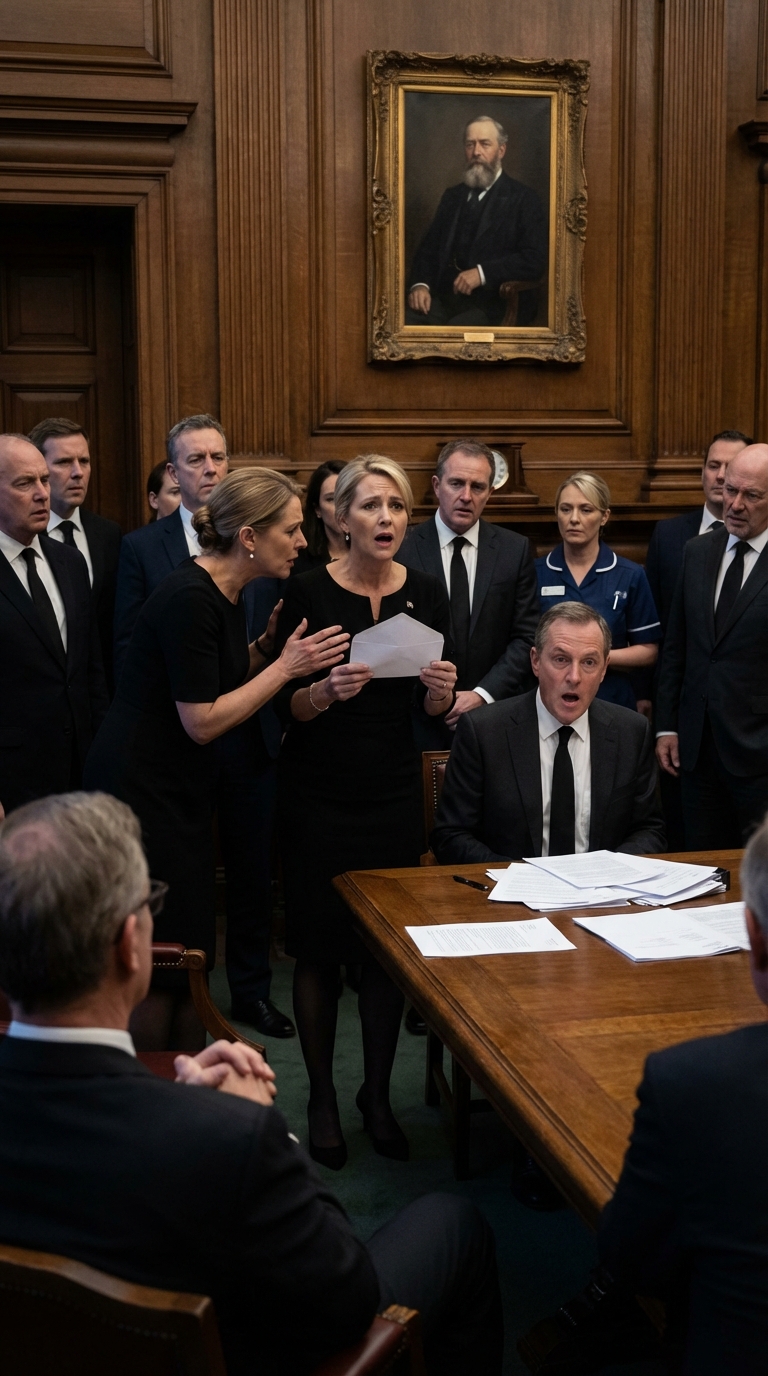
At my father’s funeral, while everyone was quiet, heads bowed, my sister leaned over and whispered something that made my blood run cold. “He left her nothing,” she said, loud enough for a few people around us to hear. “She never meant anything to him.” I didn’t react. I didn’t even turn my head. I just stared straight ahead, my hands clenched in my lap, my stomach twisted. But I wouldn’t give her the satisfaction of seeing me crack. I had come to say goodbye, to pay my last respects, even if my relationship with my father had been complicated, distant, mostly silent, sometimes painful. But I never expected cruelty from my own sister. Not today. Laya always knew how to twist the knife. She was my father’s favorite, the golden daughter who could do no wrong. She inherited the business, the house, the trust. I inherited nothing but silence. After the service, the lawyer confirmed it. Everything had been left to Laya, every last dollar. She sat there smug, pretending to mourn, but her eyes sparkled like she had won some prize. I stayed quiet. What was the point in arguing with the dead? But just as the lawyer began packing up his papers, a nurse I’d never seen before stepped forward. She looked nervous but determined, holding a small white envelope. “Are you Ava Mercer?” she asked. I nodded. “He asked me to deliver this to you, and only you.” And that’s when everything changed.
Chapter 1: The Thorn in My Side
I hadn’t seen my father in nearly two years before the funeral. Not since our last conversation ended in silence. No yelling, no final blowout, just the quiet disappointment of two people who had never really understood each other. His name was Brianna Keaton. To most people, he was a respected man, a sharp businessman, co-founder of a financial firm, a donor to three local charities, and the very face of control and order. But to me, he was something else entirely: an absence. He was the man who raised me without ever truly seeing me.
My sister, Laya, was different. She was the image of my father in every way: confident, polished, goal-driven. She joined Dad’s company right out of college, was promoted within a year, and started wearing suits that cost more than I made in a month. She knew how to speak Dad’s language—numbers, results, legacy. I didn’t. I was the daughter who pursued writing, moved away from the city, and never came back for the family holidays. I became the stranger they spoke of in short, sharp phrases, a cautionary tale of squandered potential.
When I was little, my father kept to himself. My mother, Caroline Mercer, was the warmth in the house. She would sing while she folded laundry, kiss our foreheads even when we didn’t want her to, leave little notes in our lunchboxes with smiley faces and short poems. When she died, I was ten. Laya was thirteen. Her funeral felt like the start of something we couldn’t name but felt every day after. The house got colder. My father became a man of strict routines and brief nods instead of hugs. Laya adapted. I didn’t.
As the years passed, I tried. I really did. I brought home stories I had written. I got scholarships, graduated early, submitted my first short story to a national contest. I remember handing it to him at dinner one night, excited, waiting for his reaction. He didn’t even open it. He pushed it aside, asked me if I had considered a “real job.” That night, I stopped trying to prove anything to him. The invisible contest Laya always seemed to win, I had no interest in entering.
Our final conversation was two years ago. I’d called to tell him I was moving to Vermont to take a job teaching creative writing. It wasn’t glamorous, but it was mine. I thought maybe this time he’d be proud, but all he said was, “So, you’re still running from responsibility?” I told him he didn’t know who I was. He said, “Maybe I don’t want to.” And that was it. We never spoke again.
So, when I stood in the church surrounded by people in dark suits and stiff expressions, I didn’t know how to feel. Grief was there, yes, but it wasn’t clean. It was mixed with resentment, guilt, confusion. I had lost something I never really had, and that was a strange kind of ache. Laya stood near the casket like she was hosting the event. She shook hands, gave short, rehearsed smiles, offered polite nods. When I arrived, she looked me over like I was a stranger who had wandered in off the street.
“Didn’t think you’d come?” she said, her voice a low murmur that only I could hear.
“I did.”
“That’s brave, considering.”
“Considering what?” I asked, my voice flat. She didn’t answer, just walked away like I had already lost some invisible contest. I never agreed to play.
During the service, I watched people cry. Some spoke about my father’s generosity. One man said he mentored him for years and changed his life. Another called him a pillar of the community. I listened, wondering if we had known the same man.
The will reading was scheduled right after the service. It was held in a side room at the funeral home. The lawyer, Mr. Donovan Hale, was professional, old-school, with a briefcase that looked older than I was. He greeted us, opened a folder, and began reading. To my sister, everything. To me, nothing. No explanation. No note, no acknowledgment. I expected disappointment. But somehow hearing it out loud still hit harder than I imagined, like he had taken one last chance to erase me. And this time, it would stick. Laya turned to me with that smirk I’d known since childhood, the one that said she had won again, and I would never catch up. That’s where I sat, numb and alone, watching her bask in victory.
And then, a woman I had never seen before, a nurse, stepped forward, holding a white envelope in her hand. “Are you Ava Mercer?” she asked. I said, “Yes.” She looked me straight in the eye. “Your father asked me to give this to you, and only you.”
Chapter 2: The Unexpected Delivery
The moment the nurse handed me the envelope, the air in the room shifted. Her name tag read “Mallerie,” and her face was lined with kindness and something else—protectiveness—like she was guarding something important. She didn’t glance at anyone else, not even Laya, who was standing only a few feet away, practically vibrating with irritation. Mallerie’s eyes stayed on me. “Your father was very clear,” she said, her voice soft but firm. “This is for you. No one else.”
Laya stepped forward, irritation breaking through her polite facade. “I’m sorry, who are you again?”
“I’m Nurse Helen Brooks. I cared for your father during the last weeks of his life.”
Laya forced a polite smile, her eyes still narrowed. “Then I assume you’re familiar with his will. Everything’s been settled.”
Mallerie didn’t flinch. “He also left this. He gave it to me directly and said it was only to be opened by his daughter, Amira.”
Mr. Donovan Hale, the lawyer, raised an eyebrow, his professional composure momentarily ruffled. “I wasn’t informed of any additional documents.”
Mallerie opened her bag and pulled out a sealed white envelope. It was slightly worn at the corners, as if it had been handled many times. My name was written on the front in thick black ink. His handwriting. There was no mistaking it. I took it without saying a word, the paper feeling cool and heavy in my palm.
Laya scoffed. “This is ridiculous. Probably some sentimental nonsense. Doesn’t change anything.”
I turned to her, calm on the outside, but fighting to keep my voice steady. “Then why do you look so nervous?”
She didn’t answer, her jaw clenching, her face a mask of barely contained fury. I sat down and stared at the envelope, my fingers trembling. I held it tightly, not ready to open it. Not yet. There were too many eyes, too many agendas, too many unspoken expectations hanging in the air. For a moment, I just needed to breathe.
The room was silent, tense, as if the will had been a carefully orchestrated performance, and now this envelope had interrupted the script. Laya paced. Mr. Donovan Hale looked uncomfortable, adjusting his tie. Even some of our distant relatives shifted in their chairs, unsure what to say, their whispers dying down.
Mallerie broke the silence. “Your father wasn’t a perfect man,” she said, her voice low but unwavering, cutting through the thick atmosphere. “But in the last few weeks, he tried to make peace with that. He spoke about you often, Amira. Not about your failures, about your strength, about how he wished he’d seen you sooner.”
I blinked, unsure how to take that in. It didn’t fit with the man I had known. The man who missed recitals, forgot birthdays, stayed late at work to avoid dinner conversations. And yet here she was, a stranger, telling me he had been thinking about me in his final days, contemplating my strength.
Laya couldn’t take it anymore. “Whatever’s in that letter, it has no legal standing. The estate is already transferred.”
“I don’t care about the estate,” I said, meeting her gaze, though that wasn’t entirely true. It wasn’t about the money itself. It was about what it represented: recognition, inclusion, a sign that I mattered to the man who had always kept me at arm’s length.
Mr. Donovan Hale cleared his throat. “Technically, anything outside the will can’t impact the division of assets. But if there’s evidence of a final wish, especially from a medical witness, it could complicate matters.”
Laya turned on him, her eyes blazing. “You’re a lawyer! You should know better than to entertain this!”
“I’m also an officer of the court,” Carile replied coolly, maintaining his professional demeanor. “And if there’s video or signed testimony, it’s worth reviewing.”
Mallerie reached into her bag again. “He asked me to record something. He couldn’t physically sign a new document, but he wanted his words captured. He said, ‘They’ll believe it if they hear it from me.’”
My heart pounded. I looked at the envelope again, still sealed in my hand. My father had never been a sentimental man, but maybe near the end, he had changed. Maybe he had finally seen me, not as a burden or disappointment, but as his daughter, as someone worth reaching out to.
“I want to open it alone,” I said, my voice firm.
Laya rolled her eyes. “Of course, you do.”
“I’m not doing this for drama,” I said, meeting her gaze directly. “I need to know what he was trying to say, and I’m not going to let your bitterness ruin that for me.” She didn’t respond, just turned away, jaw clenched. As I walked out of the room with the envelope clutching in my hand, I felt something I hadn’t felt in years. Not victory, not even hope. Clarity. Whatever was inside, it was meant for me, and no one could take that away.
Chapter 3: The Secret in the Study
I stepped outside with the envelope pressed tightly in my hand. The funeral home’s garden was quiet, tucked behind the building where no one followed. For the first time all day, I could breathe. I sat on a wooden bench near the fountain, my fingers tracing the edge of the envelope. It felt heavier than it should have. The paper was soft, worn at the corners like it had been handled more than once. My name was written in my father’s distinct handwriting—sharp, angled, unchanging.
For years, I had told myself I didn’t need anything from him. Not love, not approval, not answers. But I was wrong. I needed this. Not just the envelope. I needed to know that I wasn’t invisible to him.
I opened it carefully. Inside was a folded letter, a small brass key, and a small photograph.
The photo was old. I recognized the moment instantly. I was six years old, sitting on my mother’s lap, covered in paint. She was smiling, holding my hands, both of us stained with blue and green from one of our weekend art sessions. My father had taken that picture.
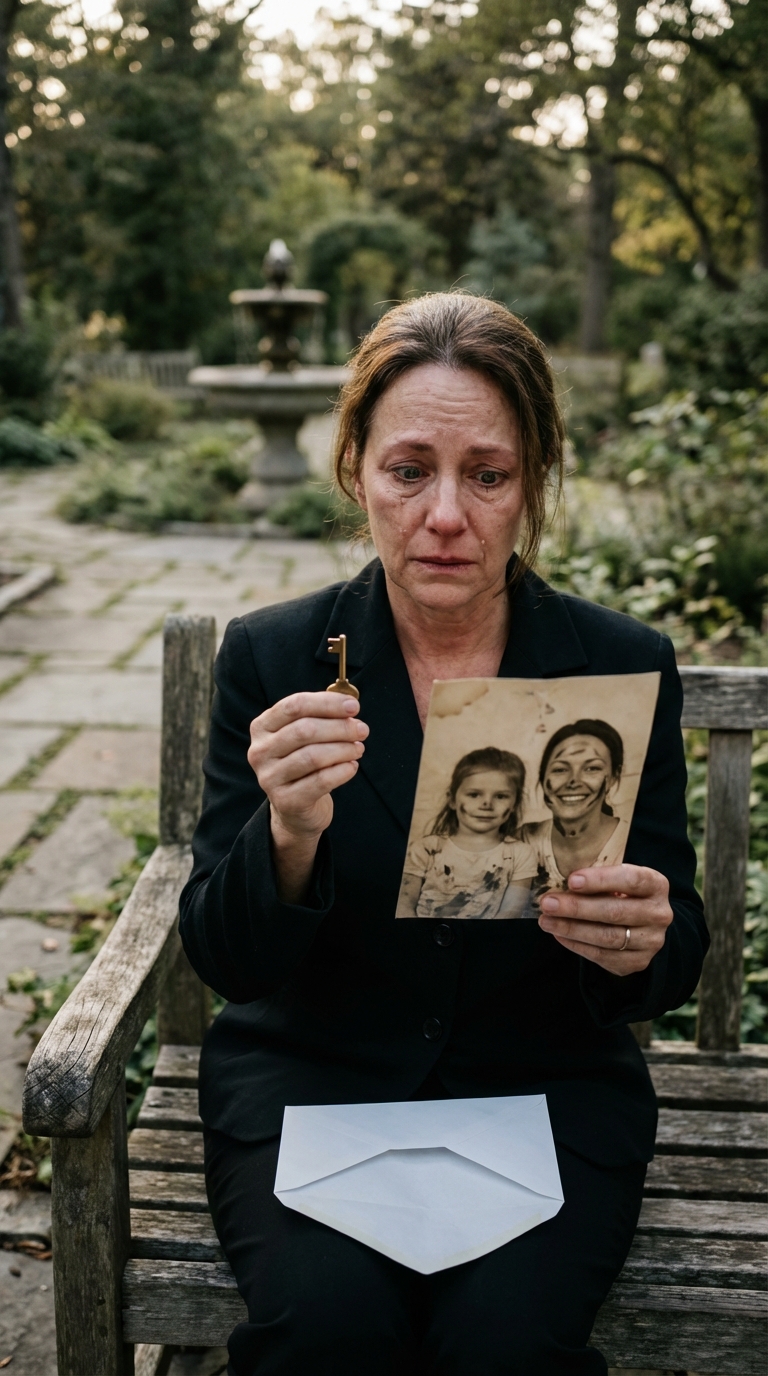
I remembered now. He had leaned into the doorway, snapped it quickly, and disappeared again, a fleeting presence in a moment of pure joy.
The letter began simply: “Amira, if you are reading this, it means I didn’t find the courage to say what I needed to while I was alive. I failed in many ways, but my greatest failure was how I treated you.”
My hands shook. I blinked hard and kept reading, the words blurring through unshed tears. I told myself I was preparing you for the world, that keeping you at a distance would toughen you. I see now that I was just afraid. You reminded me too much of your mother. You were too bright, too passionate, too alive. I didn’t know how to handle it, so I pushed you away. Laya fit into my world. You never did. But that was never your fault. That was mine.
After the cancer diagnosis, I started writing letters, watching old tapes, reading your stories. I kept every single one. Even the ones I told you didn’t matter. I kept your first published piece in a drawer in my study. I’ve read it more times than I can count. I just didn’t know how to tell you that I was proud.
The key is to the cedar chest in my study closet. Inside are your mother’s journals, her paintings, and my own attempts at apology. I wanted to change the will to reflect the truth, but I waited too long and my health declined faster than I expected. Still, I asked Nurse Helen Brooks to help me record my last wishes. I needed you to have this because the legacy I want to leave isn’t money or property. It’s truth. You were never a disappointment. You were the part of me I wish I had been brave enough to embrace. I’m sorry. I love you, Dad.
I read it twice before I could breathe again. The words pressed into my chest like a weight and a release all at once. I had spent years building armor to protect myself from a father who never seemed to care. And now here it was, unraveling in my hands. It wasn’t redemption. It wasn’t enough to erase the years of silence, the missed opportunities for connection, but it was real. It was something.
A brass key sat in my palm, warm from my grip. I knew exactly where it went. The cedar chest in his study had been locked for as long as I could remember. I had once asked about it when I was thirteen. He had told me it was just “old files.” I never asked again.
I stood up and looked back at the funeral home where Laya was likely still arguing with Mr. Donovan Hale, trying to maintain control. She had always been obsessed with control, with being the one who “won.” But this wasn’t a game anymore. This was something she couldn’t touch, couldn’t manipulate.
I walked to my car, heart racing, not from fear, but from a strange, powerful pull. I wasn’t sure what I would find inside that chest, but I knew it was meant for me. Whatever my father had hidden there, it would not be numbers or contracts. It would be pieces of him, pieces of her, pieces of me. This wasn’t about reclaiming an inheritance. It was about reclaiming a history I had been shut out of. A voice I had long believed didn’t exist. And now I was finally ready to hear it.
Chapter 4: Unlocking the Past
I drove straight to the house, not to the cemetery, not to the reception. I had nothing left to say to Laya or anyone else circling like vultures around my father’s estate. The Thorne house sat quiet at the top of its long driveway. It looked exactly the same as when I left it ten years ago: greystone, white shutters, sharp corners that made it look more like a courthouse than a home. The porch creaked under my shoes as I unlocked the front door, the sound echoing in the stillness.
Inside, the air was still, heavy with the faint scent of old wood and lingering sadness. The furniture was untouched, meticulously arranged, almost staged for showings or inheritance photos. But I knew the way. My steps found the path to the study without thinking, a muscle memory of a forbidden place. His study had always been off-limits. When we were kids, we weren’t even allowed to peek inside. Even after I was grown, the door remained mostly shut. It had always felt like a vault built around his private life, his real one, the version he never shared.
I stepped inside. The room smelled faintly of cedar and paper. His desk was neatly arranged. No dust, no disorder. Everything had its place, a testament to his meticulous nature. The walls were lined with books, degrees, a framed newspaper article from when he was named one of the top CEOs in the state. And there it was, the cedar chest. It sat beneath the window exactly where I remembered, unmoving, untouched, locked until now.
I knelt beside it and slid the brass key into the lock. It turned with a quiet click, a small, resonant sound that broke years of silence. The lid lifted easily, revealing stacks of folders, canvas rolls, photo albums, and three leather-bound journals tied with faded red ribbon. The scent of old paper and dried paint filled the air, a ghost of my mother’s presence.
I reached for the journals first. My mother’s name was written on the inside cover of each one: Caroline Mercer Thorne. The handwriting was hers—fluid, bright, full of life. As I flipped through the pages, I saw poems she had written during her final year, delicate drawings of me and Laya, letters she never sent. She wrote about her hopes for us, her fear of dying too young, and her longing for my father to show more warmth, to break through his emotional walls. She had left pieces of herself for us, and they had been hidden for more than fifteen years.
I was still holding her third journal when I noticed a folder beneath it. It was labeled in my father’s handwriting: For Amira. Inside were copies of every story I had ever sent him—the short story that won second place in my college contest, the poem I had published in an online magazine, even the essay I had submitted for graduate school. He had printed them out, annotated them with notes in the margins. Things like strong opening, vivid imagery, and one that simply said, This one made me cry.
I covered my mouth and sat back against the wall, my mind reeling. This man, who I had believed never saw me, had read everything. And he hadn’t just read it. He understood it. He had known me more than I realized, maybe more than I had allowed him to.
I found a flash drive at the bottom of the chest labeled Final Message. I plugged it into the laptop he had left behind, a sturdy, no-nonsense model. His face appeared on the screen, thinner than I remembered, eyes tired but focused. “Amira,” he began, his voice hoarse. “I’m sorry I didn’t say this sooner. If you’re watching this, it means I didn’t make it. But I needed to speak directly to you because a letter didn’t feel like enough.” He paused for a breath, a visible struggle. Then he said, “You were never a mistake. I was the one who failed to see you for who you were. I was so afraid of losing control that I pushed you away instead of pulling you in. Everything I hid in that chest was meant for you. Not just the contents—the truth. The parts of your mother I buried. The parts of myself I was too ashamed to share. I don’t care if the will says otherwise. That house is yours. That room is yours. Your mother wanted it that way. And now, so do I.”
The video ended without fanfare, just silence and a still frame of a man who, finally in his last days, had faced what mattered. I sat there for a long time, not crying, not angry, just still. The kind of stillness that comes after a storm has finally passed, leaving a strange, quiet calm. He didn’t leave me out. He just didn’t know how to include me until it was too late. But he tried. And that effort, even delayed, meant more than I expected it could. For the first time in years, I felt something settle inside me. Not closure—that’s a myth—but something close, something real.
Chapter 5: Reclaiming a History
I stayed in the house that night. I didn’t plan to. I had packed nothing, expected nothing. But after everything I had just seen, the idea of leaving felt wrong. I made a bed on the couch in the living room and let the weight of the day settle into my chest. It wasn’t grief exactly, or at least not the kind I had expected. It was more like something heavy unraveling inside me, releasing years of tightly wound hurt.
In the morning, I walked back into the study and opened my mother’s journals again. I read until the sun rose, painting the room in soft, golden hues. Her voice came through every page with warmth and wit and fierce love. She had wanted us to grow up brave. She had worried about how we’d manage without her. She had asked my father in one of her entries to “make sure Amira knows she matters.” Maybe it had taken him too long. Maybe the damage had already been done, but he tried. In his own flawed way, he tried to honor that promise.
Two weeks later, I met with Mr. Donovan Hale again. I brought the letter, the flash drive, and Mallerie’s statement. He listened carefully, then nodded, his expression grave. “There’s enough here to challenge the existing will,” he said, especially with a video and a medical witness. “And since the house hasn’t officially transferred to your sister, we can file a claim.”
Laya wasn’t happy. She sent a short message through her attorney, a terse email accusing me of exploiting sentiment and undermining our father’s wishes. I didn’t respond. I didn’t need to. The truth had already spoken for itself.
The legal process took time, a slow, methodical grind, but in the end, I kept the house. I didn’t want the money. I let Laya have it. Let her keep the company, the accounts, the control. She could stay in her world of profit margins and prestige. I had something better. Something she never noticed was missing. The legacy my father left me wasn’t measured in dollar signs. It was measured in understanding, in regret, in effort, and in that small, simple word he had never said before: Love.
I turned the study into a writing room, not just for me, but for others. I opened it twice a week as a creative space for young writers who had no place to go. We read my mother’s stories. We painted. We laughed. We wrote things that felt too honest and too raw for classrooms or workshops, things that poured directly from the soul. It became something real, something alive, echoing the vibrant spirit of my mother.
One day, I found a folder hidden in the bottom of the chest I had somehow missed. It was filled with letters my father had written but never sent. Some were addressed to me. Others were notes to himself. They weren’t polished or even coherent in places, but they were honest. And they showed a man who had spent the last months of his life trying to understand who he had been and who he had hurt. That was the thing I never expected. Not just the apology, but the effort behind it. He could have died with the same silence he lived in. But he didn’t. He asked a nurse to deliver something no lawyer could. He chose words over wealth, meaning over inheritance. That choice rewrote the end of our story.
Months later, I published a book, a hybrid memoir. Half my writing, half my mother’s journals and artwork. At the center was my father’s letter. I titled it The Chest Under the Window, A Daughter’s Inheritance. It didn’t hit bestseller lists. It didn’t make headlines, but it found readers. One day at a book event, a teenage girl walked up to me, clutching her copy like it was something fragile, something precious. She asked, “Did your dad ever read your stories while you were still writing them?” I paused for a moment before answering, searching for the right words. Then I said, “He did, just not when I needed him to.” She nodded like she understood something I hadn’t expected her to. That was the truth of it. Some people find their way back too late to change the past, but not too late to leave something meaningful behind. My father didn’t raise me with words, but in the end, he left me his. And in choosing to open that envelope, I finally opened the part of my life I thought had been sealed forever.
Chapter 6: A New Beginning
A year later, something unexpected happened. I was reviewing applications for the next writing session when I noticed one that made me pause. The handwriting was familiar, careful, but unpracticed. The applicant had written about struggling to find her voice after years of following someone else’s expectations. I looked at the name twice before I believed it: Brianna Keaton.
Her personal statement was raw in a way I’d never seen from her before. She wrote about losing herself in the pursuit of perfection, about realizing she had never created anything meaningful, only executed what others expected. She mentioned our mother’s journals and asked if there might be space for someone who was starting over at thirty-five.
When she arrived for her first session, she looked different, still polished, but softer somehow. She carried a simple notebook instead of her usual designer bag. And when she spoke, her voice carried uncertainty rather than authority. “I know this is awkward,” she said after the other participants had introduced themselves, her gaze meeting mine, then quickly flickering away. “I spent so many years thinking creativity was frivolous.” She paused, taking a shaky breath. “But reading Mom’s journals, seeing what you’ve built here, I realized I never learned who I am when I’m not competing.”
The other writers, sensing a shared vulnerability, welcomed her without knowing our history. She struggled at first, unused to vulnerability or imperfection. Her early attempts were stilted, formal, like business reports disguised as personal essays. But gradually, something began to emerge. One evening, she read a piece about the day our mother died. She described watching me cry while she stood frozen, too afraid to show emotion because she thought it would make her weak. The room was silent when she finished. “I learned to win,” she said quietly, her voice thick with emotion. “But I never learned to grieve.”
Our relationship didn’t transform overnight. There were still moments of tension, old patterns trying to reassert themselves, echoes of childhood competition. But slowly, week by week, we began to discover each other as adults rather than the children we’d been frozen as since our mother’s death. She never moved back to the family house, but she helped expand the writing program. Her business skills, once a tool for control, proved invaluable in securing grants and organizing workshops. More importantly, she brought her own story of transformation, showing other participants that it’s never too late to start over.
The program grew, but it never lost its intimate feeling. We added group therapy sessions, weekend retreats, even a small publishing initiative for participants who wanted to share their work. Laya suggested we dedicate everything to our mother’s memory, and somehow, that felt right.
One day, while cleaning out the last of our father’s papers, I found an unfinished letter addressed to both of us. In it, he worried that his death would drive us further apart. He wrote about hoping we might find our way back to each other, that perhaps his failures could become the foundation for our healing. I showed it to Laya, and for the first time since childhood, we cried together, not in anger or sorrow, but in a shared release, a common understanding.
And maybe that’s what matters most. Not how a story starts or even how it falls apart, but how we choose to carry the truth forward once we finally have it in our hands. Sometimes the most important inheritance isn’t what’s left in a will, but what we choose to build together from the pieces we’ve been given.
If this story spoke to you, if it reminded you of someone you’ve loved or lost, please take a second to like the video, share it with someone who needs to hear it, and leave a comment below. I read every one, and your stories matter, too. And if you want more real stories that stay with you long after they end, subscribe to the channel and turn on notifications so you never miss the next one. Thank you for being here.







Leave a Reply